
News from Companies

Why a Bundesrat Delegation’s Visit to a School in Bucharest Signals More Than a Diplomatic Courtesy
06 May 2026

Why a Bundesrat Delegation's Visit to a School in Bucharest Signals More Than a Diplomatic Courtesy

Why this matters beyond education

Germany's approach to education places strong emphasis on the development of the next generation, including through its international school network. Within this framework, the Zentralstelle für das Auslandsschulwesen (ZfA), in cooperation with the Embassy of Germany in Bucharest, supports institutions such as the Internationale Deutsche Schule Bukarest.

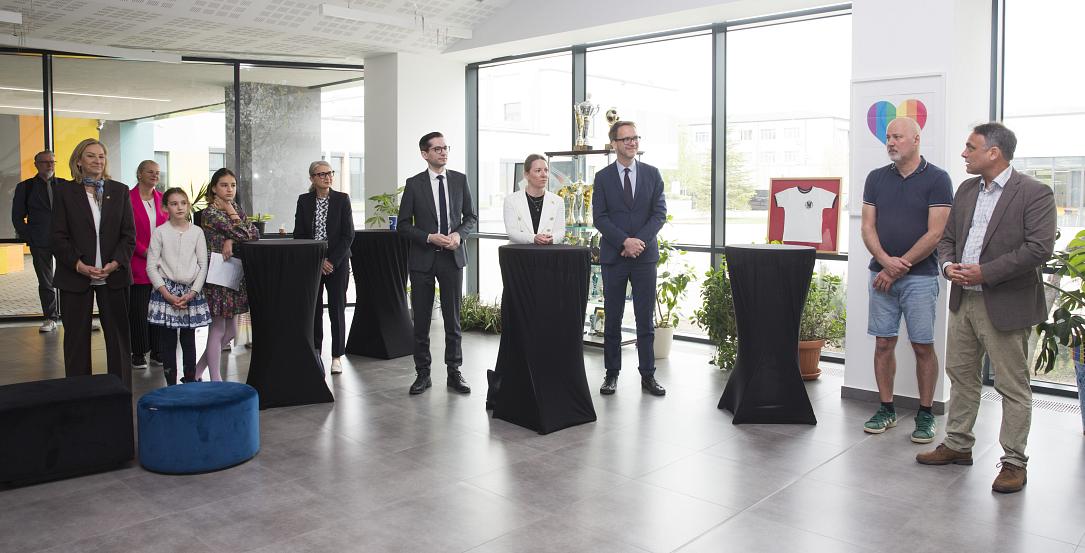
This broader framework was reflected in the recent visit of a high-level delegation from the Bundesrat to the school's campus in Bucharest.

The delegation, part of the Bundesrat's Standing Advisory Board, brought together senior decision-makers from across Germany, including, Sandra Gerken, Jutta Bieringer, David Kolesnyk, Markus Franke, accompanied by Ute Rettler and Claudia Asbeck de Treutler and the German Embassy represented by Theresa von Saldern.

Such visits are often seen as symbolic, but in this case, the focus was placed on direct exchange. The delegation took part in a roundtable discussion with a group of carefully selected students, who engaged in a structured dialogue on current social, political, and economic issues.

The students were not chosen at random. Their participation was based on the relevance and clarity of the questions they initially formulated, reflecting both their level of understanding and their ability to engage with complex topics in a structured and meaningful way.

The discussion highlighted not only what students know, but how they think, how they structure arguments, and how they position themselves in relation to complex issues.

At the same time, the format emphasized the role of dialogue in the learning process. Engaging directly with experienced decision-makers required students to listen, adapt their arguments, and respond in a structured and coherent way — skills that are rarely visible in traditional classroom settings.

A structured international education framework

German Schools Abroad operate within an international framework that combines standardized academic quality with local relevance, ensuring both consistency and real-world connection.

In practice, this becomes visible in moments of direct exchange, such as the roundtable discussion, where educational principles are tested in real dialogue.

In Bucharest, this model is further strengthened by the close collaboration between iDSBU and the German Embassy. This partnership connects the school environment to a broader diplomatic and public context, where these exchanges gain additional relevance.

From classroom practice to long-term outcomes

At iDSBU, the focus is on understanding and application, supported by the gradual development of independent thinking. Multilingualism plays a central role, with German, English, and often French used as working tools in everyday learning.

This approach aligns closely with international higher education expectations and provides direct access to universities worldwide.

For families, the outcome is tangible: access to the Deutsches Internationales Abitur (DIA), a qualification recognized by universities worldwide.

For policymakers and institutions, the relevance is broader. Schools like iDSBU contribute to the development of internationally mobile, highly skilled graduates — a key factor in today's interconnected economy.

A signal beyond the classroom

In this context, the presence of the Bundesrat delegation reinforces a clear message: international education is not a peripheral element, but an active component in shaping how countries develop talent, maintain academic standards, and remain competitive.

Moments like these illustrate how education can create meaningful connections between learning and real-world engagement, offering students early exposure to the kinds of discussions and responsibilities they will encounter beyond school.

*This is a press release.

Normal
News from Companies

Why a Bundesrat Delegation’s Visit to a School in Bucharest Signals More Than a Diplomatic Courtesy

06 May 2026

Why a Bundesrat Delegation's Visit to a School in Bucharest Signals More Than a Diplomatic Courtesy

Why this matters beyond education

Germany's approach to education places strong emphasis on the development of the next generation, including through its international school network. Within this framework, the Zentralstelle für das Auslandsschulwesen (ZfA), in cooperation with the Embassy of Germany in Bucharest, supports institutions such as the Internationale Deutsche Schule Bukarest.

This broader framework was reflected in the recent visit of a high-level delegation from the Bundesrat to the school's campus in Bucharest.

The delegation, part of the Bundesrat's Standing Advisory Board, brought together senior decision-makers from across Germany, including, Sandra Gerken, Jutta Bieringer, David Kolesnyk, Markus Franke, accompanied by Ute Rettler and Claudia Asbeck de Treutler and the German Embassy represented by Theresa von Saldern.

Such visits are often seen as symbolic, but in this case, the focus was placed on direct exchange. The delegation took part in a roundtable discussion with a group of carefully selected students, who engaged in a structured dialogue on current social, political, and economic issues.

The students were not chosen at random. Their participation was based on the relevance and clarity of the questions they initially formulated, reflecting both their level of understanding and their ability to engage with complex topics in a structured and meaningful way.

The discussion highlighted not only what students know, but how they think, how they structure arguments, and how they position themselves in relation to complex issues.

At the same time, the format emphasized the role of dialogue in the learning process. Engaging directly with experienced decision-makers required students to listen, adapt their arguments, and respond in a structured and coherent way — skills that are rarely visible in traditional classroom settings.

A structured international education framework

German Schools Abroad operate within an international framework that combines standardized academic quality with local relevance, ensuring both consistency and real-world connection.

In practice, this becomes visible in moments of direct exchange, such as the roundtable discussion, where educational principles are tested in real dialogue.

In Bucharest, this model is further strengthened by the close collaboration between iDSBU and the German Embassy. This partnership connects the school environment to a broader diplomatic and public context, where these exchanges gain additional relevance.

From classroom practice to long-term outcomes

At iDSBU, the focus is on understanding and application, supported by the gradual development of independent thinking. Multilingualism plays a central role, with German, English, and often French used as working tools in everyday learning.

This approach aligns closely with international higher education expectations and provides direct access to universities worldwide.

For families, the outcome is tangible: access to the Deutsches Internationales Abitur (DIA), a qualification recognized by universities worldwide.

For policymakers and institutions, the relevance is broader. Schools like iDSBU contribute to the development of internationally mobile, highly skilled graduates — a key factor in today's interconnected economy.

A signal beyond the classroom

In this context, the presence of the Bundesrat delegation reinforces a clear message: international education is not a peripheral element, but an active component in shaping how countries develop talent, maintain academic standards, and remain competitive.

Moments like these illustrate how education can create meaningful connections between learning and real-world engagement, offering students early exposure to the kinds of discussions and responsibilities they will encounter beyond school.

*This is a press release.

Normal

Romania Insider Free Newsletters