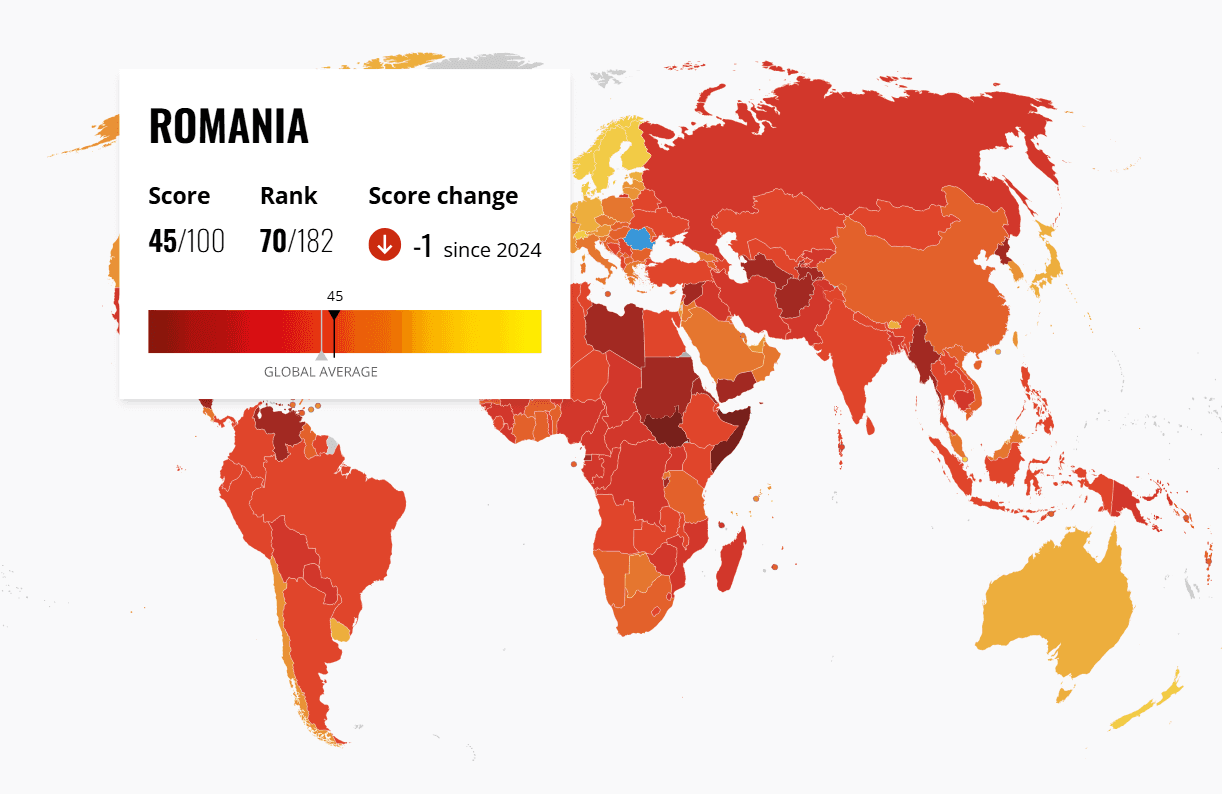
Romania among last EU countries in Transparency International’s Corruption Perceptions Index
Romania obtained 45 points in the Corruption Perceptions Index 2025, below the average of fragile democracies, which stands at 47 points, according to the report released on Tuesday, February 10, by the organization. As such, the country remains among the last three states in the EU in the CPI ranking, alongside Bulgaria (40) and Hungary (40).
The Corruption Perceptions Index measures perceptions of corruption in the public sector of 182 states and territories by aggregating data from 13 independent sources. The ranking is compiled by awarding points from 0 to 100, where zero means ‘highly corrupt’ and 100 means ‘not corrupt at all.’

States with strong democracies have, on average, a score of 71 points in the CPI. None of these countries scores below 50 points. By contrast, fragile democracies record an average score of 47 points.
Eastern Europe and Central Asia remain one of the world’s lowest-performing regions, with widespread impunity for corruption being driven by the vested interests that dominate most governments and their institutions.
Corruption is worsening at the global level, including in consolidated democracies, against the backdrop of a decline in leadership, Transparency International warns.
“The number of countries with scores above 80 points has decreased from 12, as there were a decade ago, to just 5 in CPI 2025. At the European level, anti-corruption progress has been stagnating for over a decade, with the EU average again standing at 62 points this year,” the organization said in the accompanying press release cited by Agerpres.
The organization noted, however, that there are states that have recorded significant score variations in recent years, such as Greece (+14 points compared to 2012), Estonia (+11 points compared to 2012), Hungary (−15 points compared to 2012), and Poland (−10 points compared to 2015).
Transparency International’s analysis showed that long-term improvements in CPI scores observed in some democratic countries reflect the existence of sustained reforms, consolidated institutions, and political consensus in favor of integrity-based governance. By contrast, low or declining scores are generally correlated with the erosion of democratic oversight mechanisms, politicization of the judicial system, undue influence in the political process, and lack of protection for civic space.
“The consequences of corruption are widespread in society, being particularly visible and destructive in four key areas: justice and the rule of law; democracy and political integrity; civic space and freedom of the press; access to public services. In each of these areas, corrupt behaviors not only consume resources and violate rules, but also deepen power imbalances and erode public trust,” the organization emphasized.
Transparency International warned that, in a context marked by major challenges, Europe needs effective leadership and strong independent institutions more than ever, capable of defending standards of integrity and the public interest.
“In December 2025, the European Union adopted its first anti-corruption directive, aimed at harmonizing criminal laws at the level of member states and establishing a zero-tolerance approach to corruption. The transposition of the EU directive is a good opportunity for Romania to set ambitious objectives and reforms. A major objective centered on integrity in public office and anti-corruption reforms leading to the strengthening of democracy in Romania could implicitly result in achieving a score of at least 50 points in the Corruption Perceptions Index by 2030,” said Transparency International.
According to the organization, at the institutional level it is necessary to establish the leadership of the National Integrity Agency, ensure the stability of the leadership of the National Anticorruption Directorate, strengthen the operational capacity of ANABI through the transfer of certain competences to it, reform the National Office for the Prevention and Combating of Money Laundering, and continue consolidating the quality of anti-corruption criminal investigations to ultimately ensure that they succeed in court and provide sustainability to cases.
“The rulings handed down by courts in recent years, concerning investigations carried out previously, were generated not only by poor quality and legislative instability, but also by sanctioning the lack of quality of criminal prosecution in relation to the expectations created in society through spectacular accusations that did not pass the test of the court,” Transparency International further stated.
(Photo source: transparency.org)