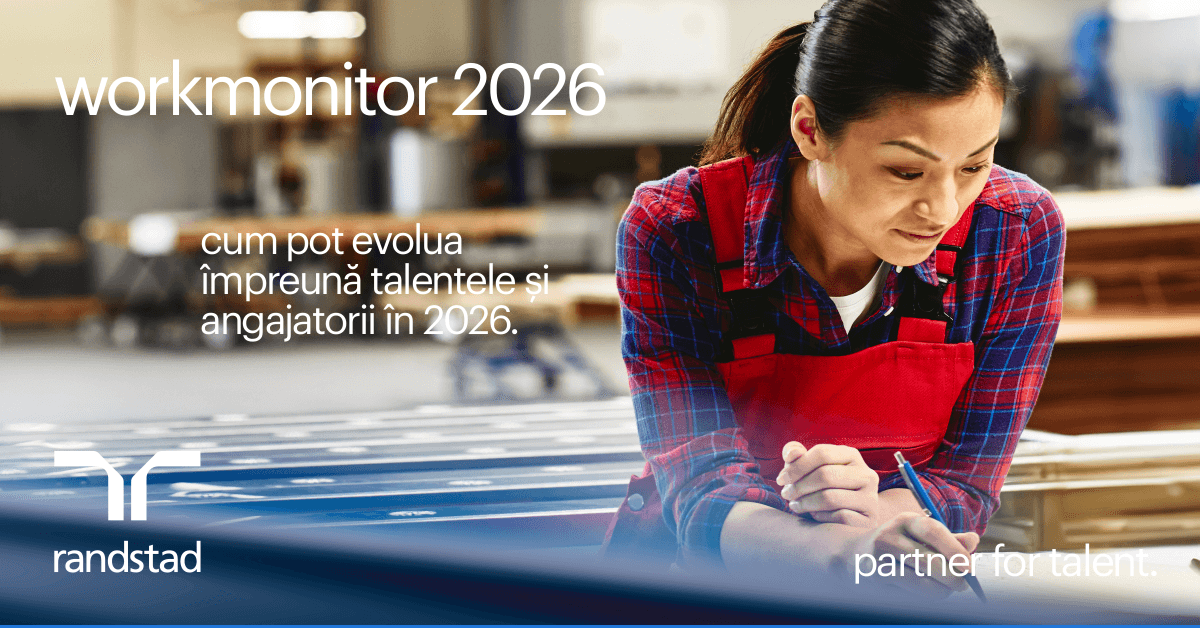
Randstad Workmonitor: 82% of Romanians choose jobs based on salary, but stay for work-life balance
Pay is the top factor for 82% of Romanian employees when looking for a new job, while work-life balance has overtaken salary and job security as the main reason for staying in their current role, according to data from Workmonitor 2026 Research conducted by Randstad Romania.
Nearly half (47%) of Romanian employees say they have taken on or are looking to take on a second job, above the global average of 40%. At the same time, one-third report increasing or planning to increase their working hours in their current role, up from one in five employees in 2025.

These findings signal a more cautious workforce focused on income stability and personal well-being over professional mobility.
“Romanian talent has become increasingly pragmatic — actively navigating their own career paths and seeking greater control over their professional future. This shift is creating a clear tension in today’s workplace: while employers acknowledge that autonomy drives performance, many still struggle to operationalize it in practice,” said Dagmara Chudzińska-Matysiak, Managing Director, Randstad Romania.
While 82% of Romanians cite pay as the most important factor when looking for a new job, work- life balance (48%) remains the main reason for staying in their current role, ahead of pay (30%) and job security (17%).
Compared to last year, Romanian employees appear more risk-averse than in previous years. Fewer respondents report requesting pay rises or threatening to quit to negotiate better conditions. Dissatisfaction no longer translates as quickly into resignation, and even a lack of belonging is also less motivation to consider leaving than in 2025. For employers, diversifying work formats and ensuring a sense of security are now the ultimate levers for retention.
On the other side, employers increasingly value skills and experience over formal qualifications (80%) and consider the traditional linear career path outdated. Nearly two in five (37%) say they want a “portfolio career,” moving across sectors and roles throughout their professional life (global: 38%). At the same time, 42% still prefer a traditional linear career path (global: 41%).
Flexibility remains a decisive factor for Romanians: 40% would not accept a new job without location flexibility, 42% would refuse a role without working-hours flexibility (global: 43% for both). Approximately 43% of employees say they have left jobs that did not fit their personal lives (global: 39%), while 30% resigned because they lacked independence in how they performed their work (global: 25%).
In comparison, 75% of employers agree that greater autonomy leads to higher engagement, productivity, and retention (vs. 72% globally). However, 85% do not allow employees to set their own schedules.
Over 70% of Romanian employees trust their company’s leadership and their colleagues. More than 60% have a strong relationship with their manager and feel more connected to him/her more than to the company as a whole. Yet, 50% of them use AI for work advice instead of consulting their manager.
AI adoption has accelerated significantly over the past year, evolving from the experimental stage to a core business tool. 80% of employers, particularly in technology and logistics, invested in this direction in the last 12 months.
Meanwhile, demand for AI skills continues to rise. Dedicated training ranks among the top three desired learning areas, increasing from 40% to 44% year-on-year. Two-thirds of employees want greater investment in AI skills development from their employers. While AI-related job postings have surged dramatically, with vacancies requiring specific skills rising by 1,587%, 21% of Romanians believe AI will not affect their job at all, and 34% fear their role may disappear within the next five years. 70% of employers estimate it will impact workplace tasks, compared to 48% of employees.
63% consider that AI makes their job easier and enables them to focus on more fulfilling tasks, yet 44% believe the primary beneficiaries of its adoption will be companies rather than employees. However, they are somewhat unclear about the structural implications of new technologies on their own roles and future careers.
The Randstad Workmonitor 2026 explores the views of working people in Europe, Asia-Pacific, and the Americas. The survey was conducted between 10 and 28 October 2025 among 27,062 workers, and between 9 and 30 October 2025 among 1,225 employers, across 35 markets.
(Photo source: press release)