No Shortcuts: How Cambridge School of Bucharest Is Preparing Students for a World in Motion

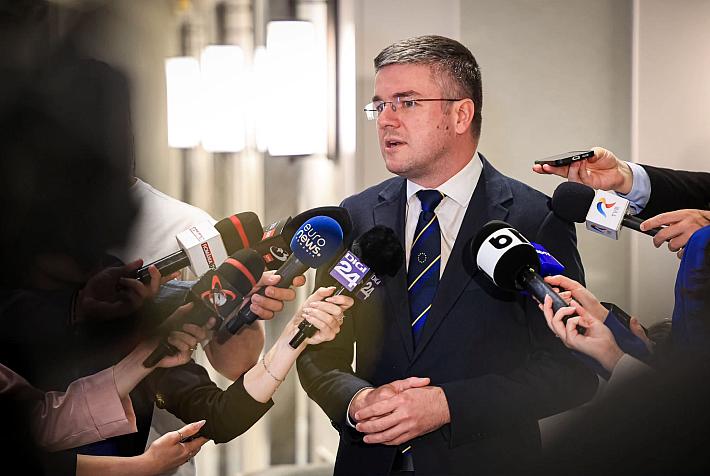
Alexandra Dache, Ph.D., IB Coordinator at Cambridge School of Bucharest (CSB) and National Coordinator of the International Economics Olympiad (IEO), shares more about how the International Baccalaureate Diploma Programme prepares students not just for university, but for lifelong learning and adaptation.
As artificial intelligence reshapes industries and university pathways grow more competitive, families are increasingly asking a difficult question: What kind of education truly prepares students for an unpredictable future? At Cambridge School of Bucharest, the answer has taken shape in the form of offering both the CIE A Levels and the International Baccalaureate Diploma Programme. These pathways were not chosen for their ease, but for their ambition.
The International Baccalaureate Diploma Programme, now in its second year at the school, has attracted students willing to take on a programme defined by depth, discipline, and intellectual risk. They are not promised shortcuts. Instead, they are asked to connect ideas across subjects, manage long-term projects, and confront complexity early on.
That choice is already bearing fruit. Members of CSB’s first IB Diploma cohort have received offers from leading universities, including medicine at the University of Cambridge and business and economics at the University of Bath, early markers that academic rigor combined with independence is resonating beyond the classroom, according to Alexandra Dache, Ph.D., IB Coordinator at CSB.
But grades and destinations are only part of the picture. As artificial intelligence accelerates decision-making across finance, policy, and labour markets, the ability to interpret human behaviour, weigh ethical trade-offs, and understand uncertainty has become increasingly valuable. Economics and the social sciences, often overshadowed by the rise of STEM, are reasserting their relevance. “Technology can process information, but it cannot replace human judgment, ethical reasoning, or an understanding of how societies function,” says Alexandra Dache.
Inside the classroom, theory meets application. Students test models against real data, debate global issues, and learn to sit with unanswered questions. The same mindset drives preparation for international academic competitions, where excellence is built through sustained mentoring and resilience rather than raw talent alone.
In a world where career paths are increasingly fluid, the focus shifts from predicting jobs to developing durable ways of thinking. As Ms. Dache puts it, students may not know what the future holds, but they can learn how to meet it with confidence.
Read the full interview below:
CSB is in the second year of being an IB World School. How has the IB option been received by the students? Why do they opt for this route?
Alexandra Dache: The International Baccalaureate has been received with a great deal of curiosity and growing confidence. This confidence has been bolstered now that our first IB Diploma Program cohort has begun to receive their university offers, which include an offers to study medicine at the University of Cambridge and to study business and economics at the University of Bath and the University of St Andrews. Top destinations for any intrepid learner.
Regardless of what students wish to study at university, what we see very clearly is that students choose the IB not because it is an easy path, but because it is a meaningful one that grants entry into the best universities in Europe, the US, the UK, and all over the world. They are drawn to a programme where subjects are deliberately connected, mirroring the way real-life challenges require skills from multiple areas, not just one at a time.
Some students and parents initially feel unsure whether the IB is “for them.” What has been crucial at CSB is that we do not wait for students to prove they belong. We introduce them to opportunities, guide them carefully, and help them grow within the programme. Once students realise that learning is connected to real life, that their voice matters, and that they are supported every step of the way, motivation follows naturally.
This approach has led to strong student engagement and has also been recognised externally, including through TES Award nominations for student-driven and interdisciplinary initiatives, which confirms that when the right environment is created, students rise to the challenge.
How does the IB route influence their graduate studies options?
Alexandra Dache: The International Baccalaureate keeps options open, and that is exactly what families want in a rapidly changing world. Our students graduate with strong academic foundations, but also with skills that universities repeatedly tell us they value: independent research, clear writing, time management, collaboration, and intellectual resilience.
Because IB students are accustomed to inquiry, reflection, and managing long-term projects, the transition to university is smooth. They are not overwhelmed by academic expectations; they have already developed the self-management skills required. Whether students apply to economics, STEM, social sciences, humanities, or interdisciplinary degrees, they do so with confidence because they understand how to learn, not just what to learn.
STEM disciplines have attracted more interest lately. How do you see the role of social sciences evolving in an AI-dominated context?
Alexandra Dache: In an AI-dominated world, social sciences are essential. Technology can process information, but it cannot replace human judgment, ethical reasoning, or an understanding of how societies function.
Economics, in particular, helps students make sense of uncertainty: how decisions are made, how incentives work, how data connects to real human outcomes. As artificial intelligence reshapes labour markets, finance, and policy, students who can think critically, evaluate trade-offs, and understand impact will be the ones best prepared for leadership and adaptation.
This is why social sciences at CSB are not taught in isolation, but in constant dialogue with technology, science, and real-world challenges.
How are social sciences taught at CSB? How do theoretical and practical learning mix? What is the focus?
Alexandra Dache: At Cambridge School of Bucharest, theory is the foundation, but application is the purpose. Students learn rigorous economic models and concepts, then test them against real data, current global issues, and practical scenarios.
Learning is designed to develop the very skills that global frameworks, such as those highlighted by the World Economic Forum, consistently identify as essential for the future: critical thinking, problem solving, collaboration, adaptability, and ethical decision making. Students debate, write, research, design projects, and reflect on their learning.
Just as importantly, students are known and guided. Academic challenges are matched with structure, feedback, and care. This balance is what allows students to thrive, rather than feel overwhelmed.
You work with students who take part in international Economics Olympiads and other competitions. How does their training differ, and what does it take to reach that level of achievement?
Alexandra Dache: High-level academic achievement is rarely about innate talent alone. What makes the difference is early exposure, sustained mentoring, and inspiration. Many of the students who later succeed in international competitions did not initially see themselves as exceptional. They became exceptional because they were introduced to demanding opportunities and supported to grow into them.
Training for Olympiads develops advanced analytical thinking, resilience, and intellectual discipline, as well as humility and perseverance. These are the same qualities that prepare students for top universities and complex careers. Several initiatives that began as small student projects have gone on to receive international recognition, including TES Award nominations, reinforcing the idea that opportunity, when designed well, multiplies impact.
What would you advise students interested in pursuing a graduate degree in Economics today?
Alexandra Dache: I would advise students to focus less on predicting a specific job and more on developing a durable skill set. The IB develops disciplined thinkers who can analyse complexity, communicate clearly, act ethically, and adapt confidently. These skills remain valuable regardless of how careers evolve. Students should actively seek challenges, such as competitions, research projects, internships, debates, and learn to reflect on both success and failure. The future will reward those who can learn continuously, adapt intelligently, and think responsibly.
At CSB, our aim is simple: we may not know exactly what the future looks like, but we know how to prepare students for it.
---
*This interview was edited by Romania Insider for CSB.