Romania’s Cluj-Napoca saw polluted air on 222 days in 2025, report shows
The inhabitants of Cluj-Napoca, Romania’s second-largest city, breathed polluted air in 222 days last year, according to a study carried out by the community network ‘Strop de Aer’ and cited by G4Media. The analysis, carried out on over…
Radu Dumitrescu · Journalist
· Updated · 2 min read
The inhabitants of Cluj-Napoca, Romania’s second-largest city, breathed polluted air in 222 days last year, according to a study carried out by the community network ‘Strop de Aer’ and cited by G4Media. The analysis, carried out on over 1.8 million measurements collected from 48 sensors installed by citizens, highlights the fact that pollution was not an occasional phenomenon, but a constant exposure, with an impact on public health.
The data targeted fine particles PM2.5 and PM10, and compared them with the thresholds recommended by the World Health Organization (WHO, 2021).
The results indicate that on 222 days in 2025, PM2.5 values exceeded the annual threshold recommended by the WHO, of 5 µg/m³. In addition, on 70 days of the year, the daily threshold of 15 µg/m³ was also exceeded.
“Last year’s data taken from the Strop de Aer sensors shows some increased values if we refer to the thresholds recommended by the World Health Organization,” explained Alexandru Luchiian, founder of the network.
According to him, the annual average for PM2.5 was approximately twice above the value recommended by the WHO, and PM10 slightly exceeded the indicated threshold.
“They are not frightening values, they are still within the limits of the European Union, but if we exceed a certain limit, they can influence the occurrence of diseases such as heart attack or stroke,” he added.
The highest levels of pollution were recorded in the cold season, when fine particles accumulate due to residential heating and atmospheric stagnation. Cluj-Napoca is located in a depression, which means that the city comes under a layer of cold air that does not allow the pollution formed at ground level to disperse.
In summer, PM2.5 concentrations decrease, but PM10 particles remain a problem, especially in areas with heavy traffic. The highest values were found near roads, in dense urban areas and even in some residential neighborhoods.
Beyond daily averages, there were frequent and severe pollution peaks, with concentrations of up to six times above WHO recommendations. Such episodes can have acute effects on health, especially in children, the elderly, and individuals who engage in outdoor activities.
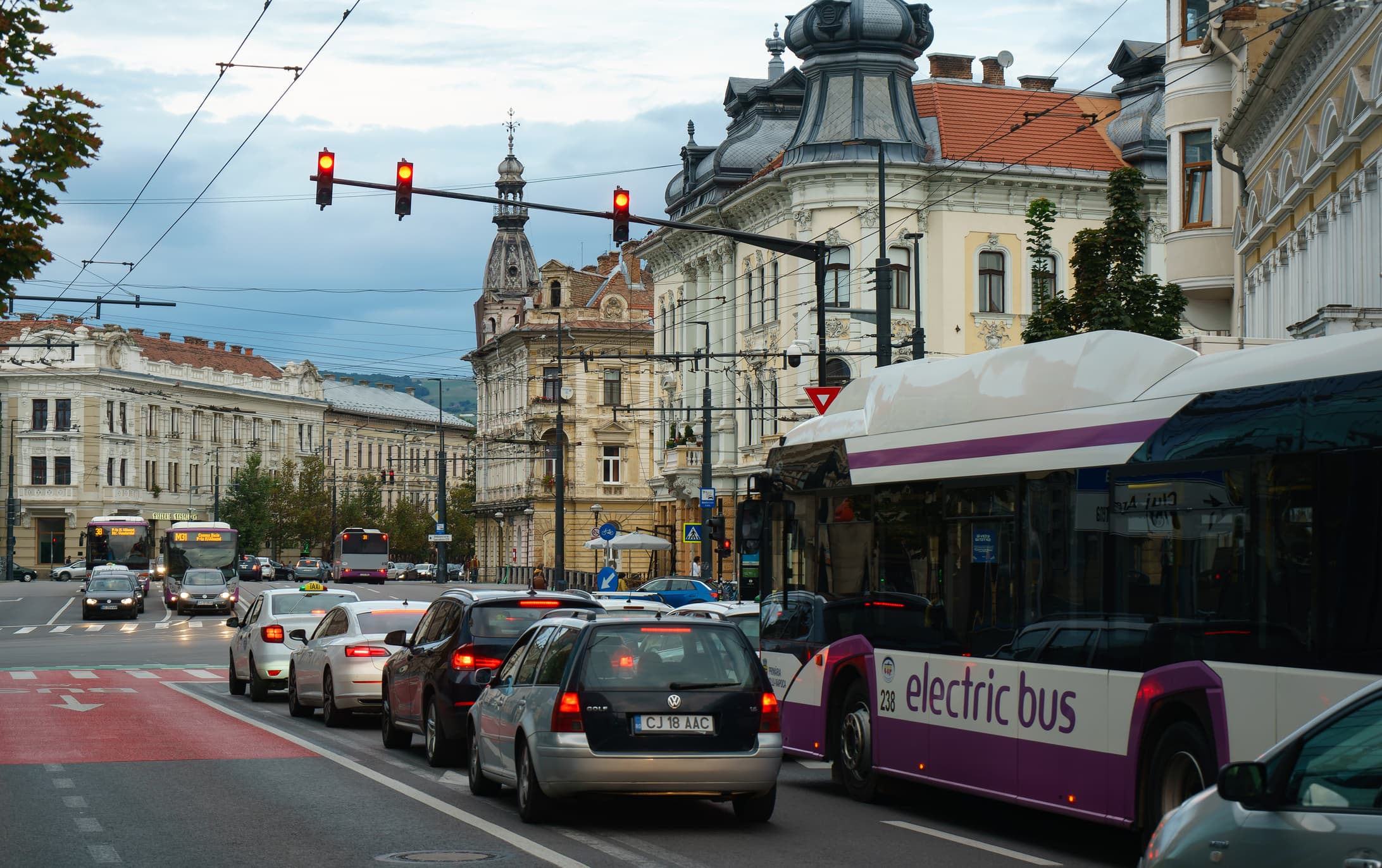
When it comes to transportation, data showed that PM10 values have begun to decrease from year to year since 2020. “
This means that the current policies are good and should continue. The changing of the bus fleet, more bicycle lanes, green spaces, and electric cars have produced results,” Luchiian argued.
Free newsletters
Romania, in your inbox before your first coffee.
Get the Daily — the morning briefing, free, in English, unsubscribe anytime. Want business, real estate or travel digests too? Pick your newsletters →