Bucharest police rescue great crested grebe that fell into the snow

25 February 2026

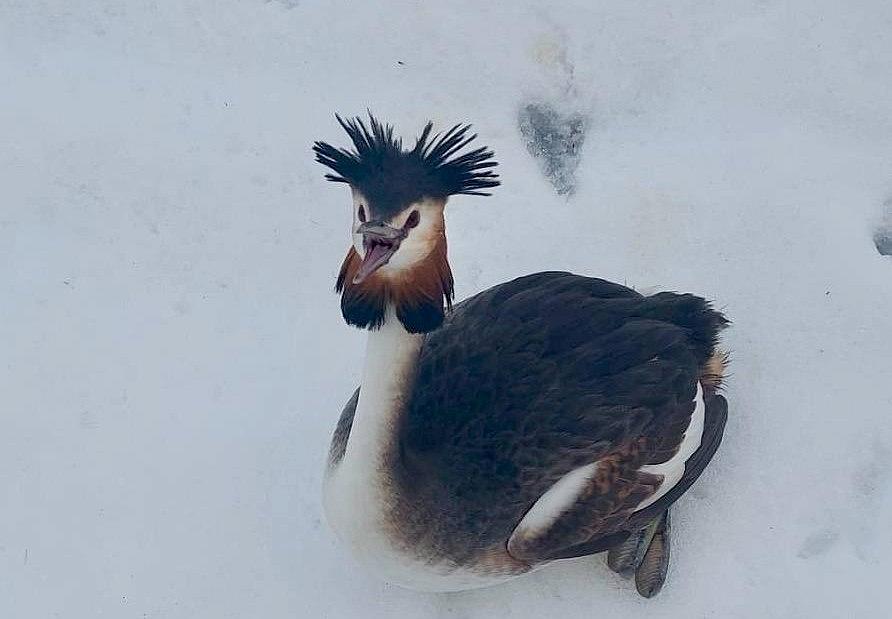
A great crested grebe (Podiceps cristatus) was rescued by a local police officer in Bucharest after it fell into the snow in the yard of a local institution.

The grebe, a protected species, most likely flew there from the nearby Văcărești Delta. Due to its legs, which are positioned far towards the back of the body, the animal could not get the momentum needed to take off from the ground.

“A ‘marathon runner’ of the waters, saved from the snow! Special mission for Ștefan, our colleague from the Animal Police. He helped rescue a bird from a protected species. A great crested grebe that had fallen into the snow in the yard of an institution located on Olteniței Road,” the Local Police of the Municipality of Bucharest said on Facebook.

The grebe’s colorful head plumage made it stand out to the maintenance staff who found the bird. The officer who intervened wrapped the bird in a towel and carefully placed it in a special cage. The grebe was then taken to the Wildlife Rescue and Rehabilitation Center, where it was taken over by a veterinarian specialized in treating wild fauna. The initial medical checks did not show any fractures or injuries to the wings or limbs.

“Although it probably fell due to exhaustion or weather conditions, it is now under the supervision of veterinary specialists. Subsequently, they will release the bird back into the wild,” the local police officers state.

According to the Romanian Ornithological Society, the great crested grebe has a wide distribution in Europe and Asia in temperate zones, and in Africa in the central and southern regions.  In Romania, it nests in hilly and plain areas throughout the entire territory of the country.

The species is associated with natural aquatic habitats with rich vegetation (pools, marshes, lake edges), where it occupies territories in spring when the breeding season begins. In winter, it gathers in large groups on the surfaces of unfrozen water bodies, especially in the south of the country and in Dobrogea.

The global population is estimated at 915,000–1,400,000 individuals. In Romania, estimates show a population of approximately 15,000–30,000 breeding pairs. 

radu@romania-insider.com

(Photo source: Primaria Municipiului Bucuresti on Facebook)

Normal

Bucharest police rescue great crested grebe that fell into the snow
25 February 2026

A great crested grebe (Podiceps cristatus) was rescued by a local police officer in Bucharest after it fell into the snow in the yard of a local institution.

The grebe, a protected species, most likely flew there from the nearby Văcărești Delta. Due to its legs, which are positioned far towards the back of the body, the animal could not get the momentum needed to take off from the ground.

“A ‘marathon runner’ of the waters, saved from the snow! Special mission for Ștefan, our colleague from the Animal Police. He helped rescue a bird from a protected species. A great crested grebe that had fallen into the snow in the yard of an institution located on Olteniței Road,” the Local Police of the Municipality of Bucharest said on Facebook.

The grebe’s colorful head plumage made it stand out to the maintenance staff who found the bird. The officer who intervened wrapped the bird in a towel and carefully placed it in a special cage. The grebe was then taken to the Wildlife Rescue and Rehabilitation Center, where it was taken over by a veterinarian specialized in treating wild fauna. The initial medical checks did not show any fractures or injuries to the wings or limbs.

“Although it probably fell due to exhaustion or weather conditions, it is now under the supervision of veterinary specialists. Subsequently, they will release the bird back into the wild,” the local police officers state.

According to the Romanian Ornithological Society, the great crested grebe has a wide distribution in Europe and Asia in temperate zones, and in Africa in the central and southern regions.  In Romania, it nests in hilly and plain areas throughout the entire territory of the country.

The species is associated with natural aquatic habitats with rich vegetation (pools, marshes, lake edges), where it occupies territories in spring when the breeding season begins. In winter, it gathers in large groups on the surfaces of unfrozen water bodies, especially in the south of the country and in Dobrogea.

The global population is estimated at 915,000–1,400,000 individuals. In Romania, estimates show a population of approximately 15,000–30,000 breeding pairs. 

radu@romania-insider.com

(Photo source: Primaria Municipiului Bucuresti on Facebook)

Normal

Romania Insider Free Newsletters