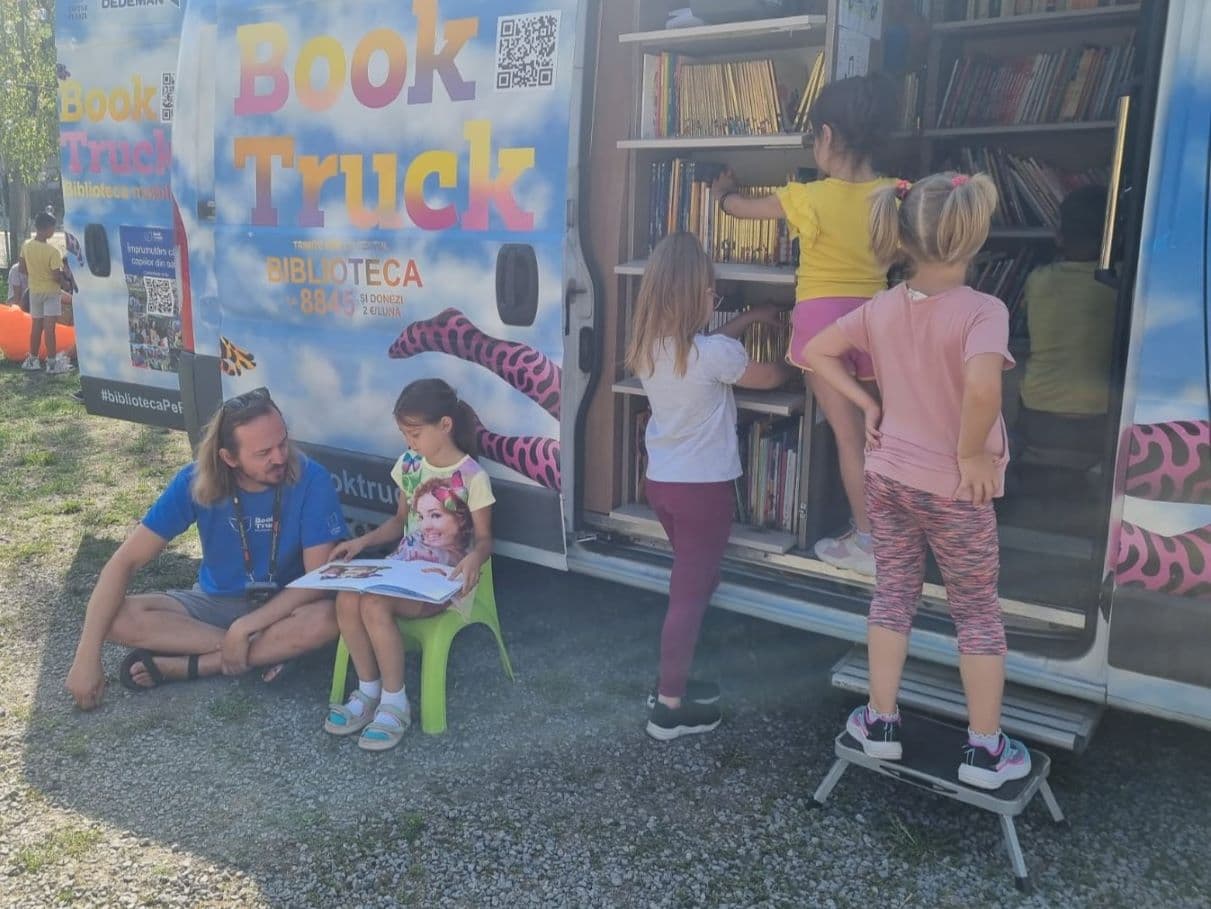
The mobile library bringing a world of books to children in Cluj county villages
The Book Truck, a mobile library set up in a van, has been traveling since 2021 to bring books to children living in villages in Cluj county, in western Romania, and sometimes further. Victor Miron, the initiator of the Book Truck and the founder of the association Cărțile pe Față, an NGO which runs various initiatives aimed at encouraging reading, shared more on how the project has developed, why regular access to books matters, and what happens when grade pressure takes a back seat.
Between 2020 and 2023, 566 libraries in the country closed, according to data from the National Commission of Libraries presented this summer. Of these, 171 were rural libraries, 10 were town and municipal libraries, 334 were school libraries, and 52 were specialized units. Although more than half of libraries (60.6%) are located in rural areas, these hold only 21.8% of the available book stock and have far fewer active users, most of whom (73%) are in urban areas. Furthermore, book acquisitions in school and rural libraries remain minimal, reflecting a lack of resources for updating their collections.
The data highlights the gap between rural and urban areas, something the Book Truck team has witnessed firsthand while working to provide children in Cluj county's rural communities with regular access to a fresh supply of books. This fall, the project added a third truck, allowing for more frequent visits. Besides books, the Book Truck offers its young audience a variety of activities, including meetings with professionals from diverse fields, aiming to expand not only their reading lists but also their horizons when it comes to potential careers. Given the need the project addresses, the founder aims to cover the entire rural area of Cluj county in the next years, and from there, even more of the country. More on this in the interview below.
Over the past four years, the Book Truck has travelled monthly to villages in Cluj county, sometimes to other counties as well. How did the experience in the field compare to what you were expecting when you decided to start the project? Were there any surprises?
After four years, it is clearer than ever to us that every child deserves access to a library, including those living in rural areas. Access to stories filled with adventure and empathy is a very good way to spark children's curiosity, stimulate their imagination and creativity, and help them develop their critical thinking.
We sometimes reach schools in the city, including private schools, when children in urban areas donate books for those in rural ones. There is a significant infrastructure gap between schools in urban and rural areas.
The mission of the association Cărțile pe Față is to convince people to read at least two books per month. We are fast approaching 12 years of activity, and more than four years ago, when we started the mobile library, we understood that we had the highest chances of success if we focused on young readers. If we succeed in instilling a reading habit early on, they are much more likely to keep it throughout their lives.
What we realized from the very first year of running the mobile library was that our impact is more significant when we manage to visit the same village on a regular basis. Going once is also good, but if we go every month, we can build friendships with young readers, and it is a lot easier to befriend them further with our friends in the books we bring with us.
You added a third book truck this September. What are the logistics involved in coordinating three mobile libraries?
This year, we have managed, for the first time, to have a mobile library in a brand-new van. The first two were second-hand ones, and they kept breaking down. Now, with the new Book Truck, we go daily to one village, sometimes even two on the same day, using also one of the old mobile libraries.
How do you select the communities you reach?
We focus on Cluj county so we can set off and return to Cluj-Napoca on the same day. We reach more than 5,000 children in more than 40 schools in rural areas. The schools are the ones contacting us to request a visit from us. They either learn about our activity from other schools, or there are teachers working in several schools in rural areas. More and more schools in rural areas are reaching out to us, even from outside Cluj county or from the Republic of Moldova. We cannot reach them for the time being, but we plan to get involved by sending them mini-libraries they can set up in their school's hallways.
Who are the Book Truck librarians? What does their activity entail?
We run two kinds of activities with the mobile library in rural schools. One is book lending. Children come and choose books that they borrow until our next visit. If we don't have a title, we write it down and bring it in on one of the following visits.
We also run activities. With younger children, up through 4th grade, we read stories together. For the older ones, we have book clubs, informal education workshops, and meetings with authors and special guests from various professions (actors, athletes, psychologists, managers, IT professionals), serving as a human library that helps children broaden their professional horizons. They study in village schools up to the 8th grade, and if we ask them what they want to be when they grow up, most of them mention what they see in the village: police officer, priest, cashier, farmer, or that they want to leave the country.
How do you select the books that are available at the library? Did you have requests for specific titles? Are there certain books more in demand than others?
Initially, we had strictly the titles we received as donations from people. We continue to collect books printed after 2000 in several areas across the country; the full list is available on our website. Now, we also purchase an increasing number of books that children request but we don't have. The younger ones want books with animals, princesses, dinosaurs. The older ones already know more specific titles. Harry Potter and The Little Prince are among the most demanded ones.
You have been involved in projects promoting reading for more than ten years. What have you noticed about what drives the interest in reading and reading habits? What helps? What are the challenges?
The fact that, as a country, we are not doing well when it comes to reading is no novelty. What I've seen to be helpful is making access to good books easier, either through traditional libraries or mini-libraries in more unconventional places, such as parks, waiting rooms, buses, and botanical gardens.
You opened the Cărțile pe Față Community Center in Cluj last year, hosting some 2,000 books. What has its mission been so far, and how would you like to see it develop?
In the first year, the community center in Cluj-Napoca served as our headquarters, and this is where we set off from with the mobile library. It is a venue that can be used especially during summer, as it consists of modular containers, without proper isolation for the cold season. People still read there during the summer, and we organize there literacy workshops and story-time sessions.
How do you see the role of libraries in the community and of the Book Truck in particular?
I've heard many school librarians say that, many times, children enjoy going to the library also because no grades are assigned there. It is a place where they can nurture their curiosity with what they want, without it being for a grade or an award.
Public libraries should serve as hubs for the community, promoting lifelong learning. I think they should have a social cohesion component, to bring people together.
What is next for the association Cărțile pe Față and for the project of the mobile library?
I would be happy if our activity were no longer needed. I would be glad just to run reading clubs, to simply enjoy the beauty of books alongside other people. But, until then, we will keep working to encourage reading. With the mobile library, we would like to grow over the next three to five years and serve all 75 communes in the county. After that, we will think about growing in the region of Transylvania and maybe even nationally.
I believe reading is a form of gardening, one where, line by line, we grow ourselves. The fruits of this crop are harvested over decades, but, fortunately, reading also teaches us to be patient.
This interview has been translated into English by Romania Insider.
*In Romanian, the same word is used for both 'library' and 'bookshelf'.
(Photos courtesy of Book Truck/ Cărțile pe Față Association)
simona@romania-insider.com