CoE committee on prevention of torture signals “persistent problems” in Romanian psychiatric hospitals
The Council of Europe Committee for the Prevention of Torture and Inhuman or Degrading Treatment or Punishment, or CPT, presented its annual report for 2025 on Wednesday, April 15. The document includes the conclusions of an ad-hoc visit carried out in Romania, which signals persistent problems in forensic psychiatric hospitals.
The Committee regularly visits places of detention in states that are parties to the European Convention for the Prevention of Torture to assess how persons deprived of liberty are treated. These places include prisons, juvenile detention centers, police stations, immigration detention centers, psychiatric hospitals, and social institutions. After each visit, the CPT sends the state concerned a report with findings and recommendations.
The 2025 report focuses on trends observed during visits and on its long-standing recommendations that have not been implemented. The Committee noted that prison overcrowding risks becoming the norm in several prison systems in Europe due to the continued increase in the prison population after the COVID-19 pandemic. This impacts the functioning of prisons and exposes people to inhuman and degrading treatment, but also fosters crime in prisons, worsens relations between staff and detainees, and increases the risks of violence, tension, and deterioration of mental health, both for detainees and staff.
Following visits to immigration detention centers, the CPT repeatedly finds serious deficiencies, such as overcrowding, inadequate spaces, and poor material conditions.
In monitoring mental health institutions, the CPT identified numerous good practices, but significant problems persist, often related to a lack of medical staff, including regarding consent to treatment and the use of isolation or mechanical or chemical restraint, which require stricter control and greater accountability.
In 2025, the CPT carried out 22 visits in 20 countries, inspecting 182 places of detention: 74 prisons, 69 police stations, 17 psychiatric hospitals, 11 immigration detention centers, and 10 social institutions.
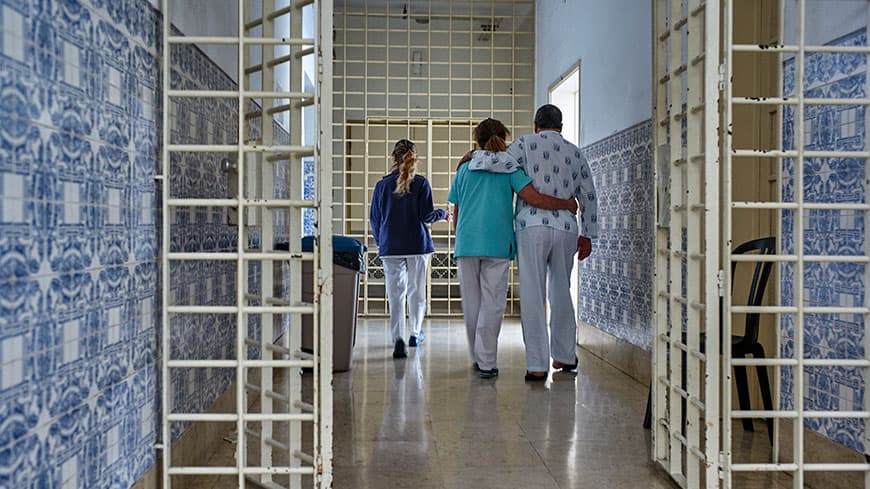
As part of this monitoring, an ad-hoc visit also took place in Romania between 30 September and 11 October 2024, with conclusions published on 15 October 2025. The report focuses on the treatment and living conditions of patients in the country’s four forensic psychiatric hospitals. The visit took place following recommendations made after the 2022 visit and shows that several serious systemic problems remain unresolved.
According to the CPT, the treatment applied to some patients in forensic psychiatric hospitals is marked by neglect and could, in some cases, amount to inhuman and degrading treatment, as well as a continuous violation of Article 3 of the European Convention on Human Rights, which provides an absolute, non-derogable prohibition against torture, inhuman, or degrading treatment or punishment.
During its visit to Romania, the CPT collected numerous credible allegations of physical ill-treatment by auxiliary staff, including slaps, punches, and, in some cases, the use of electric shock devices. Furthermore, patients’ basic needs were clearly neglected: several deaths are reported to have been caused by airway obstruction during feeding, indicating a lack of proper assessment and care for at-risk patients. Material conditions in hospitals were difficult, to such an extent that overcrowded and poorly designed units often gave the impression of a prison-like environment. Staff shortages worsened the situation, exposing patients to neglect and abusive practices.
Romania ratified the European Convention for the Prevention of Torture in 1994, and the Committee’s first visit took place in 1995. Since ratification, the CPT has carried out 14 visits to Romania, during which 73 police units, 35 prisons, 18 psychiatric institutions, 13 social and educational-correctional institutions, and 2 migrant detention centers were inspected. Romania has not accepted the automatic publication of visit reports, according to the document.
(Photo source: coe.int)