Bucharest Nine summit: Leaders back ‘NATO 3.0’ strategy in joint statement, call Russia the alliance’s main long-term threat
NATO’s Eastern Flank and Nordic allies endorsed on Wednesday, May 13, a new “NATO 3.0” strategy focused on higher defence spending, stronger European military capabilities, and a reinforced transatlantic alliance. Meeting in Bucharest, the leaders also described Russia as “the most significant, long-term and direct threat” to Allied security.
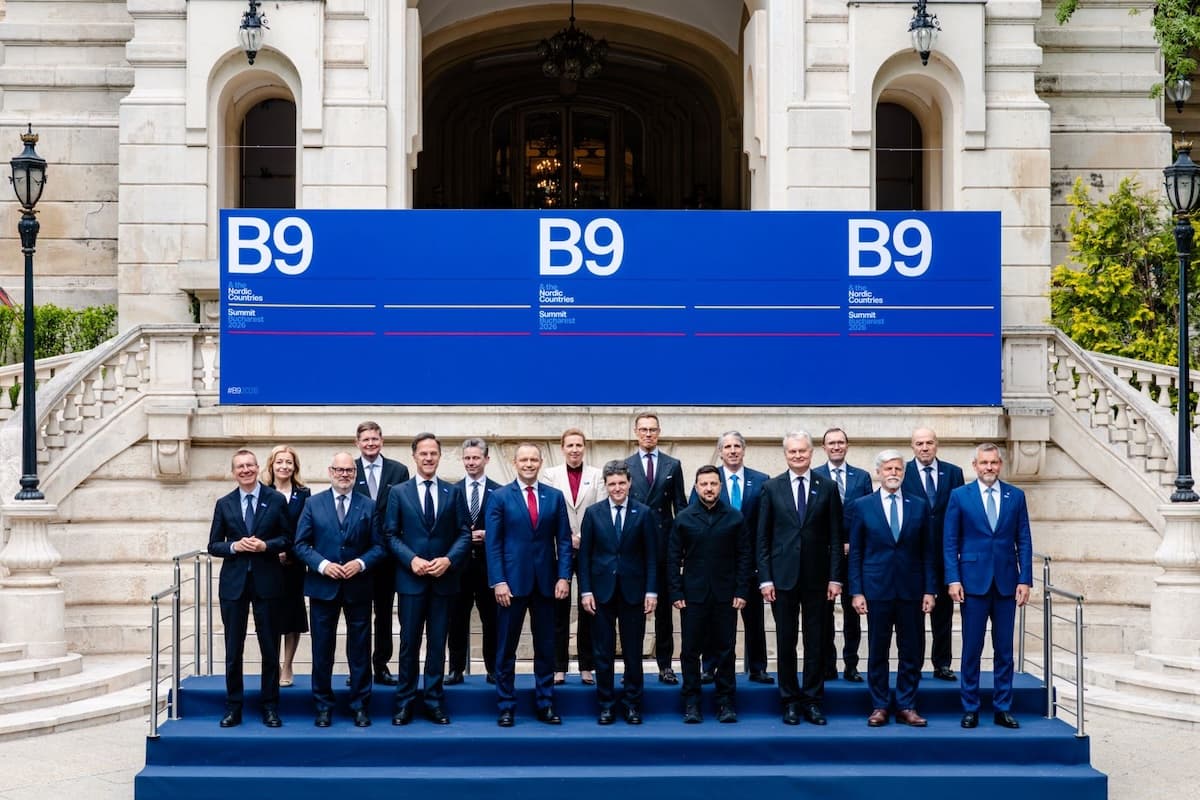
The joint declaration was adopted during the Bucharest Nine (B9) and Nordic Allies Summit co-hosted by Romanian president Nicușor Dan and Polish leader Karol Nawrocki, with the participation of NATO secretary general Mark Rutte, Ukraine’s Volodymyr Zelensky, and representatives of the United States as observers.
“Today’s meeting reflects our shared commitment to strengthening cooperation on security and defence across the entire NATO Eastern Flank, recognizing the strategic continuum from the Black Sea to the Baltic Sea and into the Nordic and Arctic regions, and our determination to deliver on NATO 3.0 by advancing a stronger Europe in a stronger NATO. The transatlantic bond remains the backbone of our collective security,” reads the joint statement.
“United in the face of profound security threats and challenges, in particular the long-term threat posed by Russia, we are further scaling up our contributions to our collective defence. We are shouldering greater responsibilities through enhanced burden sharing and increased defence investments, as Allies work towards the 5% of GDP commitment,” it added.
The leaders condemned Russia’s “sabotage, cyber-attacks, and a wide range of hybrid attacks and destabilising activities,” warning that repeated airspace violations on NATO’s Eastern Flank underline the need for stronger missile and drone defence systems.
The declaration also reaffirmed support for Ukraine, including continued military assistance and backing for the country’s Euro-Atlantic aspirations. The allies called for increased pressure on Moscow to end its war against Ukraine and engage in “meaningful peace negotiations.”
The statement highlighted the strategic importance of the Black Sea, Baltic region, and Arctic for NATO security, while stressing the need for stronger defence production capabilities, military mobility, and NATO-EU cooperation.
Speaking after the summit, Romanian president Nicușor Dan said the meeting served as preparation for the upcoming NATO summit in Ankara and confirmed that Russia was explicitly identified as a threat in the final declaration.
“As written explicitly in the declaration, Russia is a threat to our countries,” Dan said. “We also spoke about Ukraine, obviously, and about the support our countries continue to provide, both military assistance now and security guarantees in the next phase.”
Dan described NATO 3.0 as a return to NATO’s original defensive mission in response to renewed threats from Russia, combined with a more balanced distribution of responsibilities between Europe and the United States.
“NATO was founded during the Cold War, when Russia was a threat to the European continent. After 1990, it seemed Russia was no longer that threat, and NATO tried to redefine itself. Now we have returned to this reality,” he said, answering a journalist’s question.
According to the Romanian president, NATO 3.0 does not mean a reduced alliance role for the United States, but rather greater European responsibility within the same collective defence framework.
“The fact that the United States and Europe contribute more equally does not mean Europe defends Europe and the United States defends the United States,” Dan said. “NATO 3.0 simply means that within the same defence protocols, the contribution of allies becomes proportional.”
He added that the alliance’s new spending commitments, including the 3.5% defence spending benchmark plus 1.5% for defence-related investments by 2035, would create “a stronger NATO because we will have more capabilities.”
In his turn, NATO chief Mark Rutte also described NATO 3.0 as “the logical next step” for the alliance, arguing that European allies are increasingly taking responsibility for their own conventional defence while maintaining strong transatlantic cooperation.
“NATO 3.0 means a stronger Europe in a stronger NATO,” Rutte said. “And a stronger Europe in a stronger NATO means with the United States both nuclear, but also conventional, while Europeans take more responsibility for their own conventional defence.”
Rutte praised the alliance’s recent agreement to move toward 5% defence spending and said several countries were already planning to exceed the target before 2035. He also linked the strategy to the evolving geopolitical role of the United States, saying a stronger European pillar within NATO would allow Washington to gradually shift more attention toward other strategic theatres, including Asia.
“The US can, over time, step by step, pivot more towards other priorities,” Rutte said, while stressing that Europe and North America would continue acting together to avoid weakening NATO’s deterrence capabilities.
The NATO chief added that he was “cautiously optimistic” about the upcoming NATO summit in Ankara and said the NATO 3.0 concept would likely be reflected in future alliance strategy documents.
irina.marica@romania-insider.com
(Photo source: Presidency.ro)