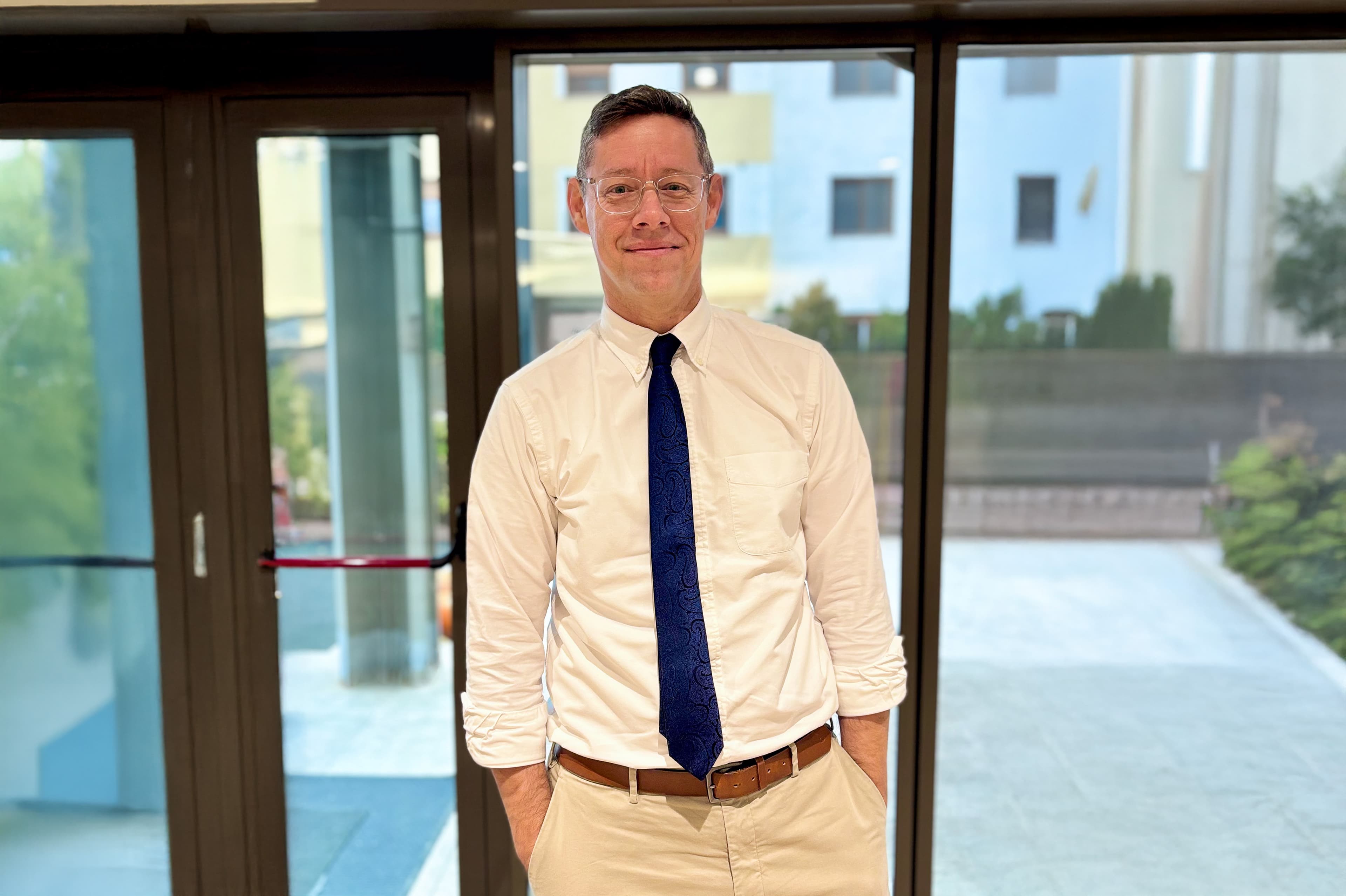
At Verita, preparing for the future means learning to think for yourself, says Head of Secondary Ashley Peek
As parents everywhere wrestle with the same uneasy question, how do you prepare children for a future shaped by rapid technological change and constant uncertainty, Verita International School is betting on a clear answer: teach students…
Romania Insider · with Ashley Peek, Head of Secondary, Verita International School
· Updated · 6 min read
As parents everywhere wrestle with the same uneasy question, how do you prepare children for a future shaped by rapid technological change and constant uncertainty, Verita International School is betting on a clear answer: teach students how to think, not what to think.
In this interview with Romania Insider, Ashley “Ash” Peek, Head of Secondary at Verita, explains why the British style pathway at the school, from IGCSEs to the International Baccalaureate Diploma Programme, puts independent thinking, critical analysis and real world problem solving at the center of learning. He argues that no one can reliably predict the “skills of the future”, but that students who can reason clearly, communicate effectively and keep learning throughout life will be equipped for whatever comes next. Peek also speaks candidly about wellbeing and resilience, describing Verita’s emphasis on social emotional learning alongside academics, and offers a direct message to anxious parents: “the kids are all right”.
The entire Q&A below:
You have been leading the Secondary section at Verita for some time now. What brought you to education in the first place, and then specifically to Verita and to Romania?Ashley Peek: I spent the early part of my work life in business management, and though it was financially rewarding I found it to ultimately be unfulfilling. I stumbled into education while looking for something more meaningful, and found that it ticked all of the boxes for me. Verita and Romania were, again, something I stumbled into. I was looking for a new challenge after spending 13 years at the same school in Bangkok, and saw the position at Verita posted on an international school job board. From my first conversation with Richard and the hiring committee I immediately felt a connection to Verita’s mission, but even more importantly to the people in the Verita community. Coming here felt almost inevitable. How does a British style education at Verita differ in practice from what most Romanian or regional families may know from more traditional school systems?Ashley Peek: In terms of general content, all school systems share more in common than they have differences. Where Verita’s education differs - especially in the International Baccalaureate Diploma Programme (IBDP) - is that it is much more focused than most traditional educational systems on building our students’ ability to think independently and critically. In mathematics, for example, a traditional learning environment might ask a student to show their learning by simplifying an equation or by solving for a specific variable. At Verita and in the IBDP a student is more likely to be asked to show their learning by being given a real-world problem that requires them to use the advanced math skills they have been taught in order to achieve a requested outcome. In English, a Verita student might be asked to analyse a piece of literature, much as a student in a traditional environment might. The difference is that the Verita student is not expected to return a specific analysis or response. Rather, students must develop their own analysis of a work, and support their viewpoint with evidence they find from the text. There is no single, correct answer. Rather, students are required to develop and support their own arguments.
Free newsletters
Romania, in your inbox before your first coffee.
Get the Daily — the morning briefing, free, in English, unsubscribe anytime. Want business, real estate or travel digests too? Pick your newsletters →
Everyone talks about preparing students for jobs that do not exist yet, but what does that actually look like in your classrooms?
Ashley Peek:
Anyone who tells you that they know what the ‘skills of the future’ will be is either lying or just guessing. A student who is going into the first year of high school next fall will still be in the prime of their worklife in 2056, and the simple fact of the matter is that no one has any idea what the workplace, or even the world itself, will look like then. The most important things we can give our children, therefore, are the skills they need to think critically, to communicate effectively, and to continue to learn independently throughout their lives. And while we live in an age where we have so much information at our fingertips, a strong, broad base of factual knowledge is still vital, as well. Without already having a good understanding of past events and about how the world around us works, it is impossible to identify the falsehoods and misinformation that so often proliferates in the modern world.
How does Verita support students' mental health, resilience and sense of purpose during these crucial Secondary years?
Ashley Peek:
At Verita we spend a great deal of time on these specific topics. Verita was founded on the principle that social-emotional learning was every bit as important and meaningful as academic learning. We recognize that academic success supports our students in their future professional careers, but believe that true happiness and fulfillment comes from a person’s internal self, rather than from any extrinsic motivations. This outlook forms a part of the very fabric of our school, and is something we try our very best to embody in everything we do. All of our secondary students through year 11 take classes on social-emotional learning. Our goal with these classes is to equip students with the skills they need to manage their own emotional regulation and to face the world with confidence, resilience, and self-possession. These classes are coupled with a counseling program that supports both the emotional and academic needs of our student body during their turbulent teenage years. Our ultimate goal, however, is to graduate students who are able to manage and support themselves in the world.
What qualifications can Verita students work towards in Secondary, for example IGCSEs, A Levels or other pathways, and how do these open doors to universities in the UK, Europe, the US or elsewhere?
Ashley Peek:
Verita’s high school students pursue their IGCSEs in years 10 and 11, followed by the IBDP in years 12 and 13. We chose these curricula for several reasons, including academic rigour and international recognition. The IGCSEs provide a balanced, comprehensive high school specification that prepares students well for both the IBDP and university after. It covers maths, literature, history, economics, language acquisition, science, and the arts. The IBDP provides a high school qualification that is among the most highly regarded around the world. It is accepted at essentially every university globally, including all national university systems in Europe, Canada, Australia, and the USA (Romania, too). Moreover, the IBDP not only opens the doors to university, it also prepares students to excel once they are there. The feedback we consistently receive from our graduates is that after completing the IBDP, university is comparatively easy.
If you could give one piece of advice to parents who feel anxious about their children’s future, about AI, the economy, or moving abroad, what would you tell them, based on what you see every day at Verita?
Ashley Peek:
Relax. As someone who works with young people every day, I can assure you that the kids are fine. They are smart, focused, capable, and kind. There is a conception among some adults that the youth today are somehow socially stunted and are hopelessly addicted to their devices. However, I can tell you from firsthand knowledge that our current middle and high school students are socially aware, engaged, and adept at interacting with others both online and in person. Do they always engage and interact well with adults? No, but when I was a teenager I didn’t relate all that well well to my parents and their peers, either. It’s normal for us to feel anxious about our children and their future - uncertainty is uncomfortable. But look at the last thirty years or so. The accoutrements of life may have changed significantly, but humans have not. In all of the most important ways we have the same needs, desires, strengths, weaknesses, struggles, and successes as our predecessors. And the fact that today’s parents are doing fine despite the changes of the last few decades is how you can be sure that today’s teens will be fine in the future. Will things change? Certainly. Will our kids struggle? Without a doubt. But, just like we did, they will find their way. Because this is what humans do. And last I checked, all of today’s high school students are, indeed, human.
--
*
This interview was edited by Romania Insider for Verita.