'Shakespeare can speak to everybody': How a theater caravan brings the works of the Bard to audiences across Romania
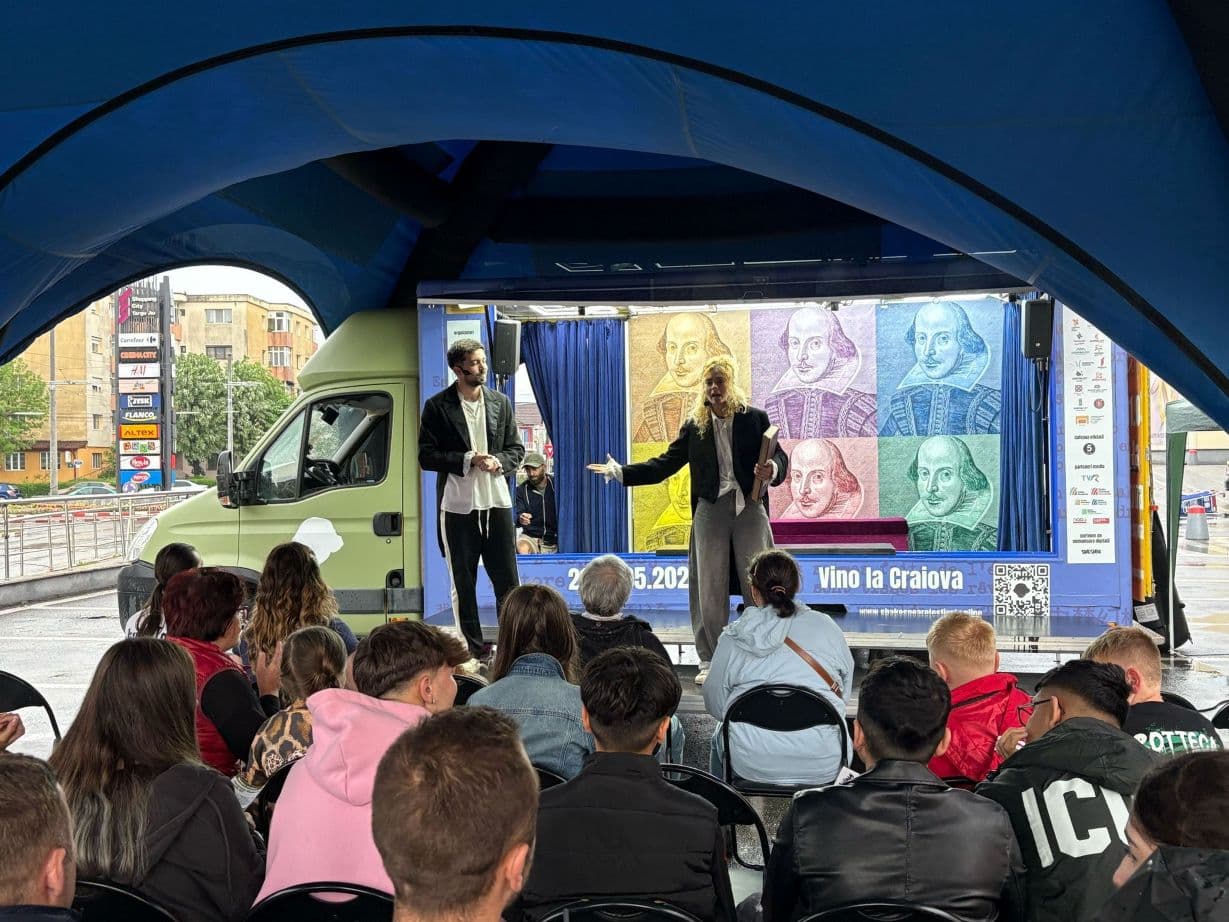
The theater caravan Shakespeare – everywhere, a project of the International Shakespeare Festival in Craiova and the Shakespeare Foundation, is currently traveling across the country to bring the work of the Bard to audiences who might not otherwise have access to it. More than half of the localities included in the tour are towns and communes that lack theater infrastructure, as the initiative aims not only to present Shakespeare but also to make attending a theater performance more relatable. Vlad Drăgulescu, the president of the Shakespeare Festival and the initiator of the caravan project, told Romania Insider more about the project and how it matters to the public and the organizers.
The caravan began this April in Craiova, the southern Romania city where the International Shakespeare Festival has been taking place for more than 30 years. The festival, which consistently features A-list directors and productions, is organized by the city's Marin Sorescu National Theater, where Drăgulescu serves as artistic director.
The touring program, extending to September, covers 61 communities (Craiova included), both large cities and localities in rural areas, turning streets, squares, and alternative venues into theater stages open to all. It's double the number of places it reached in the previous edition, and the urban-rural mix reflects a desire to speak to all types of audiences. For the organizers, it is also an opportunity to step outside their day-to-day perspective, expand their understanding of the public, and design improved projects.
"We are targeting all types of audiences and this is why we have the mix. It's very important for us to learn about our audience and to really learn the reality of the moment. In a theatre, you have your own venue, your own stage, your own audience. That might be tricky because you can think that what you understand is the reality. But the reality is out there; that's why we started this caravan: to go to 60 cities and villages and learn about the people there, how they react to what we propose, and to learn how to make a proper and better cultural intervention," Vlad Drăgulescu explains.
If the caravan's previous edition meant one truck traveling with a team of three people to 30 cities, this year it's three trucks and a team of ten people, a logistical effort backed up by the contribution of the sponsors. "It's much more expensive than last year, but thankfully, our sponsors and the Ministry of Culture understood that we need to do this type of democratization of culture, making it available for a larger number of people, especially in the rural part, where audiences don't have access to culture in a regular way."
Only 7% of those living in rural areas attended a theater performance at least once in six months, the 2024 edition of the Cultural Consumption Barometer revealed. The survey, which measures cultural consumption practices in Romania, showed the highest participation rate in theater performances outside of festivals remains in larger cities, of more than 100,000 - 200,000 residents, where the share stands at 23%.
The third edition of the caravan will see an even greater reach as plans are to show up in 600 cities and villages in a tour spanning three years. It will coincide with the renovation works that the building of the Craiova theater will undergo beginning next year.
"From next year, the Marin Sorescu National Theatre will undergo renovation, and we decided that the people from the theatre need renovation also. […] We could say that this year and last year are the pilot, the test for what we want to do. Now we know more and hopefully, in the future, we are going to get to these 600 cities and villages, spend more than one day in one place, and develop together with the audiences the program."
Meanwhile, this year, the caravan is set to reach the Enescu Festival as a special project during the classical music festival's last weekend for a performance in Bucharest's Herăstrău Park. It will also travel to Chișinău, to the reunion of the National Theatres of Romania, held in September.
The caravan presents a three-part program that covers workshops for children and teenagers, a selection of sonnets, and the comedy Shakespeare Reduced. The order was chosen to allow the audience to go from simply familiarizing themselves with what a theater performance entails to wanting to learn more about Shakespeare's work.
The workshops, exploring themes such as love, identity, or rivalry, introduce children and teenagers to Shakespeare's work in a playful way, the organizers explain. They are also a way of getting them acquainted with the performers and a welcome adjustment for a public sometimes reluctant to attend performances out of concern that they could prove too challenging to grasp.
"It was the first connection that we wanted to have, especially in the rural sites where the audience doesn't have access to theatre. It is the first introduction, by playing. We relax through games. […] It's a way of getting familiarized with theater and also with the actors. Sometimes people don't go to the theater because they think they don't have what to wear or it will be very difficult; they need to understand that they can come in a t-shirt, they can come however they want, but just come."
The sonnets-centered comes with an unmistakable reference to the Elizabethan Age, namely the costumes designed by students of the I. L. Caragiale National University of Theatre and Film (UNATC) in Bucharest. He likens this section to a travel in time, which is also the analogy used to introduce the actors reciting the sonnets.
"It's introducing them [the public] to a fixed form of poetry, to a fixed time in history and a certain type of fashion of that time. After we played, we have this much more serious act, and then for the third part we have the comedy Shakespeare Reduced where we come again to play. There's a lot of improvisation there because the actors really love to interact with the audience. Of course, they learned a text and they can develop on that text, but basically, is it a fun way of passing through several plays by Shakespeare."
Shakespeare Reduced is inspired by Jess Borgeson, Adam Long, and Daniel Singer's The Complete Wrks of Wllm Shkspr (Abridged), where Shakespeare's plays are performed in comically shortened form by only three actors. The sprint through works such as Romeo and Juliet, Othello, Julius Caesar, or Richard III was first presented by its creators at the 1987 edition of Edinburgh Fringe, now the world's biggest arts festival, known for its eclectic program. The play was one of the longest-running shows in London's West End and has been translated into more than 30 languages.
Shakespeare's notoriety made the work a good fit in the program of the caravan. "One of the games we play is they [the actors] say 'I say Romeo and you say ….' and they [the audience] know Juliet. Everybody knows Romeo and Juliet, about Hamlet. As I always say when people ask me, 'Why a Shakespeare festival?' It's because Shakespeare is not Shakespeare anymore. Shakespeare is a tool. Everybody knows about Shakespeare. When you come to the Shakespeare Festival in Craiova, you don't come to learn the story of Hamlet. You come to see the actors and a contemporary approach to a story that everybody has been telling for 400 years. That's the value."
At the same time, the humorous and irreverent take on Shakespeare's plays is meant to inspire further questions on the work and life of the playwright.
"One of the things we are trying to achieve is that after having fun with Shakespeare Reduced, they go home and do a Google search and see the whole story of Hamlet or learn more about William Shakespeare because, of course, in Shakespeare Reduced you also learn some things about Shakespeare's time and about Shakespeare himself."
Because of budget constraints, the caravan dropped the idea of an additional, fourth truck featuring a digital costume gallery that would have further exposed the audience to the fashion of the Elizabethan period.
"It [the caravan] was supposed to have also a digital gallery. We could have had one other truck with screens where people could see Elizabethan theater costumes to modern costumes, and also an exhibition about life in that period."

Theater in the community
The caravan adds to a broader focus on the community that the Craiova theater and festival have. Last year's edition of the Shakespeare Festival, for instance, featured more than 100 outdoor performances in various venues in the city, while more than 50 shows were pop-up ones, made with the help of the public.
"Starting last year our slogan is 'communities build festivals' because we truly believe that the future of festivals is in the possession of the community. They need to be the owners of the festival and build the festivals together with the institutions and the professionals. So, we started doing a lot of cultural interventions in the communities. The first thing that I can say changed is that we learn a lot about what they [the public] need and what interests them."
The commitment to the idea began years ago, with a project called Urban Reaction, which the Marian Sorescu National Theater in Craiova initiated in 2017. As part of the project, the city's residents, from the youngest to the more senior, were involved in making a show, designing the sets and costumes, and performing in the production. It's a two-way street, where the theater can learn more about the audience, while the public can see that theater is not an elitist endeavor.
"We did this three or four times at the Shakespeare Festival, in the community projects, with Philip Parr. It brought us more audience and much more interest in what we do because people realized that [theater] isn't a very high, elite art."
It is even more true of Shakespeare, whose plays were enjoyed by a diverse audience at the time when they were first presented. "Shakespeare became elitist, even though he was not elitist at all. Shakespeare can speak to everybody; back in his time, he was playing for 3,000 people in his theater. At that time, I don't know how many of those people knew how to read or write, so definitely he was not elitist; he was very popular. […] We hope that people will understand that theatre is not elitist; theatre is about people. I hope that this whole process of democratizing culture will help us learn a lot about our audience and make the right choices in our artistic adventures. Because it is an adventure at some point."
For the theater professionals, it's a constant quest for better choices, and an endeavor to stay connected to the day's realities. "We learned that we don't know anything and that everything, and that as soon as we think 'we’ve got this,' it's already lost. One of my mentors, Tim Carroll, was constantly telling us during rehearsals, 'Don't forget to get off the bus.' What he meant was that, once you find the solution, just put it away and start searching for another solution. This 'get off the bus’ became something of a constant for me. And this is the reality because, these days, when everything changes so fast, we have to be able to react to everything and be the mirror of contemporary times, of the reality that we have in front of us."

The Shakespeare Hub
Among other projects associated with the Craiova theater, a Shakespeare Hub opened in the city in January. It builds on the Shakespeare Festival founder Emil Boroghină's wish to bring the best Shakespeare work in the world to Craiova, the artistic director explains. "Shakespeare Hub is a place where we meet with people when the Shakespeare Festival is not on and where we want to do all these projects that bring the audience closer to the festival and to the top-quality theatre that is made in the world."
It runs a partnership with the Shakespeare Birthplace Trust, where, earlier this year, the public could attend the live broadcast of a conversation with Dame Judi Dench on her experience with Shakespearean roles and a Q&A session.
The hub is also a place for students and researchers, who can access there the festival's archive of performances. The event has featured by now shows from 60 countries, providing plenty of study material.
Another project will examine Shakespeare's influence in various countries and the authors he has had an impact on. Shakespeare and the Romanians would entail "finding when was the first time in Romania that people heard about Shakespeare, when it was first translated, who was the translator. A lot of translators became very famous for translating Shakespeare.” The project will be rolled out in partnership with various cultural institutes, and the results presented at the festival and at the hub, which currently has 15 cultural patrons. “We want to speak about what Shakespeare meant, not only by himself but what he managed to inspire and develop,” he explains.
simona@romania-insider.com