The "Shaping Romania's Future" editorial series is powered by the British School of Bucharest.


British School of Bucharest

‘STEM education shouldn’t be a privilege’ – RuralBots' robotics classes reach rural Romania one community at a time

06 February 2026

RuralBots Initiative, a program offering free robotics classes and summer camps to children in rural areas, will be available in three additional rural communities this month. Theodor Gorovei, the project’s manager, told Romania Insider more about the program’s beginnings, how it managed to expand its reach, and its mission.

RuralBots Initiative is a program of the Robotics, Educational Technologies and Applied Sciences Association (ARTESA), a non-profit established by a group of trainers of robotics teams at a Bucharest club to support children passionate about robotics and technology in taking part in national and international competitions. In 2024, it broadened its activity with projects dedicated to children in rural areas and neurodivergent kids.

RuralBots kicked off with a robotics summer camp in Vasilați, a commune in Călărași county. Although it is only 30 kilometers away from Bucharest, its closeness does not translate into equal access to education, Theodor Gorovei, the vice-president of ARTESA and the one who delivers the classes, explains. It is a reality that the association has made it its mission to change. Hence, RuralBots, a program offering free access to STEM education not as a one-off activity but a constant one, where a wider goal is to replace fear of failure with a willingness to experiment. More in the interview below.

How did RuralBots come about? How was the journey from idea to implementation? What worked? What adjustments were needed?

The initial idea we started from was far from a 'large program.' At the time of the launch of the pilot program, the Rural Summer Camps for Robotics and Programming, our lack of experience in managing an association didn’t allow us to think long-term. We are people coming from the business sector, and, until then, we had been successful as trainers of robotics teams at a private club in Bucharest.

The objective was simple: to bring robotics and programming to a rural area school during the 2024 summer holiday.

We then began looking for sponsors to secure robotics kits, tablets, and laptops, and to deliver regular workshops for children, free of charge, with a focus on hands-on learning rather than performance or competition. Hidroelectrica answered our call, and their support enabled us to run the program.

We took the first step in Vasilați during the summer holiday in the informatics lab of Constantin Brâncoveanu Secondary School, whose principal, Iulia Stoica, has been an involved and open supporter who understood the potential of such an endeavor.

The results exceeded initial expectations, with 208 children taking part in the robotics workshops, nearly half of those enrolled at the school. The interest confirmed that the issue isn't a lack of curiosity or motivation, but a lack of access to such activities.

Building on this, the program received support from mayor Cristian Vasile and local partners, who helped sustain the activity during the school year. The school principal undertook significant efforts to set up a dedicated area by converting a corridor connecting two buildings into a robotics lab. Thus, by the 2024 winter holiday, we had implemented the project Toamna se Numără Roboții in the robotics lab in Vasilați.

The activity up to that point drew the attention of HP, which supported the project in 2025 through a grant from the HP Foundation. This was the moment when the idea of a single program that can be scaled and implemented in any rural locality, RuralBots Initiative, emerged. Until last year's summer holiday, under this project name, we ran the program Robotics and Programming Hub.

Beginning with the 2025 summer holiday, we decided to structure RuralBots Initiative into two complementary parts: RuralBots Academy, which takes place throughout the school year, and RuralBots Summer Camps, during the summer holiday.

.
Theodor Gorovei has been the one delivering the classes

Why Vasilați? Why Mitreni, Valea Roșie and Clătești? What criteria do they meet to host the project?

RuralBots started in Vasilați for purely administrative reasons: the non-profit’s headquarters, a holiday home of one of the founders, is located here. The rural communities from which the children attending Constantin Brâncoveanu Secondary School come are the villages of Vasilați, Nuci, and Popești. These reflect the reality of many rural communities in Romania: although they are only 30 kilometers away from Bucharest, the differences in opportunities compared to the urban areas are significant. Therefore, starting an equal-chances project here was as necessary as in a locality several hundred kilometers from a large urban center. Geographical proximity doesn't automatically mean equal access to education or opportunities.

Expanding the program to the commune of Mitreni, which includes the villages of Mitreni, Valea Roșie, and Clătești, came differently. Implementing the RuralBots Academy Mitreni was carried out following the invitation from mayor Ciprian Panait – an important indication of openness on the part of the local administration. The interest of local authorities is an essential criterion: educational programs work in the long term only where there is support at the local level.

We have decided to start the activities in Mitreni even before securing dedicated funding, using the existing equipment from the Vasilați lab. At this stage, the logistics will be simple but intensive: we will transport the equipment, using our own means, for a round trip of approximately 50 kilometers, every day we hold workshops. The enrollment period for primary school children is currently open, and the workshops are set to start on February 23.

What were some of the challenges you faced when starting the project?

The challenges were predictable for an educational project developed in a rural area, but this does not mean they were easy to solve.

Funding has been and remains the most sensitive. RuralBots Initiative did not start with a stable budget or signed sponsors, but rather with a pilot program, then developed cautiously. It took time to show that a robotics program in a rural-area school is feasible and can generate real impact, and even when these aspects were demonstrated, financing is not guaranteed.

As for human resources, the challenge comes from the fact that RuralBots is a sustained effort, taking place throughout the year, not just a weekend or seasonal activity. The activity load, the number of enrolled children, and the frequency of the workshops (weekly for every child) entail a full-time schedule for every community, and, during some periods, even more.

Even if the program is offered to children for free, we wanted the STEM education we deliver to be of quality, not one that merely ticks boxes. This is why the workshops were organized from the very beginning in small groups of a maximum of six to seven children (some groups have four or five children) so that every child can receive individual attention, and any unclear points can be discussed and settled on the spot. We thought this was essential for robotics and programming to truly contribute to the children's personal development, not just to a basic familiarity with technology.

In this context, our activity cannot be supported by occasional volunteering, and establishing a stable team depends directly on the available funding. This challenge is further compounded by the fact that many sponsors explicitly rule out financing human resources, focusing mostly on equipment and materials. This is why a single person, the manager of RuralBots Initiative, has delivered the workshops.

This model will also be applied in Mitreni, where work to prepare the activities is currently underway. The program was designed to be replicated, but at a pace adapted to available resources.

The institutional opening has been and is good. In both the commune of Vasilați and the commune of Mitreni, collaboration with schools and local authorities created a favorable framework for the program's development and future implementation.

To sum up, the main challenge has been developing a constant educational program with limited resources, without compromising on the quality and consistency of activities.

In an article on the ARTESA website, you speak of the "snowball of equal opportunities." How is this idea reflected in the project? What barriers do you see in rural areas when it comes to STEM education?

We used the expression in the first article we published on our website, when we announced the Rural Summer Camps for Robotics and Programming in Vasilați, in May 2024.

What was, if you wish, a premonition that later proved true is that this program was not conceived for only one community. As it worked, delivered results, and gained structure, it proved it was replicable. Expanding the RuralBots Initiative to other rural communities, like Mitreni, is a natural continuation.

In this respect, the "snowball" is RuralBots Initiative's capacity to be adopted and adapted in similar contexts, using the same principles: free access for as many children in rural areas as possible, continuity, early STEM education, and collaboration with schools and local authorities.

The barriers in rural areas remain consistent. The first is the lack of early access to STEM education: many children reach secondary school or high school without ever having had contact with robotics or programming, which creates gaps that are hard to close later.

A second barrier is the lack of stable programs; specific initiatives or short-term ones, even when well-meaning, are not enough to bring real change. STEM education needs pace and continuity.

Another barrier is a perception issue: the idea that robotics or technology is not for children in rural areas or for girls. It is not a technical barrier but a cultural one that affects both children and the grown-ups around them.

Last but not least, there are structural barriers related to financial, human, and logistical resources that make expanding such programs difficult.

Essentially, what started as a local initiative in Vasilați turned into a model that can be replicated in other rural communities. This is the snowball of equal opportunities.

You hold demo classes to help children and parents decide on the program. How were they received? Were there elements that surprised you?

For children in urban areas, the demo classes mean they build a robot themselves, program it, and see whether they like this type of activity. In rural areas, things are different. Here, the demo classes are, first of all, presentations: children see a robot for the first time, what it can do, and how its behavior can change with programming adjustments.

For most children in rural areas, robotics is something completely new. Many of them have never seen an education robot and don't know what it means to program something. This is why the demo classes are not hands-on workshops but moments of familiarization, where the robot moves, reacts in different ways, and performs seemingly simple tasks, and the children begin to understand that they themselves could build and control it.

What is surprising almost every time is the children's reaction when they see that a robot can do completely different things when a few instructions are adjusted. This is also one of the stereotypes, namely the idea that a robot can do only one thing. Children begin to understand that technology can be learned.

There is also the perception that robotics can be complicated or the domain of pupils who excel academically. The demo classes help dismantle this idea. The fact that the robot responds immediately to programming changes makes things accessible and easy to follow, even for children who have not yet had any contact with educational technology.

Often teachers ask about the selection criteria for participating in the workshops. They are surprised to learn that there are no criteria: any child who wishes to take part is welcome, including those at risk of dropping out of school. For us, it is a fundamental principle: STEM education shouldn't be a privilege but an opportunity available to everyone.

What does a RuralBots robotics class look like? What are some of the highlight activities?

It differs depending on the school cycle and the children's experience level. The content and way of working are adapted to their age, so that activities are accessible while at the same time relevant educationally.

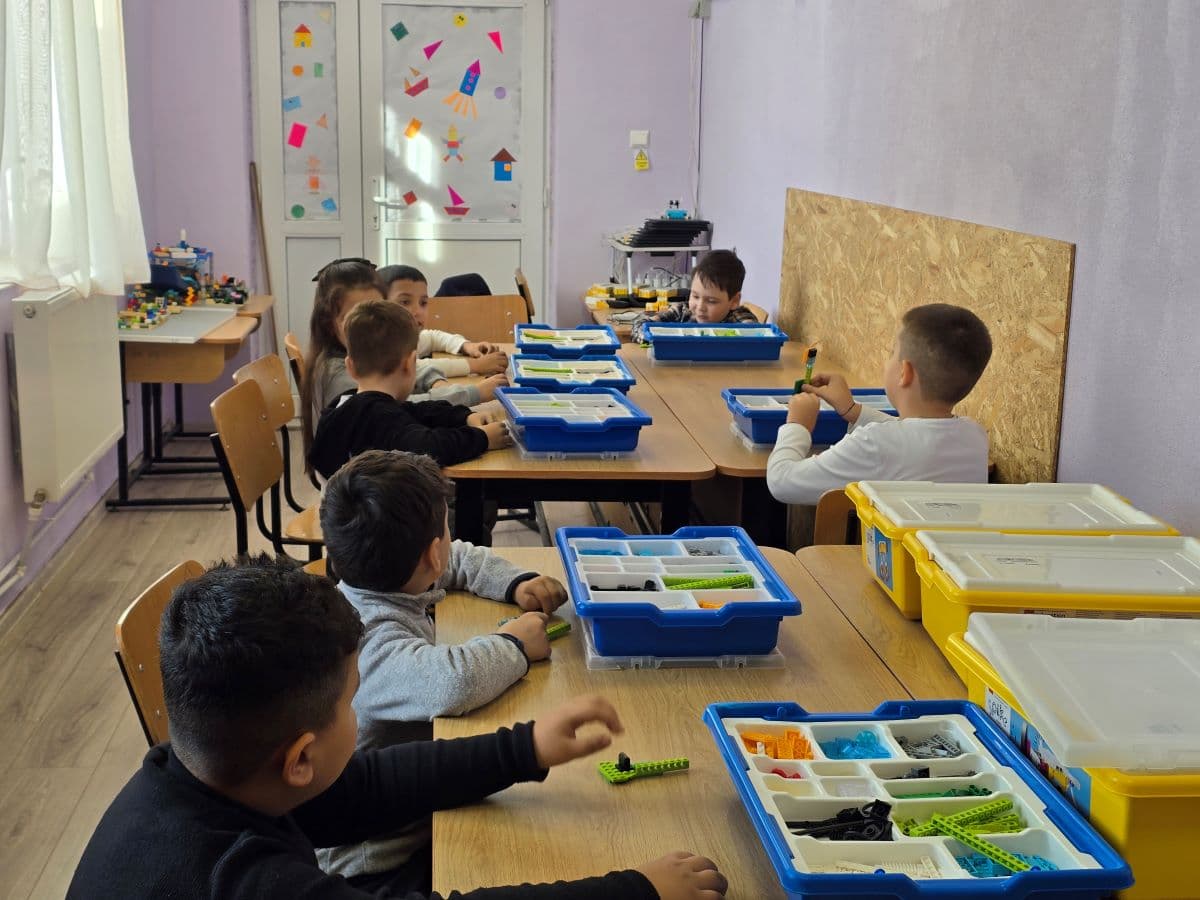
For the children in the primary school cycle, the class usually starts with a discussion anchored in the real world. We talk about things they can observe or discuss at school: pollination, earthquakes, volcanoes, recycling materials, what speed or force are, for instance. Based on these ideas, children then build a robot reflecting the topic discussed, following a scheme.

After completing the construction stage, we explain the basic instructions and the robot's initial program. It matters that programming is visual and relies on suggestive, image-based instructions. In this way, it becomes accessible to those who have yet to learn how to read or struggle.

What comes next is the favorite part for most: the challenges. The children are encouraged to change the robot's behavior themselves by modifying elements of the program; they notice the impact immediately. If time allows, the end of the hour is reserved for free experimentation with all available items and ideas.

For secondary school pupils just starting, things become more structured. The robot is built according to a scheme, but the focus shifts to understanding the instructions and programming. The children have clear tasks, which the robot needs to fulfill, from the simple to the most complex, which helps them develop their logical thinking and ability to solve problems.

For the groups of more experienced children, the robotics class usually starts from a theme. They need to think about both the construction of the robot and the program that makes it run as required. In time, these activities resulted in constructions that were surprisingly inventive, which shows how much children can develop when they have the time, space, and freedom to experiment.

The program was designed to be replicable, and it has already expanded. What does expanding it further depend on? How would you like to see it developing?

Expanding the project depends on specific things: funding, people able to support the activity, and the school and local community's opening.

In Vasilați, we had periods when the workload was difficult to bear; with the expansion to Mitreni, it is clear that the limit of a program supported by a single person has been reached.

To grow, RuralBots Initiative needs people involved locally to take the activity forward consistently. Otherwise, the development would be forced and unhealthy, turning it into a project that merely ticks boxes, which we want to avoid.

As for the development direction, the ideal is for every school in rural areas to be able to run a program like the RuralBots Initiative. It is hard to accept that, in the 21st century, a child's access to STEM education still largely depends on where he was born.

In Vasilați, the project entails both robotics classes and summer camps. How does the educational focus differ between the two?

The project started in the summer with robotics camps and then expanded throughout the school year.

Throughout the school year, the activities take place within a more structured framework aligned with the children's program.

In the summer, for almost three months, children in rural areas have very few options when it comes to personal development activities, and the extended break from learning is felt every time a new school year starts.

The robotics camps are an alternative for this summer period. Besides offering children an alternative to spending time on their phones, robotics activities keep their minds active during the school break. It is not about replacing the holiday but about maintaining a minimum learning pace, without pressure or evaluations.

The content is adapted to the children's level and time spent in the program. They can register at any time, including during the school year. For instance, children who recently entered the program, colleagues of children who have been taking part since 2024. We try, as much as possible, to work in groups of similar levels, but this is not always doable.

In these cases, the learning curve can be a bit more abrupt for those just starting. On the other hand, experience showed us that working with mixed groups has an advantage: the less experienced children progress faster when they are alongside those who have been in the program for longer, based on a principle similar to that of "the younger brother," who makes up for lost ground quickly.

Both the school-year workshops and the summer camps start from the same idea: education needs continuity and a consistent pace to be relevant.

How do you see the role of robotics competition, and how do you approach them in the RuralBots program?

The robotics competitions play an important role, but are not an end in themselves at RuralBots. We see them as an experience that can add to the work done in workshops, not as a compulsory objective or a measure of the children's value.

At present, we take part in two competitions: FIRST LEGO League Explore, which takes place in February-March, and World Robot Olympiad, which is organized in June. We chose to take part only with children in the primary school cycle, as for the young ones, the experience means play, teamwork, meeting other children, and experiencing things they might not have had the chance to otherwise. This approach is also the philosophy of one of the competitions: "It is not whether you win or lose, but how much you learn that counts."

For older children in the secondary school cycle, competitions can become much more competitive, the pressure to achieve results increases, and failure can be difficult to manage. Furthermore, the time and resources needed for training exceed the NGO’s and the children's means. This is why we chose not to push taking part in competitions at this level, and keep the focus on learning and the joy of working with technology.

What do you hope children will take away from the robotics classes?

We want them to be confident that they can learn things which, at first, might seem complicated. To understand that making mistakes is part of the process and not a failure, but a normal step towards finding a solution.

We hope they are left with the inquisitiveness to ask questions, the perseverance to try several times, and the satisfaction of seeing that their work delivers a concrete result. Robotics is often just the pretext to make these things happen.

Of course, not all of these children will end up working in tech, but regardless of the path they choose, we hope they will not stop by default at things that seem "too difficult" or "not for them." If the robotics classes succeed, even a bit, in transforming restraint into curiosity and fear of failure into willingness to try, then the purpose of the RuralBots Initiative has been achieved.

(Photos: Theodora Gorovei, courtesy of RuralBots Initiative/ARTESA)

simona@romania-insider.com

Normal

‘STEM education shouldn’t be a privilege’ – RuralBots' robotics classes reach rural Romania one community at a time

06 February 2026

RuralBots Initiative, a program offering free robotics classes and summer camps to children in rural areas, will be available in three additional rural communities this month. Theodor Gorovei, the project’s manager, told Romania Insider more about the program’s beginnings, how it managed to expand its reach, and its mission.

RuralBots Initiative is a program of the Robotics, Educational Technologies and Applied Sciences Association (ARTESA), a non-profit established by a group of trainers of robotics teams at a Bucharest club to support children passionate about robotics and technology in taking part in national and international competitions. In 2024, it broadened its activity with projects dedicated to children in rural areas and neurodivergent kids.
RuralBots kicked off with a robotics summer camp in Vasilați, a commune in Călărași county. Although it is only 30 kilometers away from Bucharest, its closeness does not translate into equal access to education, Theodor Gorovei, the vice-president of ARTESA and the one who delivers the classes, explains. It is a reality that the association has made it its mission to change. Hence, RuralBots, a program offering free access to STEM education not as a one-off activity but a constant one, where a wider goal is to replace fear of failure with a willingness to experiment. More in the interview below.

How did RuralBots come about? How was the journey from idea to implementation? What worked? What adjustments were needed?

The initial idea we started from was far from a 'large program.' At the time of the launch of the pilot program, the Rural Summer Camps for Robotics and Programming, our lack of experience in managing an association didn’t allow us to think long-term. We are people coming from the business sector, and, until then, we had been successful as trainers of robotics teams at a private club in Bucharest.

The objective was simple: to bring robotics and programming to a rural area school during the 2024 summer holiday.

We then began looking for sponsors to secure robotics kits, tablets, and laptops, and to deliver regular workshops for children, free of charge, with a focus on hands-on learning rather than performance or competition. Hidroelectrica answered our call, and their support enabled us to run the program.

We took the first step in Vasilați during the summer holiday in the informatics lab of Constantin Brâncoveanu Secondary School, whose principal, Iulia Stoica, has been an involved and open supporter who understood the potential of such an endeavor.

The results exceeded initial expectations, with 208 children taking part in the robotics workshops, nearly half of those enrolled at the school. The interest confirmed that the issue isn't a lack of curiosity or motivation, but a lack of access to such activities.

Building on this, the program received support from mayor Cristian Vasile and local partners, who helped sustain the activity during the school year. The school principal undertook significant efforts to set up a dedicated area by converting a corridor connecting two buildings into a robotics lab. Thus, by the 2024 winter holiday, we had implemented the project Toamna se Numără Roboții in the robotics lab in Vasilați.

The activity up to that point drew the attention of HP, which supported the project in 2025 through a grant from the HP Foundation. This was the moment when the idea of a single program that can be scaled and implemented in any rural locality, RuralBots Initiative, emerged. Until last year's summer holiday, under this project name, we ran the program Robotics and Programming Hub.

Beginning with the 2025 summer holiday, we decided to structure RuralBots Initiative into two complementary parts: RuralBots Academy, which takes place throughout the school year, and RuralBots Summer Camps, during the summer holiday.

.
Theodor Gorovei has been the one delivering the classes

Why Vasilați? Why Mitreni, Valea Roșie and Clătești? What criteria do they meet to host the project?

RuralBots started in Vasilați for purely administrative reasons: the non-profit’s headquarters, a holiday home of one of the founders, is located here. The rural communities from which the children attending Constantin Brâncoveanu Secondary School come are the villages of Vasilați, Nuci, and Popești. These reflect the reality of many rural communities in Romania: although they are only 30 kilometers away from Bucharest, the differences in opportunities compared to the urban areas are significant. Therefore, starting an equal-chances project here was as necessary as in a locality several hundred kilometers from a large urban center. Geographical proximity doesn't automatically mean equal access to education or opportunities.

Expanding the program to the commune of Mitreni, which includes the villages of Mitreni, Valea Roșie, and Clătești, came differently. Implementing the RuralBots Academy Mitreni was carried out following the invitation from mayor Ciprian Panait – an important indication of openness on the part of the local administration. The interest of local authorities is an essential criterion: educational programs work in the long term only where there is support at the local level.

We have decided to start the activities in Mitreni even before securing dedicated funding, using the existing equipment from the Vasilați lab. At this stage, the logistics will be simple but intensive: we will transport the equipment, using our own means, for a round trip of approximately 50 kilometers, every day we hold workshops. The enrollment period for primary school children is currently open, and the workshops are set to start on February 23.

What were some of the challenges you faced when starting the project?

The challenges were predictable for an educational project developed in a rural area, but this does not mean they were easy to solve.

Funding has been and remains the most sensitive. RuralBots Initiative did not start with a stable budget or signed sponsors, but rather with a pilot program, then developed cautiously. It took time to show that a robotics program in a rural-area school is feasible and can generate real impact, and even when these aspects were demonstrated, financing is not guaranteed.

As for human resources, the challenge comes from the fact that RuralBots is a sustained effort, taking place throughout the year, not just a weekend or seasonal activity. The activity load, the number of enrolled children, and the frequency of the workshops (weekly for every child) entail a full-time schedule for every community, and, during some periods, even more.

Even if the program is offered to children for free, we wanted the STEM education we deliver to be of quality, not one that merely ticks boxes. This is why the workshops were organized from the very beginning in small groups of a maximum of six to seven children (some groups have four or five children) so that every child can receive individual attention, and any unclear points can be discussed and settled on the spot. We thought this was essential for robotics and programming to truly contribute to the children's personal development, not just to a basic familiarity with technology.

In this context, our activity cannot be supported by occasional volunteering, and establishing a stable team depends directly on the available funding. This challenge is further compounded by the fact that many sponsors explicitly rule out financing human resources, focusing mostly on equipment and materials. This is why a single person, the manager of RuralBots Initiative, has delivered the workshops.

This model will also be applied in Mitreni, where work to prepare the activities is currently underway. The program was designed to be replicated, but at a pace adapted to available resources.

The institutional opening has been and is good. In both the commune of Vasilați and the commune of Mitreni, collaboration with schools and local authorities created a favorable framework for the program's development and future implementation.

To sum up, the main challenge has been developing a constant educational program with limited resources, without compromising on the quality and consistency of activities.

In an article on the ARTESA website, you speak of the "snowball of equal opportunities." How is this idea reflected in the project? What barriers do you see in rural areas when it comes to STEM education?

We used the expression in the first article we published on our website, when we announced the Rural Summer Camps for Robotics and Programming in Vasilați, in May 2024.

What was, if you wish, a premonition that later proved true is that this program was not conceived for only one community. As it worked, delivered results, and gained structure, it proved it was replicable. Expanding the RuralBots Initiative to other rural communities, like Mitreni, is a natural continuation.

In this respect, the "snowball" is RuralBots Initiative's capacity to be adopted and adapted in similar contexts, using the same principles: free access for as many children in rural areas as possible, continuity, early STEM education, and collaboration with schools and local authorities.

The barriers in rural areas remain consistent. The first is the lack of early access to STEM education: many children reach secondary school or high school without ever having had contact with robotics or programming, which creates gaps that are hard to close later.

A second barrier is the lack of stable programs; specific initiatives or short-term ones, even when well-meaning, are not enough to bring real change. STEM education needs pace and continuity.

Another barrier is a perception issue: the idea that robotics or technology is not for children in rural areas or for girls. It is not a technical barrier but a cultural one that affects both children and the grown-ups around them.

Last but not least, there are structural barriers related to financial, human, and logistical resources that make expanding such programs difficult.

Essentially, what started as a local initiative in Vasilați turned into a model that can be replicated in other rural communities. This is the snowball of equal opportunities.

You hold demo classes to help children and parents decide on the program. How were they received? Were there elements that surprised you?

For children in urban areas, the demo classes mean they build a robot themselves, program it, and see whether they like this type of activity. In rural areas, things are different. Here, the demo classes are, first of all, presentations: children see a robot for the first time, what it can do, and how its behavior can change with programming adjustments.

For most children in rural areas, robotics is something completely new. Many of them have never seen an education robot and don't know what it means to program something. This is why the demo classes are not hands-on workshops but moments of familiarization, where the robot moves, reacts in different ways, and performs seemingly simple tasks, and the children begin to understand that they themselves could build and control it.

What is surprising almost every time is the children's reaction when they see that a robot can do completely different things when a few instructions are adjusted. This is also one of the stereotypes, namely the idea that a robot can do only one thing. Children begin to understand that technology can be learned.

There is also the perception that robotics can be complicated or the domain of pupils who excel academically. The demo classes help dismantle this idea. The fact that the robot responds immediately to programming changes makes things accessible and easy to follow, even for children who have not yet had any contact with educational technology.

Often teachers ask about the selection criteria for participating in the workshops. They are surprised to learn that there are no criteria: any child who wishes to take part is welcome, including those at risk of dropping out of school. For us, it is a fundamental principle: STEM education shouldn't be a privilege but an opportunity available to everyone.

What does a RuralBots robotics class look like? What are some of the highlight activities?

It differs depending on the school cycle and the children's experience level. The content and way of working are adapted to their age, so that activities are accessible while at the same time relevant educationally.

For the children in the primary school cycle, the class usually starts with a discussion anchored in the real world. We talk about things they can observe or discuss at school: pollination, earthquakes, volcanoes, recycling materials, what speed or force are, for instance. Based on these ideas, children then build a robot reflecting the topic discussed, following a scheme.

After completing the construction stage, we explain the basic instructions and the robot's initial program. It matters that programming is visual and relies on suggestive, image-based instructions. In this way, it becomes accessible to those who have yet to learn how to read or struggle.

What comes next is the favorite part for most: the challenges. The children are encouraged to change the robot's behavior themselves by modifying elements of the program; they notice the impact immediately. If time allows, the end of the hour is reserved for free experimentation with all available items and ideas.

For secondary school pupils just starting, things become more structured. The robot is built according to a scheme, but the focus shifts to understanding the instructions and programming. The children have clear tasks, which the robot needs to fulfill, from the simple to the most complex, which helps them develop their logical thinking and ability to solve problems.

For the groups of more experienced children, the robotics class usually starts from a theme. They need to think about both the construction of the robot and the program that makes it run as required. In time, these activities resulted in constructions that were surprisingly inventive, which shows how much children can develop when they have the time, space, and freedom to experiment.

The program was designed to be replicable, and it has already expanded. What does expanding it further depend on? How would you like to see it developing?

Expanding the project depends on specific things: funding, people able to support the activity, and the school and local community's opening.

In Vasilați, we had periods when the workload was difficult to bear; with the expansion to Mitreni, it is clear that the limit of a program supported by a single person has been reached.

To grow, RuralBots Initiative needs people involved locally to take the activity forward consistently. Otherwise, the development would be forced and unhealthy, turning it into a project that merely ticks boxes, which we want to avoid.

As for the development direction, the ideal is for every school in rural areas to be able to run a program like the RuralBots Initiative. It is hard to accept that, in the 21st century, a child's access to STEM education still largely depends on where he was born.

In Vasilați, the project entails both robotics classes and summer camps. How does the educational focus differ between the two?

The project started in the summer with robotics camps and then expanded throughout the school year.

Throughout the school year, the activities take place within a more structured framework aligned with the children's program.

In the summer, for almost three months, children in rural areas have very few options when it comes to personal development activities, and the extended break from learning is felt every time a new school year starts.

The robotics camps are an alternative for this summer period. Besides offering children an alternative to spending time on their phones, robotics activities keep their minds active during the school break. It is not about replacing the holiday but about maintaining a minimum learning pace, without pressure or evaluations.

The content is adapted to the children's level and time spent in the program. They can register at any time, including during the school year. For instance, children who recently entered the program, colleagues of children who have been taking part since 2024. We try, as much as possible, to work in groups of similar levels, but this is not always doable.

In these cases, the learning curve can be a bit more abrupt for those just starting. On the other hand, experience showed us that working with mixed groups has an advantage: the less experienced children progress faster when they are alongside those who have been in the program for longer, based on a principle similar to that of "the younger brother," who makes up for lost ground quickly.

Both the school-year workshops and the summer camps start from the same idea: education needs continuity and a consistent pace to be relevant.

How do you see the role of robotics competition, and how do you approach them in the RuralBots program?

The robotics competitions play an important role, but are not an end in themselves at RuralBots. We see them as an experience that can add to the work done in workshops, not as a compulsory objective or a measure of the children's value.

At present, we take part in two competitions: FIRST LEGO League Explore, which takes place in February-March, and World Robot Olympiad, which is organized in June. We chose to take part only with children in the primary school cycle, as for the young ones, the experience means play, teamwork, meeting other children, and experiencing things they might not have had the chance to otherwise. This approach is also the philosophy of one of the competitions: "It is not whether you win or lose, but how much you learn that counts."

For older children in the secondary school cycle, competitions can become much more competitive, the pressure to achieve results increases, and failure can be difficult to manage. Furthermore, the time and resources needed for training exceed the NGO’s and the children's means. This is why we chose not to push taking part in competitions at this level, and keep the focus on learning and the joy of working with technology.

What do you hope children will take away from the robotics classes?

We want them to be confident that they can learn things which, at first, might seem complicated. To understand that making mistakes is part of the process and not a failure, but a normal step towards finding a solution.

We hope they are left with the inquisitiveness to ask questions, the perseverance to try several times, and the satisfaction of seeing that their work delivers a concrete result. Robotics is often just the pretext to make these things happen.

Of course, not all of these children will end up working in tech, but regardless of the path they choose, we hope they will not stop by default at things that seem "too difficult" or "not for them." If the robotics classes succeed, even a bit, in transforming restraint into curiosity and fear of failure into willingness to try, then the purpose of the RuralBots Initiative has been achieved.

(Photos: Theodora Gorovei, courtesy of RuralBots Initiative/ARTESA)

simona@romania-insider.com

Normal

Romania Insider Free Newsletters