Business Views

Decarbonization, a new engine of economic competitiveness - Auchan Romania contributes to accelerating the transition of the agri-food chain through the Climate Supplier Event

03 December 2025

In the context in which agri-food systems are responsible for almost one third of global greenhouse gas emissions, Auchan Romania assumes an active role in the transition of its supply chain toward a more sustainable model.
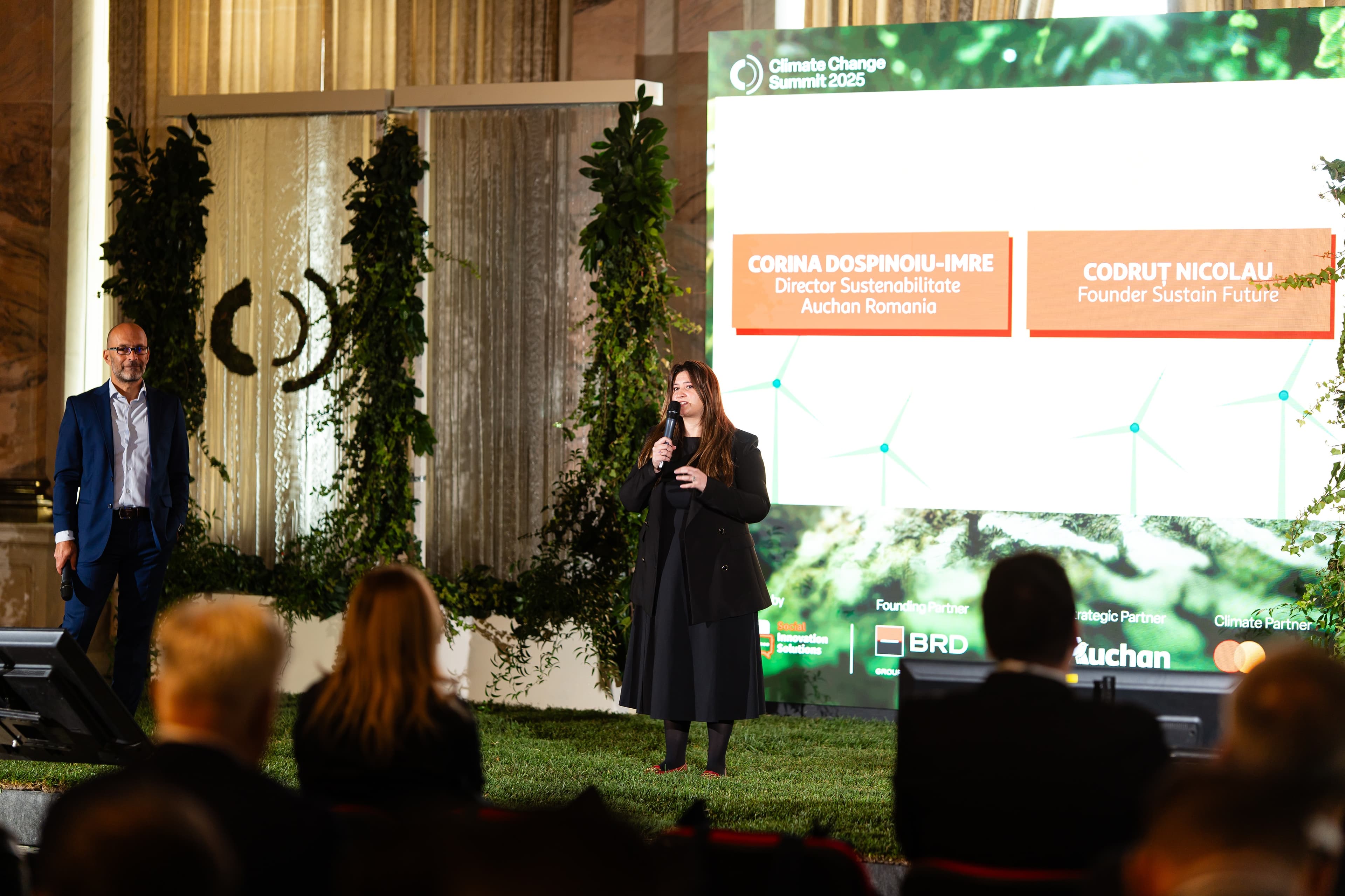
At the second edition of the Climate Supplier Event, organized under the aegis of the Climate Change Summit, the company brought together over 100 producers and suppliers to begin measuring emissions and to intensify decarbonization actions, strengthening their resilience and competitiveness. We speak with Corina Dospinoiu-Imre, Sustainability Director of Auchan Romania, about the importance of this effort, the concrete steps taken and what a food chain prepared for the future means.


What prompted you to organize a new edition of the Climate Supplier Event and what were the main objectives of this meeting? 

Corina Dospinoiu-Imre: We considered it the right moment to accelerate collaboration with our suppliers. The main objective of this edition was to create a framework for dialogue through which we could discover what the opportunities are for streamlining business processes, what we stand to gain from an economic perspective, and to understand together how we measure the carbon footprint, what the reduction levers are and how we can support our partners to adopt sustainable practices through education and financing programs. By bringing together over 100 suppliers at the Climate Supplier Event, we aim to generate a transformation at the supply chain level, which has the effect of a quantifiable reduction of carbon emissions in the near future.


Why do you consider that this event is relevant not only for Auchan suppliers, but for the entire food industry in Romania?

Corina Dospinoiu-Imre: A major event such as the Climate Supplier Event is relevant both for Auchan suppliers and for the entire food industry in Romania, because food chains function as an interconnected system. If only one retailer or a few producers act, the impact remains limited. Agriculture, processing, logistics, packaging, all these elements contribute to generating emissions, costs and competitiveness. This is why our event is about how the entire sector can become more efficient, more sustainable and more resilient in the face of climate change.


How does Auchan support local suppliers in the transition to more sustainable business models?

Corina Dospinoiu-Imre: We launched the Partners for Decarbonization program in which we collaborate directly with suppliers to measure their emissions and to develop plans to reduce them. Also, to support Auchan suppliers, for the first time, through the partnership with BRD – Groupe Société Générale, the bank offers our suppliers access to an extended range of sustainable financing options, from which they can choose depending on the specifics of their company’s activity. By accessing these instruments, companies can quickly reduce operational costs related to energy, logistics and resources, and in time they strengthen their competitiveness and their capacity to manage climate risks. In addition, a responsible approach visibly increases their credibility and opens easier access to financing that requires clear sustainability criteria.

In parallel, during the event a workshop took place through which suppliers chose several levers for optimizing and streamlining their own businesses, which will result in reducing emissions as well as costs. We aim in the immediate period ahead to take contractual commitments with our suppliers regarding emission measurement, the creation of decarbonization plans and tracking constant progress. What remains an important stake for us is to continue finding solutions through which we can support our suppliers in this endeavor.


Why do you say that decarbonization is not only an environmental issue, but also one of economic competitiveness? 

Corina Dospinoiu-Imre: Reducing emissions is not only an expense, but also a tool for increasing efficiency. For example, optimizing the logistics chain, reducing food waste, improving energy efficiency and reducing packaging translate directly into lower costs, which leads to better profitability, and the effect of these measures also impacts the reduction of carbon emissions. Thus, decarbonization becomes a growth engine and not an environmental obligation.


How can Romanian farmers and processors turn sustainability into a real market advantage?

Corina Dospinoiu-Imre: Sustainability becomes a real competitive advantage for Romanian farmers and processors through the rigorous optimization of resources, which leads to a significant reduction of operational costs. Adopting practices such as precision agriculture, which optimizes the use of water, fertilizers and pesticides, and integrating renewable energy sources (solar, biomass) in farms and processing units minimize the carbon footprint and expenses. Efficient management of water and waste also contributes to lowering long-term costs, turning sustainability investments into substantial savings.

Moreover, applying the principles of the circular economy allows the intelligent valorization of agricultural by-products and processing waste. These can be transformed into new revenue streams, such as compost or biogas, while reducing disposal costs. This approach not only reduces waste but also creates opportunities for market differentiation, adding value to the entire production cycle and responding to the growing demand for responsible products and processes.

These sustainability efforts also open access to crucial strategic financing. Companies with a strong sustainability profile that integrate ESG (Environmental, Social, Governance) criteria become attractive from an investment perspective. Thus, they benefit from easier access to European funds and banking financing under better conditions than companies that do not prioritize sustainability.


What does a food chain prepared for the future mean, in your view?

Corina Dospinoiu-Imre: For us, a food chain prepared for the future is one in which every link, from farmer, processor and retailer to logistics, adopts clear sustainability objectives, uses technology and data to improve performance, and creates value together for the end consumer. In essence, we aim to create a strong ecosystem that mitigates its risks, whether they are climate-related or linked to current and potential high energy or raw material costs, by transforming business models.

I wish for all of us a chain in which we reduce waste and excessive energy consumption, optimize transport and in which quality and resilience become a standard. In this way, we will be prepared not only for climate challenges but also for consumer and global market requirements.

Through projects such as the Climate Supplier Event and dedicated partnerships, Auchan Romania encourages the integration of sustainability principles throughout the supply chain as part of a joint effort for a responsible transition. In this sense, the company reaffirms its ambition to build a Romanian model of responsible sourcing, capable of generating a positive impact for nature and communities and, at the same time, supporting economic growth.


*This interview was edited by Romania Insider for Auchan Romania.


Normal
Business Views

Decarbonization, a new engine of economic competitiveness - Auchan Romania contributes to accelerating the transition of the agri-food chain through the Climate Supplier Event

03 December 2025

In the context in which agri-food systems are responsible for almost one third of global greenhouse gas emissions, Auchan Romania assumes an active role in the transition of its supply chain toward a more sustainable model.

At the second edition of the Climate Supplier Event, organized under the aegis of the Climate Change Summit, the company brought together over 100 producers and suppliers to begin measuring emissions and to intensify decarbonization actions, strengthening their resilience and competitiveness. We speak with Corina Dospinoiu-Imre, Sustainability Director of Auchan Romania, about the importance of this effort, the concrete steps taken and what a food chain prepared for the future means.


What prompted you to organize a new edition of the Climate Supplier Event and what were the main objectives of this meeting? 

Corina Dospinoiu-Imre: We considered it the right moment to accelerate collaboration with our suppliers. The main objective of this edition was to create a framework for dialogue through which we could discover what the opportunities are for streamlining business processes, what we stand to gain from an economic perspective, and to understand together how we measure the carbon footprint, what the reduction levers are and how we can support our partners to adopt sustainable practices through education and financing programs. By bringing together over 100 suppliers at the Climate Supplier Event, we aim to generate a transformation at the supply chain level, which has the effect of a quantifiable reduction of carbon emissions in the near future.


Why do you consider that this event is relevant not only for Auchan suppliers, but for the entire food industry in Romania?

Corina Dospinoiu-Imre: A major event such as the Climate Supplier Event is relevant both for Auchan suppliers and for the entire food industry in Romania, because food chains function as an interconnected system. If only one retailer or a few producers act, the impact remains limited. Agriculture, processing, logistics, packaging, all these elements contribute to generating emissions, costs and competitiveness. This is why our event is about how the entire sector can become more efficient, more sustainable and more resilient in the face of climate change.


How does Auchan support local suppliers in the transition to more sustainable business models?

Corina Dospinoiu-Imre: We launched the Partners for Decarbonization program in which we collaborate directly with suppliers to measure their emissions and to develop plans to reduce them. Also, to support Auchan suppliers, for the first time, through the partnership with BRD – Groupe Société Générale, the bank offers our suppliers access to an extended range of sustainable financing options, from which they can choose depending on the specifics of their company’s activity. By accessing these instruments, companies can quickly reduce operational costs related to energy, logistics and resources, and in time they strengthen their competitiveness and their capacity to manage climate risks. In addition, a responsible approach visibly increases their credibility and opens easier access to financing that requires clear sustainability criteria.

In parallel, during the event a workshop took place through which suppliers chose several levers for optimizing and streamlining their own businesses, which will result in reducing emissions as well as costs. We aim in the immediate period ahead to take contractual commitments with our suppliers regarding emission measurement, the creation of decarbonization plans and tracking constant progress. What remains an important stake for us is to continue finding solutions through which we can support our suppliers in this endeavor.


Why do you say that decarbonization is not only an environmental issue, but also one of economic competitiveness? 

Corina Dospinoiu-Imre: Reducing emissions is not only an expense, but also a tool for increasing efficiency. For example, optimizing the logistics chain, reducing food waste, improving energy efficiency and reducing packaging translate directly into lower costs, which leads to better profitability, and the effect of these measures also impacts the reduction of carbon emissions. Thus, decarbonization becomes a growth engine and not an environmental obligation.


How can Romanian farmers and processors turn sustainability into a real market advantage?

Corina Dospinoiu-Imre: Sustainability becomes a real competitive advantage for Romanian farmers and processors through the rigorous optimization of resources, which leads to a significant reduction of operational costs. Adopting practices such as precision agriculture, which optimizes the use of water, fertilizers and pesticides, and integrating renewable energy sources (solar, biomass) in farms and processing units minimize the carbon footprint and expenses. Efficient management of water and waste also contributes to lowering long-term costs, turning sustainability investments into substantial savings.

Moreover, applying the principles of the circular economy allows the intelligent valorization of agricultural by-products and processing waste. These can be transformed into new revenue streams, such as compost or biogas, while reducing disposal costs. This approach not only reduces waste but also creates opportunities for market differentiation, adding value to the entire production cycle and responding to the growing demand for responsible products and processes.

These sustainability efforts also open access to crucial strategic financing. Companies with a strong sustainability profile that integrate ESG (Environmental, Social, Governance) criteria become attractive from an investment perspective. Thus, they benefit from easier access to European funds and banking financing under better conditions than companies that do not prioritize sustainability.


What does a food chain prepared for the future mean, in your view?

Corina Dospinoiu-Imre: For us, a food chain prepared for the future is one in which every link, from farmer, processor and retailer to logistics, adopts clear sustainability objectives, uses technology and data to improve performance, and creates value together for the end consumer. In essence, we aim to create a strong ecosystem that mitigates its risks, whether they are climate-related or linked to current and potential high energy or raw material costs, by transforming business models.

I wish for all of us a chain in which we reduce waste and excessive energy consumption, optimize transport and in which quality and resilience become a standard. In this way, we will be prepared not only for climate challenges but also for consumer and global market requirements.

Through projects such as the Climate Supplier Event and dedicated partnerships, Auchan Romania encourages the integration of sustainability principles throughout the supply chain as part of a joint effort for a responsible transition. In this sense, the company reaffirms its ambition to build a Romanian model of responsible sourcing, capable of generating a positive impact for nature and communities and, at the same time, supporting economic growth.


*This interview was edited by Romania Insider for Auchan Romania.


Normal

Romania Insider Free Newsletters