Romanian PM Ilie Bolojan’s government falls after losing no-confidence vote
The Romanian government, headed by Liberal (PNL) prime minister Ilie Bolojan, has collapsed after losing a no-confidence vote in Parliament on Tuesday, May 5. The motion gathered 281 votes in favor, well above the 233 votes required.
The government will now continue in an interim capacity, with limited powers, until a new executive is formed.

The Ilie Bolojan government came to power roughly 10 months ago, backed by a so-called pro-European ruling coalition made up of the Social Democratic Party (PSD), PNL, Save Romania Union (USR), and the Democratic Union of Hungarians in Romania (UDMR), amid a rise of the far-right side in Romania. However, PSD has repeatedly clashed with the Liberal prime minister over the fiscal measures, and finally ended up withdrawing its support for the PM and exiting the government.
The no-confidence motion, initially signed by more than 250 MPs, was submitted last week by members of the former ruling partner PSD and the far-right Alliance for the Union of Romanians (AUR), and formally presented in Parliament by AUR Senate leader Petrișor Peiu.
The text focuses heavily on prime minister Ilie Bolojan, accusing him of planning to list shares of state-owned companies on the stock exchange, failing to implement reforms, and not reducing public spending in 2025, despite having taken office only midway through last year.
Ilie Bolojan: Motion is “false, cynical and artificial”
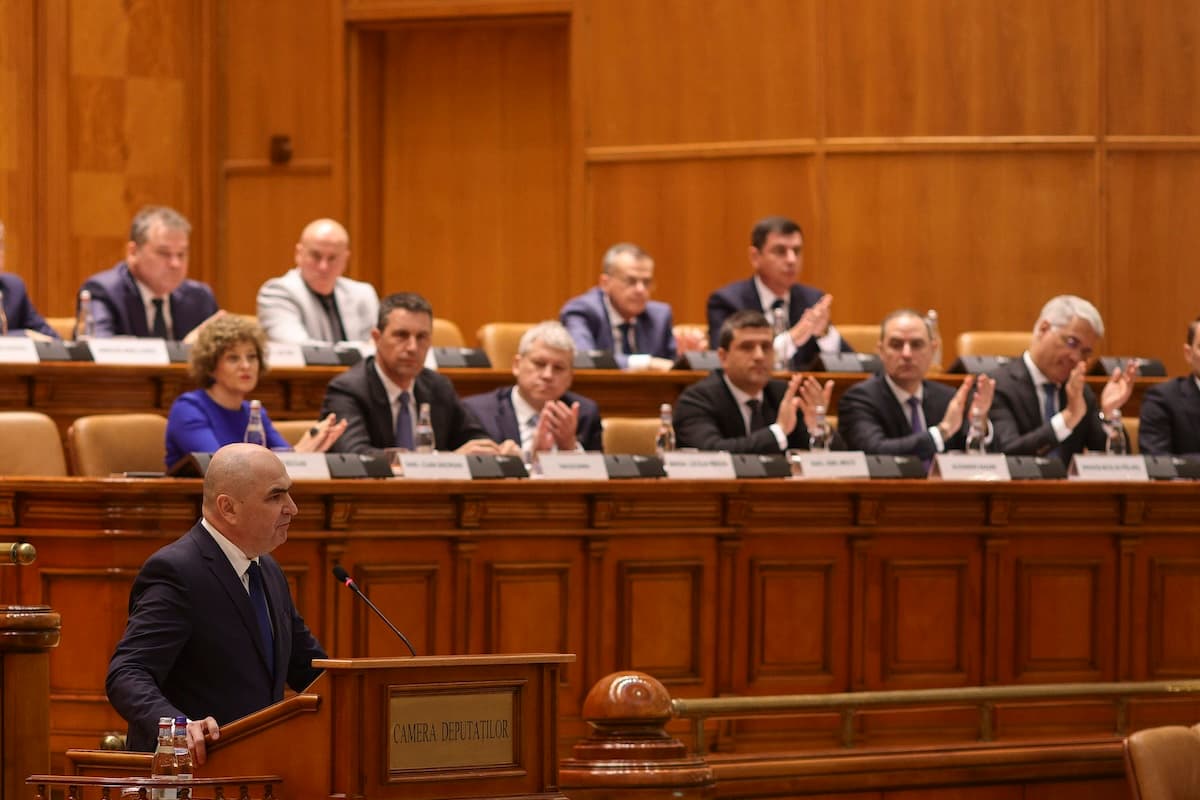
Speaking in Parliament after the motion was read, Ilie Bolojan strongly rejected the accusations, calling the initiative “false, cynical and artificial” and arguing that it contains a “logical fracture,” especially given PSD’s recent role in government.
“If the motion is true, where have you been until now? Haven’t you been in government? If it’s not true, I would be ashamed to sign such a thing,” Bolojan said, as quoted by Biziday.ro.
He stressed that he took office in a difficult context and chose to implement necessary reforms rather than popular ones. “Ten months ago, I accepted this position in a difficult situation to do what is necessary, not what is popular,” he said.
The prime minister pointed to Romania’s 9.3% budget deficit in 2024, the highest in the EU, as a key challenge inherited from previous governments. “I didn’t create it, I found it, and I couldn’t hide it,” he said, adding that earlier administrations had postponed reforms while international partners tolerated delays only up to a point.
Bolojan also accused some of the motion’s signatories of knowingly ignoring the fiscal situation they had helped create. “Some who signed this motion knew what they left behind. They knew the figures because they were in government,” he said.
Defending his record, the prime minister highlighted measures such as cutting public spending, reducing bonuses, and initiating long-delayed reforms, including changes to magistrates’ pensions. He argued that these steps triggered backlash from local political figures accustomed to using public funds without accountability.
“We started correcting injustices and reducing state spending, and that upset local barons who could no longer treat the state budget as their personal piggy bank,” he said.
Further on, Ilie Bolojan also addressed criticism over austerity measures, including tax increases and social contributions, accusing opponents of hypocrisy. “Didn’t we decide these together? Didn’t we know this? How hypocritical can you be?” he said.
He acknowledged the economic burden on citizens but argued that fiscal correction inevitably comes with costs. “There has never been a deficit correction anywhere in the world without economic constraints and effort,” he said.
The prime minister warned that the motion could have serious consequences for Romania’s stability and credibility. “We risk losing credibility, losing EU funds, and going back to where we started,” he said.
“I may leave, but the problems remain. They don’t leave with me,” Ilie Bolojan added, warning that political gains could come at the expense of citizens.
He also accused the initiators of the no-confidence motion of having no plan moving forward, regarding a new government or a new direction.
What happens next
Now adopted, the motion automatically withdraws Parliament’s confidence in the government, leading to its dismissal. The cabinet will remain in an interim capacity, with limited powers, until a new government is formed.
President Nicușor Dan will subsequently hold consultations with parliamentary parties and nominate a new prime minister, who must seek a vote of confidence from Parliament.
Romania has seen six governments fall through no-confidence votes in the post-communist era, including those led by Emil Boc (2009), Mihai Răzvan Ungureanu (2012), Sorin Grindeanu (2017), Viorica Dăncilă (2019), Ludovic Orban (2020), and Florin Cîțu (2021).
How the no-confidence motion came about
The political turmoil escalated on April 21, when PSD voted almost unanimously (97.7%) to withdraw its political support for prime minister Ilie Bolojan. “When 97.7% of colleagues tell you that Ilie Bolojan must go home, there is no room for anything else. I have understood this, and I assure you that, in line with your vote, we will act in the coming days,” PSD leader Sorin Grindeanu said after the internal vote.
The Social Democrats then issued an ultimatum to the prime minister: resign or face the withdrawal of all PSD ministers from the government. Ilie Bolojan refused to step down, and two days later, on April 23, the PSD ministers and the party’s deputy prime minister resigned.
Following these developments, PSD joined forces with AUR and PACE – First Romania to file the no-confidence motion. In the motion text, the signatories accused the prime minister of “destroying the economy,” “impoverishing the population,” and planning a “fraudulent sale of state assets.”
irina.marica@romania-insider.com
(Photo source: Inquam Photos/Octav Ganea)