The Last Transhumance: Romanian filmmaker Dragoş Lumpan’s journey to bring a disappearing way of life to screen
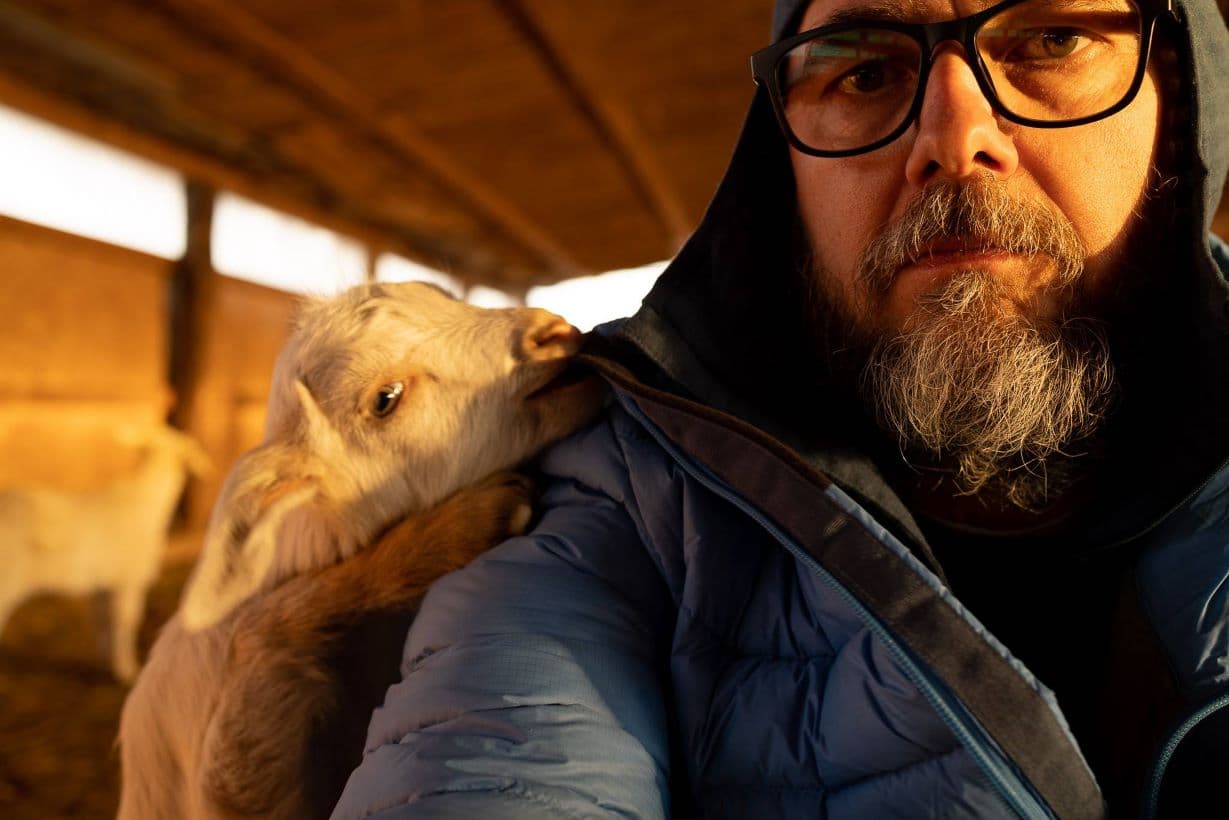
Twenty years ago, Dragoş Lumpan began to document the age-old practice of transhumance, the seasonal movement of shepherds with their livestock between mountain and lowland pastures. He travelled for 50,000 kilometers across six countries - Romania, Turkey, Greece, Italy, Albania, and Wales - to capture in photography and film what is now a fading way of life. As his documentary The Last Transhumance reaches local cinemas, he looks back on his work to bring the project to the screen.
Filmmaker and photographer Dragoş Lumpan likens the work on the film to a personal transhumance: a series of peaks and valleys, of highs and lows. He learned along the way what the post-production of a documentary entailed. Had he known the costs involved, he might not have started it. Nonetheless, after a journey that brought him “friends, joy, and good cheese,” he says he would “do it again twenty times over if it were possible.”
The Last Transhumance began as a photography project, started at his own expense in 2007. Funding received in 2010 allowed him to exhibit the photographs he had taken, but also to expand the project to film. By then, backpack-sized filming equipment had become available, making it possible to achieve good results in ways that were not possible a few years earlier.
He accompanied shepherds on their journey, witnessed a different way of measuring time and space, and saw families give up the practice, part of a pervasive series of shifts. “We adapt to the changes around us, and the shepherds adapt as well. They’re the ones who have to adapt even faster than we do,” he explains.
The documentary entered the festival circuit three years ago and has since been awarded at CineEco 2023 - 29th Serra da Estrela International Environmental Film Festival (Seia, Portugal), Festival Pastoralismes et Grands Espaces (Grenoble, France), Alpin Mountain Film Festival (Brașov, Romania), Baikal Film Festival People and Environment (Irkutsk, Siberia), ETNOFILM International Film Festival (Bratislava, Slovakia), and PASTURAS - International Film Festival on Pastoralism and Transhumance (Malargüe, Argentina).
The next screenings of The Last Transhumance, followed by Q&A sessions, are in Timișoara (Cinema Studio – May 7), Arad (Cinema Arta – May 8), and Bucharest (Romanian Peasant Museum Cinema – May 12). Updates on the screenings are available here.
More on the time he spent with the shepherds, the process to bring the film to its final form, and some of the stories left out in the interview below.
Did you set about knowing that you would be documenting a disappearing custom or is that something that became clear as you worked on the project?
On the one hand, I had a hunch that it would become less common. I didn’t imagine it would disappear so quickly, especially while I was working with a particular family, for example, that that family would give it up. That was around 2007–2008.
In 2010, when I expanded the project, I found another family of shepherds who were practicing transhumance, or ‘taking to the road,’ as they call it, and they gave it up as well in the end. And certainly not because I was photographing or filming them, but simply because that is how things go, this is how society is. There is no criticism here; it’s just an observation.
With the integration into the European Union, I think we all expected certain changes, some good, perhaps others we might consider less so, but they are part of the natural course of things. So, back then, I had a sense that something would change, but certainly not this quickly, not so dramatically or radically or visibly.
What did you know about transhumance when you started the project? How did you conceive it initially? What did you discover along the way?
I certainly knew very little. I had heard of shepherds who set out on a long journey. There are several definitions of transhumance, but the broadest and most common one, which I also adopted, is that journey of several hundred kilometers, made over more than two or three weeks, or even more.
I had never met such shepherds, I didn’t know them, I had only heard of them. In fact, I started looking for them in 2006, when I came across such a family or rather, a shepherd who traveled with his family on this journey, but at that time it seemed impossible for us to actually meet. Communication broke down. It was too complicated. His son had a mobile phone, but usually there was no signal. His sheepfold was about two hours away on foot, and he pointed vaguely to left and right, along paths, so I couldn’t have found them again.
It was only in 2007 that I found the first family of shepherds who agreed to let me come along with them on the road. We exchanged phone numbers, but then they backed out, not from the journey, but from the agreement to be photographed. They were helped, to put it mildly, to turn me down. But, quite ironically, I eventually ended up again with that very first family of shepherds.
I used to think I would go four times over the course of a year. That is how it looked to me from my desk in the city. We have four seasons, I thought I would go once per season, and that’s that.
At the time, I was also collaborating with National Geographic Romania. I pitched the project to them, and they found it very beautiful, interesting, but when they heard I would have to go four times over the course of a year, well… it became complicated. National Geographic Romania was a wonderful magazine, and it also folded. So, I understood them.
But it was clear to me that something was changing. So, in 2007 I started this project on my own dime. And I went with them not four times, but twelve. I might have gone even more, but they told me they were giving up the journey. This first family, the one that gave the project its title, The Last Transhumance, I photographed them as they were making that final journey.
Because by 2009 I had quite a lot of photographs, I thought I could put together an album and an exhibition, or either an album or an exhibition. That year, there was a crisis somewhere on Wall Street. I never understood the connection between Wall Street and what was happening here; the idea of a global village wasn’t as obvious then, at least not to me, and I couldn’t find any support to produce the exhibition and the album, which I could no longer afford out of my own pocket.
I knocked on various doors: calls for entries, projects, applications. Nothing. Everything was closed to this project in 2009. However, in 2010, I found funding that allowed me not only to exhibit what I had done, but also to expand it.
That’s when I expanded the project onto film. On the one hand, I had finished a degree in cinematography; on the other, technology had emerged that didn't exist in 2006–2007: filming equipment you could fit in a backpack and get decent results with.
In Romania, I found another family - as I said, they too eventually gave up the journey- and I expanded the project to five other countries: Albania, Greece, Turkey, Italy, and Wales. Of course, transhumance isn’t practiced only in these countries, but I visited shepherds there. And naturally, I learned a great deal, both about the shepherds in Romania and about those in the other countries I mentioned.
So, the transition to a filmed project was made possible thanks to that funding you received.
Yes, exactly. Otherwise, it would have been impossible. Nowadays, of course, it may seem strange somehow. Our mindset changes with the times, which is natural. We forget what things were like 10 or 20 years ago. All sorts of nostalgic people appear, glorifying a terrible period in in our country’s history. I can understand these things. […] But beyond this natural tendency we have to idealize an illo tempore, an almost mythical time, let’s be serious: things weren’t actually that great in the past, back in the day.
To come back to my point: about 15 years ago, it wasn’t that easy for us here in Romania to buy a camera that could also film very well, along with the necessary accessories. It was a greater financial burden than it is now. Not that these cameras are very cheap today, but on the one hand they’re much better, and on the other, our purchasing power has increased. The most obvious sign are the delivery workers: 15 or 16 years ago, they simply didn’t exist on the streets of Romania. There weren’t so many people coming from other countries to work in all kinds of fields, from restaurants to construction and so on. Our purchasing power has increased significantly. Back then, I couldn't have afforded that kind of equipment.
Nor could I have afforded those trips. Today, it’s much easier to travel. Borders have opened up far more than they were 20-something years ago, and financially it’s much cheaper as well. Hearing a friend say, ‘Hang on, I’m just coming back from Japan, or Australia, or Canada,’ has become something completely normal.

How long did the actual filming take? When did filming wrap?
I didn’t asses the photography period of 2007–2008 separately from the second phase of the project, where the bulk of the work was done in 2010–2011. Overall, I spent about half a year out in the field, day and night, across these six countries.
Very roughly speaking, the 2010–2011 stretch probably lasted around four months, with a bit more in 2012, and in the following years I only filmed very little. By then, I was already trying to edit and move into post-production, which, likely due first and foremost to my lack of experience turned out to be more complicated and a more difficult process for me, but one that I somehow enjoyed. I learned from my mistakes; I learned as I went along. I allowed myself - I can say that now, of course - to make mistakes, but all in all, I think things turned out better this way.
On the project website, there’s a phrase that struck me as poetic sounding, about how the shepherds' journey “measures time and space with tools that we have forgotten.” Could you tell us a bit more about that?
While I was traveling with the shepherds, I kept a journal. When we entered post-production for the film, I went back through it. That journal had been written in various places, or spoken and recorded on a device, so it was full of stumbles. To make it work for the film, I asked a friend of mine who has a much more poetic way with words than I do, Dani Macarie, to polish the journal a bit, specifically the parts I wanted to include in the documentary. Based on my text that he constructed this, indeed, poetic sentence.
He’s an old friend, not just of mine but of the Transhumance project as well. Yesterday [e.n. last week] I met him to record a radio spot to promote the film. While he was waiting for his Uber - speaking of how things have changed in twenty years - we chatted for a bit. Completely by chance, he mentioned a talk he'd seen about how language shapes thought. There is a tribe in Australia or New Zealand that doesn’t use terms like “left,” “right,” “up,” or “down.” They have always used cardinal directions, like north or southeast; everything relates to those points, something we no longer possess. Thinking along those lines, I think we can better understand this sentence, which may seem poetic, but actually describes a reality. That sentence appears in the film, along with two or three other things that might seem inflated for the sake of poetry or the extraordinary, but that is the reality.
For instance, I walked with the shepherds at night as well. For various reasons explained in the film, they have to travel at night; it’s not because they enjoy it or because they are insomniacs. There were moments when I could see absolutely nothing where we were walking. We weren't on roads or paths; we were crossing fields and hills. Naturally, the next day I would ask them, “How do you know where to go? How do you reach the new destination?”
Nowadays, we have GPS and final destinations, but for them, a GPS is out of the question because there are no trails where they go; it would be useless. They obviously didn't use one; they simply know those things. So that, too, is a tool we’ve lost. We don’t orient ourselves by cardinal points anymore. We don't say “move a bit to the northeast,” we say “move a bit to the right,” don't we? It’s the same with their pace, and the same with their time; it is a different kind of time. Their time is much closer to natural time, let's call it, the time of nature, of day and night, of the seasons.
Of course, they use modern objects. Sure, they talk to each other on mobile phones. But when I would speak with them after I finished the project, they would often ask me how the weather was in Bucharest, where I live. To me, it had almost no relevance. In a city, you can wear almost the same clothes all year round. We have roughly the same indoor temperatures. Around 20 degrees. You get in a car, it’s about the same. You take a bus, it’s the same. So the weather doesn’t really matter to us. For them, it is essential. Did it rain? Did it not? Do the sheep have something to eat, something to drink? As mundane as these things sound when explained, they are in fact, quite striking. Those are the tools we have forgotten. For us, the weather doesn't really matter anymore; it’s just small talk.

How did you handle the communication in so many countries?
Every time I arrived somewhere for the first time, someone, let’s call them a fixer, would take me to the family I was going to stay with, to that specific place. They would explain to the shepherds who I was and what I was doing there, obviously in their language. And they would stay with me for another hour or two. In Turkey, it happened that the fixer, who eventually became a friend, stayed overnight, one night. This fixer in Turkey, for example, is actually a high school principal; being a fixer isn’t his job, even though he’d be extraordinary at it. Still, he couldn’t stay very long; it was not an environment he was used to. And in a way, it was actually very good that the fixers or the people helping me didn’t stay too long, because, obviously, since I spoke English with them, I would have been tempted to spend at least part of the time talking to them.
Instead, I picked up very basic things like “the meal is ready, come eat,” or “now we go up that hill,” or “we’re going over there.” I understood mostly through gestures, of course. That turned out to be a good thing because they knew perfectly well that I was filming them, recording what they were saying, but they were comfortable talking amongst themselves, including talking about me. I only found out what they were saying much later, during post-production, when various friends translated what the shepherds had been saying. I had some extraordinary surprises; I laughed heartily and, naturally, I included those bits in the film. I figured if I laughed, the audience might enjoy them too.
Were there communities that were more open, easier to approach than others? Were there any significant differences, if any?
In the current climate, this might sound strange. Being politically correct and the political agenda are one thing, but how things actually happen sometimes shows us something a bit different. In Turkey and among the Muslim communities in Albania, I felt a sense of hospitality that was far beyond the kind of hospitality we ourselves also have. Of course, we like to say that we are very hospitable, but it depends who we compare ourselves to. If we compare ourselves, in the case of this project, to Wales, or to the UK in general, then yes, we are very hospitable. Not that they treated me badly, quite the contrary, they were open, kind, and friendly. When I was present, they spoke in English, and among themselves in Welsh. But otherwise, those in the communities, or let’s say, the Muslim areas, have a completely different level of hospitality. It is a way of being hospitable that goes far beyond what we Europeans might imagine. This is also in a context where we unfortunately have certain superiority complexes, completely unfounded, in my opinion, having traveled at least somewhat in those regions. And I say this as someone who tries to stay close to Orthodox Christianity, let’s say. I am not saying for a moment that I’ve converted to Islam. No, I haven’t converted. But the Muslim world, at least when it comes to hospitality, operates on a completely different level from what we generally know.
You told the story in both photography and film. What changed when you transitioned from one medium to the other?
For me, almost nothing. When I was out in the field, yes, there were moments when I was filming and moments when I was taking photographs, but I didn’t feel like I was changing anything radically. You press the buttons a bit differently, but that is about it.
The real changes came in the second stage. For better or worse, I already knew what it meant to select photos, to edit them, and what follows in order to put together an exhibition or a photo album. Whereas with filming, I had somehow held onto the obviously false impression that you have the raw footage, you go into editing, talk to the editor for a bit, and that’s it.
That is roughly how it went, except it took me about ten years, during which I had to learn what I had not learned about editing, because I often skipped the editing classes. Since I was studying cinematography, editing wasn’t interesting for me at the time; it seemed boring. A very big mistake. Go to your editing classes.
In 2019, you had a feedback questionnaire regarding the film. How much did you change as a result of it?
I couldn't tell you. I have to admit that, precisely because of my lack of experience in post-production, I first had to run a couple of crowdfunding campaigns. Then I had a short-film draft, then a feature-length draft. Over the course of these nearly ten years, I did occasionally take into account what people told me, but to truly answer that question, I would have to go back to those questionnaires and look at their responses.
However, I can give you another example that I do remember. At one point, this feature-length draft was screened at a festival I really loved - which, unfortunately, has since folded - called Pelicam. It was an environmental film festival, and the organizers invited me to bring the draft; to my surprise, they even screened it on the opening night. It was almost too much of an honor for me, but overall, it went well. I also saw other documentaries there and had meetings with various acquaintances.
One of them, a photographer from Turkey, had brought his mother along, and he told me, “You know, my mother cried twice.” That wasn’t the intention of the film, but I figured if she cried, I should ask which moments moved her. To describe one of them, he said, “You know, my mother isn’t religious, she doesn’t really go to church, but at one point in the film there’s a monk who is the son of a shepherd and who used to herd sheep himself. And he talks about how he remembers that time, when he was a child and was droving the sheep. That’s when my mother cried.”
I have to admit that until then, I was planning to cut that moment from the film. I thought people wouldn't understand it because it wasn't explained well enough. I couldn’t include a very long interview with a monk because it didn't fit the film; the narrative thread was elsewhere. On the other hand, the fragment that remained felt too short, and I thought people wouldn't get it. Well, once someone tells you their mother cried at that moment, especially someone with no connection to that world, you keep it. So, yes, at least partially and from time to time, I did take feedback and opinions into account.
I can’t take all feedback into account. Let me give you another example: I published the photo album in 2011 and brought it to the shepherds, including those in other countries. Naturally, while they were looking at the album, I was watching them look at it. Their comments were incredible to me; they were noticing completely different things in the album than I did. For instance, they were looking at the sheep's tail to see if it was a meat breed or a dairy breed, or at the grass, what kind of grass it was, and if it was good for the sheep or not.
I had never noticed those things, and even now I wouldn’t be able to point them out again with the same precision, the same attention that they had. It’s the same with the film. Now I’m starting to get feedback, and there are people who see things I have never noticed. I can’t take all feedback into account. You can imagine that I didn’t select photographs based on the sheep’s tail or the beauty of the grass. So, some feedback I followed, some I didn’t.

Of all the footage you shot, were there many things you left out? Were there other stories you could have told?
Absolutely. There are over 100 hours of footage, and the film is 90 minutes long. So, about 99 hours were left aside. Yes, you could easily make another film right now, an entirely different one that has nothing to do with this one. For instance, a film about the shepherds from Mărginimea Sibiului, who, about 100 years ago, went to and more or less settled in Crimea and the southern Caucasus. I was lucky enough to interview their descendants, grandchildren and great-grandchildren, who knew all these family stories. They seem incredible today, considering all the changes since then. They lived very well until the Bolshevik Revolution came, and, in the end, everything eventually went south for them. Whoever could, escaped.
There are stories of those who managed to return; in one case, a family's child had been left behind, and the woman said, “Alright, I’m going back." She went with a lot of gold and brought her child home. This has nothing to do with the film I made. I didn't include such stories because I didn't really have a place for them. They didn't connect with the narrative. Besides, they weren't practicing transhumance anymore; once they reached those near-infinite steppes, they no longer needed to make the trek, the commute, so to speak, between Crimea and Mărginimea Sibiului.
There were other stories that I didn’t include… The film is generally screened in cities, to an urbanized mindset, let’s say. We can’t always understand certain, let’s call them wild, moments that they face, and to which they have to respond swiftly, firmly, clearly. It’s not that people wouldn’t understand because of their intelligence; it’s strictly about the mindset. Here we are used to a certain mentality, that of a city dweller. When you are out on the road among wolves, bears, and the weather isn’t always good, idyllic, poetic, as in ‘on a gentle hillside’, one might have to behave a bit differently. As I was saying earlier, if your temperature is constant, you might not understand that others live at different temperatures.
In an interview I did a while ago with an Italian photographer who shot shepherds in Italy in the late 1970s, he told me something very beautiful: shepherds used to be wild. Well, maybe today they are less so, but to be a true shepherd, one has to be a bit wild. And he is right. On the other hand, you can only show that wildness partially; otherwise, I risk portraying them in a light that isn't true. Beyond those forceful, rougher moments, they are certainly sensitive people who have their own gentle side. It wouldn't be right to cast them in a bad light, which is not necessarily a bad light, just one that we misunderstand.
Now that the documentary is being screened, what would you like the audience to take away from it?
Last night [e.n. April 23], after the first screening for a general audience, outside the festival circuit, people seemed to resonate well with it. I haven't managed to get enough feedback to understand how each person resonates with it, and I probably never will. But one acquaintance of mine, a former colleague at the Film School, was a bit upset that the film ends with the conclusion of transhumance, with the end of that way of life. Indeed, it’s not exactly a comedy, even if people laugh from time to time. It’s a documentary. I didn’t film actors for this project, and yes, the families in Romania, for instance, both the first and the second, have given up the journey.
So, what I wouldn’t want the audience to take away: I wouldn’t want them to leave with a sense of disaster. It isn't something I want to announce, that we should be sad that the shepherds no longer go on the journey. It’s not necessarily a joy or the best news, but it comes with the changes we are not just witnessing, but are a part of. We are participants in these shifts, and that’s normal. We adapt to the changes around us, and the shepherds adapt as well. They’re the ones who have to adapt even faster than we do. We’re all part of the game. That’s how the game is played now.
(All photos courtesy of Dragoş Lumpan)
*This interview was conducted in Romanian and translated by Romania Insider