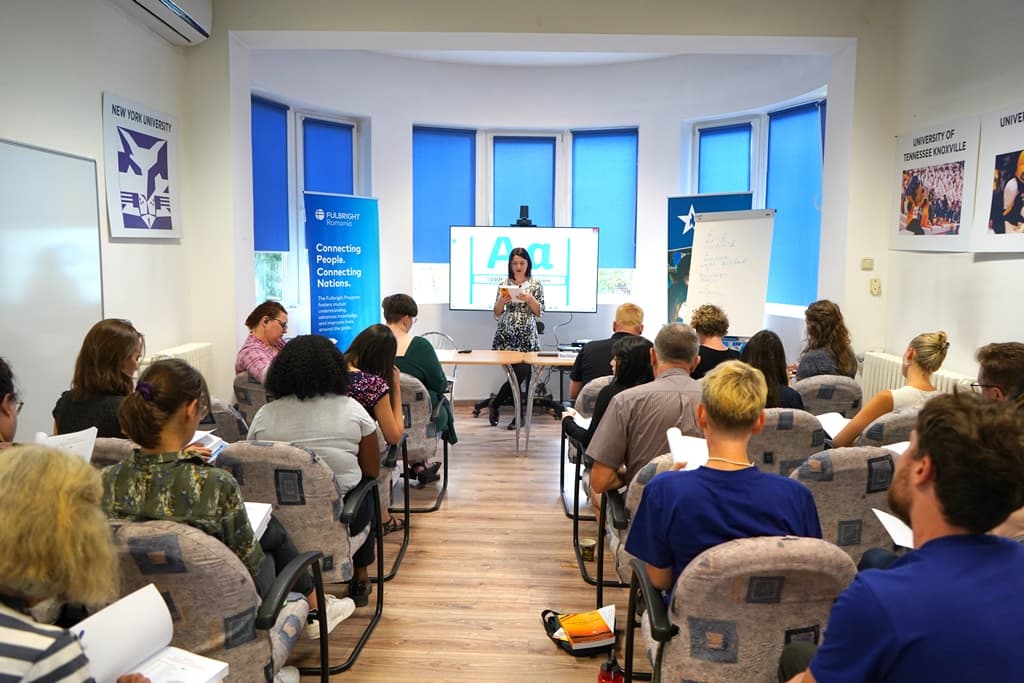
From language to integration: How ROLANG School teaches Romanian to the world
Dr. Mona Pologea, founder of ROLANG School and a seasoned linguist, shares insights into why the Romanian language is increasingly seen as a valuable professional and cultural asset. She discusses how Romania’s economic development,…
Romania Insider · with Dr. Mona Pologea, Founder, ROLANG School
· Updated · 7 min read
Dr. Mona Pologea, founder of ROLANG School and a seasoned linguist, shares insights into why the Romanian language is increasingly seen as a valuable professional and cultural asset. She discusses how Romania’s economic development, particularly in IT and business, has reshaped the motivations of language learners, and how mastering Romanian can be a decisive factor in professional success and everyday integration.
As Romania continues to attract international professionals, entrepreneurs, and digital nomads, interest in learning the Romanian language is steadily growing. At the intersection of language, culture, and integration stands ROLANG School, a Bucharest-based institution dedicated exclusively to teaching Romanian as a foreign language. Founded in 2009, ROLANG has become a reference point for foreigners seeking not only linguistic proficiency, but also a deeper understanding of Romanian society and history. Dr. Mona Pologea also reflects on how ROLANG has evolved in recent years, from relocating to a larger, central space in Bucharest to expanding its online offerings, which now account for more than half of the school’s courses. The conversation touches on changes in student demographics, including a rise in learners from Asia and the school’s active involvement in supporting Ukrainian refugees through language education. Beyond the classroom, Dr. Pologea shares how learning Romanian inevitably leads to questions about culture and history, especially about Romania’s post-communist transition, and how these topics are woven into ROLANG’s programs. She also addresses modern language-learning trends, from visual learning styles to the role of AI, which she views as a complement rather than a replacement for human teaching. “Language is never just about words—it’s about belonging, understanding, and confidence in a new environment,” she notes, capturing the philosophy that continues to guide ROLANG’s growth and future direction. Read the complete Q&A interview below: Romanian is gaining visibility globally as more foreigners relocate or work with Romanian companies. From your perspective, what makes Romanian an attractive language to learn today?Dr. Mona Pologea: Romanian is highly attractive to learn today primarily because it serves as a key to professional success and cultural immersion. With Romania's rapid economic growth, especially in the IT and business sectors, learning Romanian significantly enhances career opportunities for foreigners relocating to or working with Romanian companies. Mastering the local language is essential for practical daily integration and for fully participating in the local community and society. In 2023, ROLANG School relocated to a larger, more central space. Have you seen an increase in the number of students since this move? What is the current split between students attending in person and online?
Free newsletters
Romania, in your inbox before your first coffee.
Get the Daily — the morning briefing, free, in English, unsubscribe anytime. Want business, real estate or travel digests too? Pick your newsletters →
We are indeed seeing a constantly increasing demand for our Romanian language courses, though this growth has largely shifted online since the pandemic. Over 50% of our classes are now conducted digitally, catering to diverse needs including group courses, conversation practice, and private tutoring. We are covering language proficiency, cultural integration, citizenship, and business Romanian, both physically and online.
Looking at your student community, have you seen any significant changes in recent years in terms of nationality or profession? (For example, have you noticed an increase in the number of Asian students?)
Dr. Mona Pologea:
Yes, we have observed notable changes in our student demographics in recent years. While we have certainly seen an increase in students from Asia, the most significant shift has been the substantial number of Ukrainian refugees we have actively worked with, providing essential language training for integration. Our student body remains diverse, but these two groups currently represent the most prominent changes in nationality. Nevertheless, the majority of our students continue to come from the European Union and North America.
Language learning often reflects cultural curiosity. What aspects of Romanian culture do students find most surprising or most challenging to understand?
Dr. Mona Pologea:
Language learning inherently reflects cultural curiosity, and what students often find most engaging is Romania's complex history. The country's journey, particularly its path from communism to democracy, is a topic that consistently sparks curiosity and challenge. This is why, for instance, at our Sibiu Summer School, we delivered popular lectures dedicated to Romanian history and the post-communist transition, which we now plan to expand for our Bucharest and online programs to deepen students' cultural understanding.
As a linguist, what trends do you observe in how people learn languages today - attention spans, learning styles, technology use - and how do these trends influence your teaching approach?
Dr. Mona Pologea:
I observe several clear trends in how people learn languages today, primarily driven by technology and the digital environment. Notably, studies suggest that up to 70% of foreign language learners are visual learners, which significantly influences the delivery of education. Consequently, ROLANG has profoundly adapted its teaching approach: we prioritize a highly visual, communicative methodology that integrates rich digital content, such as color-coded flashcards and visual charts. This focus ensures we effectively cater to the dominant learning style, maintaining engagement and maximizing the practical application of the Romanian language.
When it comes to technology, and especially new AI tools, do you see this as a threat to your business, and do you try to incorporate it into your activities?
Dr. Mona Pologea:
We view new AI tools and technology not as a threat, but as a powerful complement to human instruction. While AI excels at generating practice exercises, and providing instant vocabulary lookups, it fundamentally cannot replicate the nuanced cultural exchange, personalized feedback, or motivating human interaction that our experienced teachers provide. We actively incorporate technology into our activities by using AI-powered tools for content creation and efficiency, allowing our instructors to focus their energy where it matters most: delivering high-quality, communicative teaching and fostering genuine connections with the Romanian language and culture.
In your experience, what are the biggest misconceptions foreigners have about the Romanian language, and how do you usually help them overcome these?
Dr. Mona Pologea:
The biggest misconception foreigners have about the Romanian language is that it is primarily a Slavic language due to Romania's geographical location. Learners are often genuinely surprised to discover that Romanian is fundamentally a Romance language, with 70–80% of its vocabulary derived from Latin, French, and Italian. We help them overcome this by immediately highlighting the linguistic common ground with other Romance languages, and emphasizing the clear Latin grammatical structures. This reframing instantly makes the language feel more accessible and less intimidating, allowing students to approach it with confidence. Despite this being a widespread misconception, it is not shared by the vast majority of our students, who are already aware that Romanian is fundamentally a Latin language.
What advice would you give to someone just beginning their journey with Romanian, especially those who feel intimidated or think it may be too difficult?
Dr. Mona Pologea:
For someone just beginning their journey with Romanian who feels intimidated, my best advice is to embrace the language's unique identity and focus on the accessible elements first. -Start with Sounds, Not Grammar: The sounds might seem daunting, especially the specific letters like ă and î. Spend dedicated time mastering the pronunciation early on. Once you can pronounce words correctly, your confidence will soar, and the rest will feel less intimidating. -Prioritize Communication: Don't get stuck in grammar books initially. Use the communicative approach, learn practical phrases for greetings, ordering food, and asking simple questions. Focus on being understood rather than being perfect. You can fix grammar later, but building confidence in speaking is vital now. -Immerse Creatively: Incorporate Romanian into your daily routine. Listen to simple Romanian music, podcasts, etc., dedicate at least 20 minutes/day for your study.
Looking ahead to the next 2-3 years, what are your strategic priorities for ROLANG School?
Dr. Mona Pologea:
Our strategy involves a significant pivot toward digital innovation. Beyond our standard textbooks, we are committed to developing a range of new digital products and teaching resources, seamlessly integrating them into our pedagogical process. We are actively exploring how to leverage AI tools to enhance efficiency and enrich the learning experience. Furthermore, we aim to expand our role as a leading training center for language instructors. We currently hold two prestigious international accreditations for teacher training: the EUROLTA (European Certificate in Language Teaching to Adults) and the “Empowering Romanian Instructors” program. Our goal is to scale up these offerings, training more teachers globally. These accreditations are conferred by the ICC – The International Language Association, which is a distinguished member of the ECML (European Center for Modern Languages of the Council of Europe). Finally, we plan to boost our community engagement by organizing more conferences dedicated not only to advancing teaching methodologies but also to providing valuable cultural and professional insights for expatriates living and working in Romania. --- *
This interview was edited by Romania Insider for ROLANG School.