Romania comes in fourth at International Olympiad in AI with 8 medals
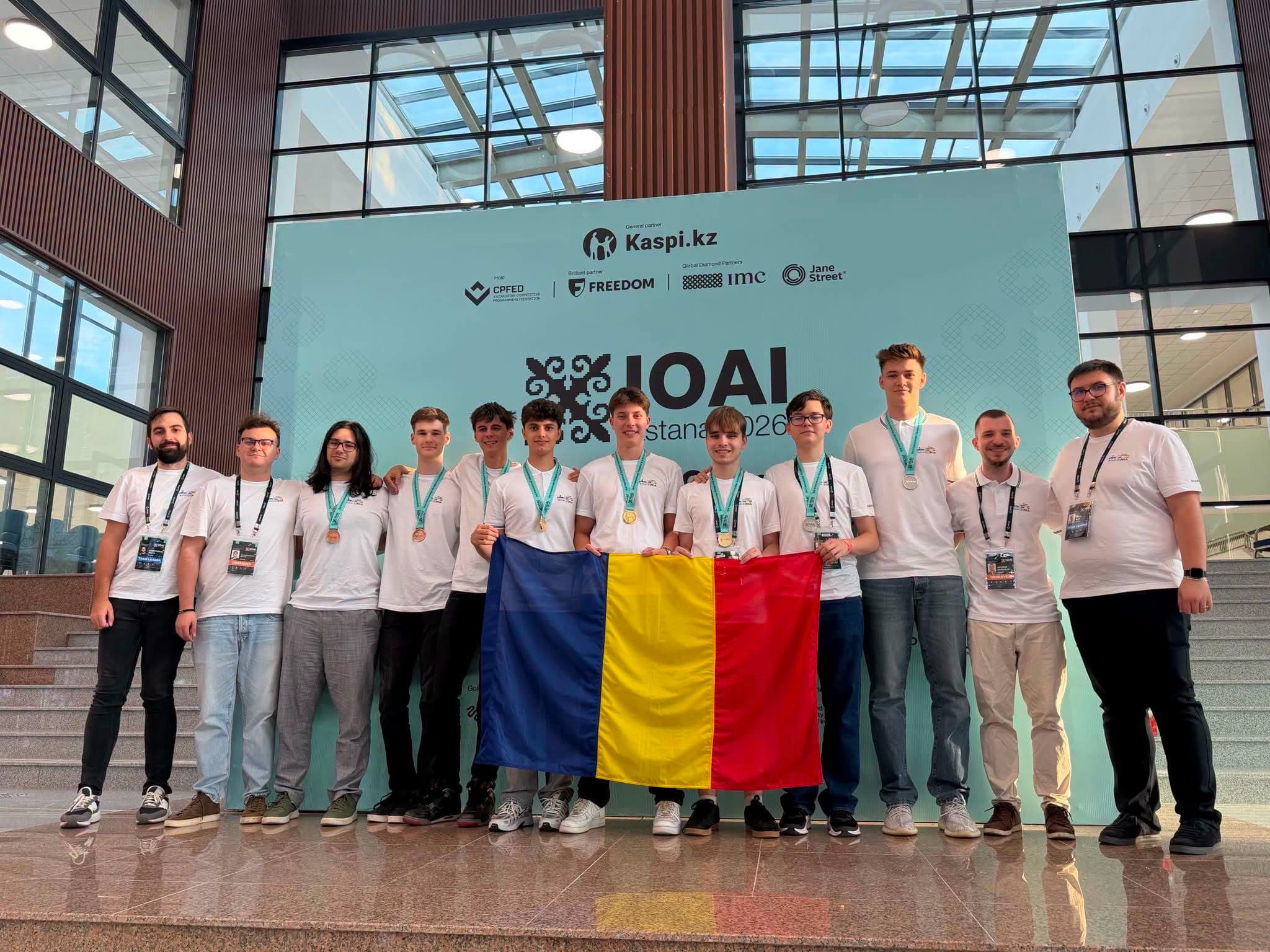
Romania ranked fourth in the world at the International Olympiad in Artificial Intelligence (IOAI), held between 2 and 8 August in Astana, Kazakhstan, after all eight students in its delegation managed to win medals.
In total, the Romanian team won three gold, two silver, and three bronze medals in a competition that brought together contestants from 108 countries and territories, according to one of the coordinators of the Romanian team, Robert Mihai Colca.

The three gold medals were won by David Georgescu from the “Constantin Diaconovici Loga” National College in Timișoara, Alexandru Thury-Burileanu from the “Mircea cel Bătrân” National College in Constanța, and Roland Petrean from the “Silvania” National College in Zalău.
The silver medals were obtained by Mihnea-Teodor Stoica from the International Theoretical High School of Informatics in Bucharest and Darius-Adrian Dobre from the “Matei Basarab” National College of Informatics in Râmnicu Vâlcea.
Three other students won bronze medals: Iulian Nistor from the “Tiberiu Popoviciu” Informatics High School in Cluj-Napoca, Daniel-Antoniu Bence-Muk from the “George Barițiu” National College in Cluj-Napoca, and Matei-Tudor Pop from the “Avram Iancu” Theoretical High School in Cluj-Napoca.
According to a press release, the participation of Romania’s team at IOAI 2026 was supported by the Ministry of Education and Research, together with the Union of Informatics Teachers of Romania (UPIR) and the Romanian Artificial Intelligence Hub (HRIA).
Approximately 500 students from more than 100 countries took part in the olympiad. The competition was held over two days, each consisting of six hours of work and three problems, according to Digi24.
The tests assessed both theoretical knowledge and the competitors’ ability to quickly build and improve solutions based on modern artificial intelligence techniques. Among this year’s challenges were reconstructing the correct order of a conversation from mixed audio fragments, predicting the next action of a robot based on environmental information and a natural-language instruction, and identifying the point at which a human-written text began to be continued by an AI-generated sequence.
The preparation of the team was coordinated by Robert Mihai Colca, a doctoral student at the West University of Timișoara, and Mihai Nan, a lecturer at the National University of Science and Technology Politehnica Bucharest.
This year’s result surpassed the one achieved at the previous edition, when Romania had also won eight medals, but only one of them had been gold. This year, Romania placed ahead of the United States, United Kingdom, India, Singapore, Japan, South Korea, France, Germany, and others.
During the olympiad, competitors had access to the same infrastructure and worked under comparable technical conditions. The differences between countries became visible during the preparation period, when access to high-performance processors and computing resources allowed students to become familiar with training and optimizing artificial intelligence models.
(Photo source: Ministerul Educatiei on Facebook)