Romania could recover part of EUR 770 mln RRF grant if it legislates Wage Law within two months

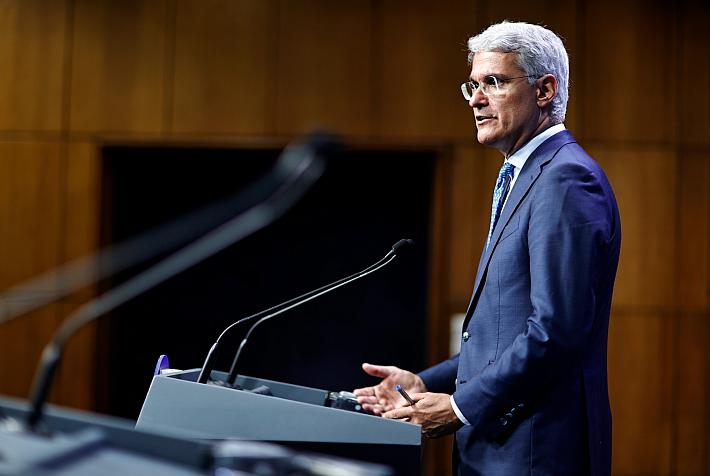
If Romania manages to legislate the Wage Law for the budgetary sector by the end of October, meaning by the end of the European Commission’s evaluation of the measures scheduled under the sixth and latest disbursement request of the Recovery and Resilience Facility (RRF), the Commission may decide to disburse part of the EUR 770 million grant linked to this milestone, minister of investments and European projects Dragoș Pîslaru told Digi24.
Minister Pîslaru claimed that “technically, the draft law is almost ready” and that “the draft, in its latest version, is not at all far from meeting the targets set under the RRF, so there are still possible minor adjustments.” However, public communication surrounding the Wage Law has centred on its implementation in 2027 - namely, the public payroll that the country can afford to pay in 2027 - and less on the structure of the coefficients for positions in the budgetary sector, which is where employees have expressed the most substantial concerns. The public payroll in the coming years will define the pace of convergence towards the desired (and transparent) structure of relative wages - the key purpose of the Wage Law.
“The reason why the law was not adopted was strictly political,” minister Pîslaru explained, claiming that “there were some promises and some underground discussions between the Social Democratic Party (PSD) and unions, things that slowed down the entire process.”
In any case, Romania would not receive the entire amount, but only part of it, minister Pîslaru said. “We cannot estimate at this moment what amount it would be,” he said.
Minister Pîslaru explained that if the law were adopted by the end of October, Romania could receive part of the EUR 770 million, “based on the effort that we can document by August 31.”
“The effort can be documented. We are discussing here the analyses of function equivalence, the salary analyses and the entire project that we worked on,” Pîslaru said.
Earlier this week, commenting on Romania’s failed attempt to legislate a new Wage Law for the public sector, the European Commission said it “stands ready to support efforts to maintain the essence and objectives of the reform and to help the authorities identify solutions that can contribute to achieving its main objectives.” The Commission said it understood that Romania intended to achieve this before the end of the year.
Romania lost the EUR 770 million RRF grant linked to the reform after the Presidency announced last week that the centrist parties negotiating the draft had failed to reach an agreement. However, the Presidency’s press release also said that the objective remained to legislate the bill by the end of the year.
Minister Pîslaru announced that the procedures for the fifth disbursement request have advanced.
“The better news is primarily related to payment request 5, where we have advanced with the procedure. We have received the classic letter of observations from the Commission. We have to respond with clarifications and documents that are at hand. So, by September 9, we should be able to send all these clarifications on request 5, the one that was sent some time ago.”
The Wage Law and the Integrity Law are covered by the sixth payment request.
iulian@romania-insider.com
(Photo source: Facebook/Dragos Pislaru)