Romania’s progress in combating disinformation “unimpressive,” president says

16 July 2026

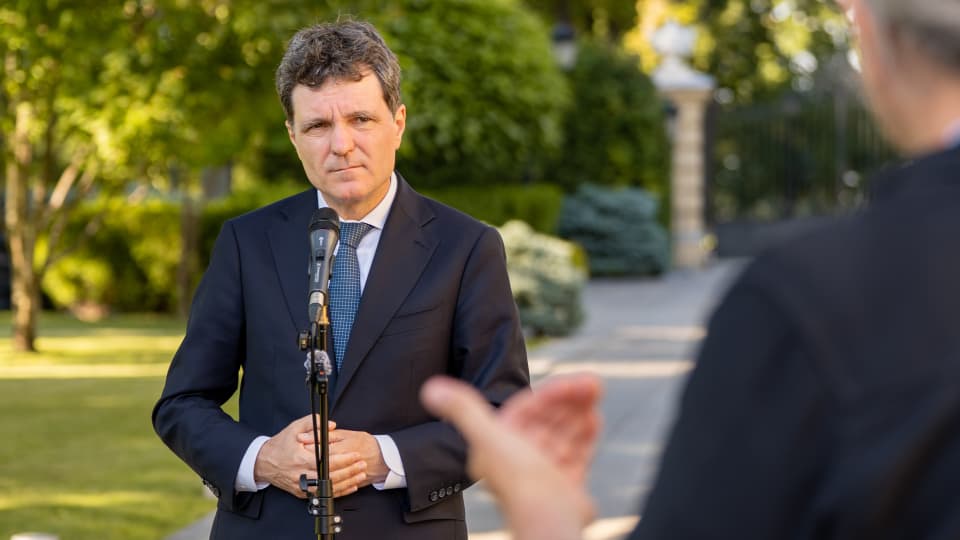
Romania’s progress in combating disinformation is insufficient, according to statements made by president Nicusor Dan during a trip to Kyiv on Wednesday, July 15. 

Dan argued that Romanian legislation should be adapted to resist the spread of false information, a phenomenon that impacted the country during the 2024 electoral year, when European, local, parliamentary, and presidential elections were held. In this way, the country will be ready to hold the 2028 election without distorted messages flooding political debates. 
Asked what measures Romania is currently taking against disinformation, Dan noted that they can be divided into measures regarding audiovisual media and social networks.

"The National Audiovisual Council (or CNA) has come to us with proposals to amend the law, so that, for example, the CNA's scope of authority should be somewhat broader, and the sanctions should be proportional to today's monetary values, not to those in effect when the law was adopted,” president Nicusor Dan said, according to the official transcript.

“On the social networks side, we have a great deal of ground to make up. We have two European regulations that we are still far from implementing. So this is something that concerns us," the head of state noted.

"The progress we have made is not impressive," the president also said.

The official further highlighted the importance of transparent communication from state institutions. 

“Very often the authorities fail to respond in real time, and if there is a gap of uncertainty lasting six hours or twelve hours, it gets filled with all kinds of speculation. Without removing responsibility from the public authorities, I believe that the media must make a very clear distinction between opinion and content," Nicușor Dan said. Much too often, he argued, journalists ask for opinions and not facts.

“Unfortunately, it seems that our concern is to interpret events before we have the facts properly established and laid out," the president explained.

Earlier this year, the Romanian Presidency backed the organization of “Rapid Response – The European Summit for Strengthening Resilience to Disinformation,” an event dedicated to tackling disinformation. During the event, a study conducted by OPSCII was presented, showing that 76% of the engagement for all disinformation narratives on TikTok was generated by only 10 accounts. Moreover, 1 in 6 influencers and 1 in 8 official or media sources repeatedly spread disinformation.

radu@romania-insider.com

(Photo source: presidency.ro)

Normal

Romania’s progress in combating disinformation “unimpressive,” president says

16 July 2026

Romania’s progress in combating disinformation is insufficient, according to statements made by president Nicusor Dan during a trip to Kyiv on Wednesday, July 15. 

Dan argued that Romanian legislation should be adapted to resist the spread of false information, a phenomenon that impacted the country during the 2024 electoral year, when European, local, parliamentary, and presidential elections were held. In this way, the country will be ready to hold the 2028 election without distorted messages flooding political debates. 
Asked what measures Romania is currently taking against disinformation, Dan noted that they can be divided into measures regarding audiovisual media and social networks.

"The National Audiovisual Council (or CNA) has come to us with proposals to amend the law, so that, for example, the CNA's scope of authority should be somewhat broader, and the sanctions should be proportional to today's monetary values, not to those in effect when the law was adopted,” president Nicusor Dan said, according to the official transcript.

“On the social networks side, we have a great deal of ground to make up. We have two European regulations that we are still far from implementing. So this is something that concerns us," the head of state noted.

"The progress we have made is not impressive," the president also said.

The official further highlighted the importance of transparent communication from state institutions. 

“Very often the authorities fail to respond in real time, and if there is a gap of uncertainty lasting six hours or twelve hours, it gets filled with all kinds of speculation. Without removing responsibility from the public authorities, I believe that the media must make a very clear distinction between opinion and content," Nicușor Dan said. Much too often, he argued, journalists ask for opinions and not facts.

“Unfortunately, it seems that our concern is to interpret events before we have the facts properly established and laid out," the president explained.

Earlier this year, the Romanian Presidency backed the organization of “Rapid Response – The European Summit for Strengthening Resilience to Disinformation,” an event dedicated to tackling disinformation. During the event, a study conducted by OPSCII was presented, showing that 76% of the engagement for all disinformation narratives on TikTok was generated by only 10 accounts. Moreover, 1 in 6 influencers and 1 in 8 official or media sources repeatedly spread disinformation.

radu@romania-insider.com

(Photo source: presidency.ro)

Normal

Romania Insider Free Newsletters