Workspace Studio: in 2026, half of an office fit-out budget goes to social and collaboration areas
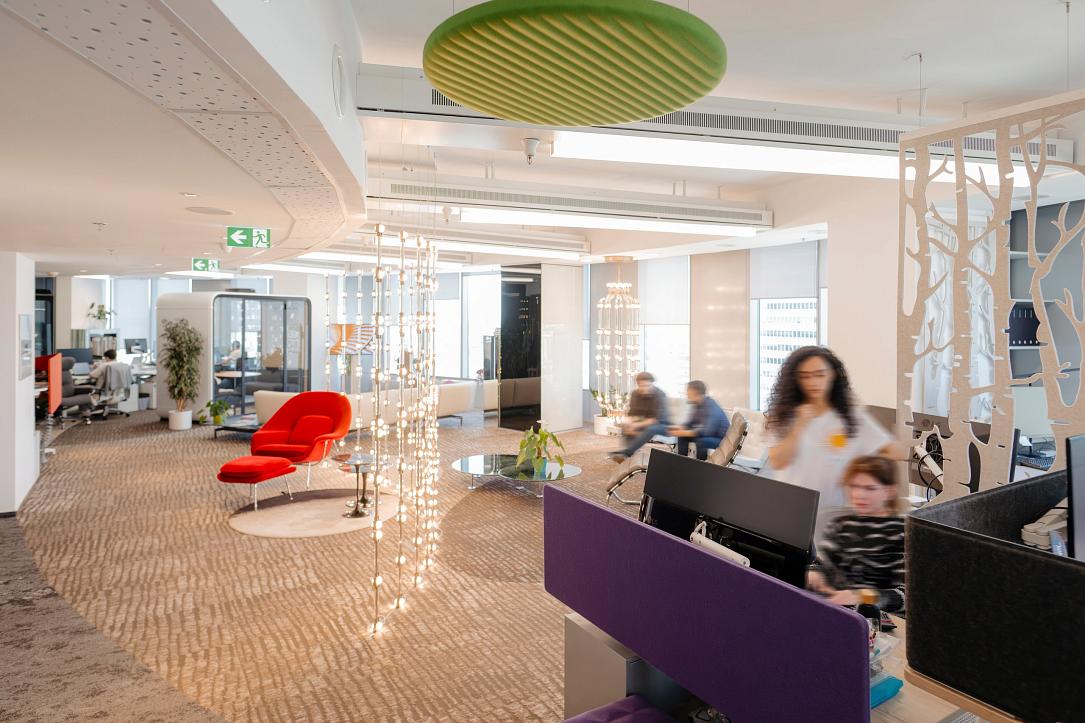
In a market slowed by the economic context, companies that continue to invest in office fit-outs are turning towards quality and concentrating their budgets in the spaces where teams collaborate.
In the projects carried out by Workspace Studio in 2026, social and connection areas account for almost half of the total budget of an office fit-out. This is the clearest shift in priorities in an otherwise cautious market, where overall demand is being held back by a tense economic and political context, and companies that move forward with a project are weighing every allocation carefully. Workspace Studio, a fit-out and workplace transformation company with a turnover of EUR 30 million in 2025, sees this reorientation directly in this year’s project portfolio, which covers over 20,000 sqm of fitted-out space.
The budget breakdown shows a clear focus on interaction. In a turnkey project, which includes finishes, installations, furniture and architectural solutions, approximately half of the budget goes to collaboration and connection areas, from meeting rooms to cafeterias and team spaces. A quarter supports individual workstations, while the remaining quarter covers support spaces: reception, circulation areas, technical areas and utilities. For individual workstations, a smaller footprint means a higher investment per square metre, a sign of rising expectations around ergonomics. At turnkey project level, the average investment in 2026 stood at around EUR 1,000/sqm, up approximately 15% compared to the previous year.
The concentration of budget in connection areas follows a simple logic. Their value lies in the interactions they host: meetings between colleagues, spontaneous conversations and teamwork made possible by the physical environment. As the individual workspace becomes more compact and better designed, investment is focused where people create value together.
“What matters is where you place the budget in order to obtain maximum value. The budget-centric approach prioritises quality solutions in the areas where teams interact. That is where the real reason for people to return to the office is built. And the individual workstation also gains in quality, even if it occupies less space,” explains Horațiu Didea, Managing Partner, Workspace Studio.
Why the budget is moving towards connection
This reorientation is directly linked to the return to the office. In 2026, office attendance has become almost the norm, in various formats, from more flexible hybrid programmes to four- or five-day requirements, while fully remote work has declined. According to Gallup, in 2025 approximately 52% of employees who could work remotely were in a hybrid setup, fewer than a quarter worked fully remotely, while JLL data shows that 55% of Fortune 100 companies require five-day office attendance, compared with only 5% in 2021.
As people return, the function of the office becomes more nuanced. Individual work can be done from anywhere, while direct, informal interaction with the team is far harder to replicate at home. Office design responds to this by concentrating investment in collaboration and social areas.
At the same time, the rest of the budget supports the foundation on which connection areas rely. Individual workstations take up less space, but gain in quality, with superior ergonomics for the time actually spent at the office. Flexibility completes the picture, with rising demand for modular and mobile solutions that allow the space to be reconfigured quickly and easily as companies redefine the way people use the office.
“Ergonomics remains non-negotiable, even under cost pressure. Electrically adjustable desks and higher-quality chairs have moved from optional features to standard elements in premium projects,” says Horațiu Didea.
Who is investing in quality office spaces
Companies with international expansion, especially in IT and insurance, continue to fit out new spaces. In parallel, companies consolidating their position on the local market, particularly in pharma and consumer, are investing in headquarters that support their long-term presence.
Regardless of sector, Workspace Studio sees two clear client profiles. The first invests consistently in ergonomics and quality solutions and seeks the maximum return on every euro allocated. The second works with a very tight budget, often built around contributions from the building owner, and needs a fully functional project within that constraint.
For both, the budget-centric approach becomes the criterion that defines the project, concentrating investment in the areas where value is created and compressing it where value decreases.
A market with an anticipated adjustment
In 2025, Workspace Studio grew by 20% and exceeded the EUR 30 million turnover threshold. For 2026, the company estimated from the beginning of the year a 20-25% correction, aligned with the market, against a backdrop of general caution in the economy and society. First-half results are in line with this forecast.
“We anticipated a market adjustment as early as January and built the year around it. The dynamics so far confirm the scenario,” says Horațiu Didea.
The projects currently under discussion start from the same challenge: identifying the areas where the office creates the most value for the people who use it. Budget caution sharpens the constraints of the decision. Companies allocate more carefully, ask for justification for each area and view the fit-out as an investment with a return.
*This is a press release.