
Can music help bring down a dictatorship? Documentary about rock scene in Romanian city where 1989 Revolution started explores the question
23 July 2026

The Vinyl Revolution, a recent documentary by Eric Fretz, a two-time Fulbright Program scholar who taught at West University of Timișoara, delves into a less documented chapter in the history of Timișoara’s rock scene and asks whether music played a role in the lead-up to the 1989 Revolution.

From Deep Purple, Led Zeppelin, and Jimi Hendrix to The Rolling Stones or The Beatles, the soundtrack for rock fans in Communist-era Timișoara was much the same as anywhere else in the world. But while audiences elsewhere could simply enjoy the music, in Romania an interest in Western rock could attract unwanted attention from the authorities.

Eric Fretz, a professor of Peace and Justice Studies at Regis University in Denver, Colorado, describes the context as “incredibly challenging and dangerous,” referencing stories of young people who were part of the rock and roll scene being taken by the Communist-era police Miliţie or threatened by the political police Securitate.

“I grew up outside of Philadelphia, Pennsylvania. I was listening to the same music, but there were no threats against me for listening to rock and roll. I just went to the record store and bought the latest Pink Floyd album and listened to it on my turntable. I really didn't think about the political dimensions of it or worry about what I was doing,” Fretz recalls.

Meanwhile, in Romania, rock music could be associated with values seen as incompatible with the communist regime. Access to albums was limited, so fans relied on records brought from abroad, cassette copies, or broadcasts by stations such as Radio Free Europe, which aired the famed pop, rock, and jazz music show Metronom of journalist Cornel Chiriac after it was banned in Romania.

These aspects of the local music scene enrich a historical account that records major events, like Bruce Springsteen’s 1988 concert in East Berlin, but not always finds a place for the many local experiences that shaped everyday cultural resistance.

“If you look at the historical record around Western rock and roll and Eastern Europe and the Soviet bloc countries in the 1980s, you get this 30,000-foot view of how these Western rockers like Springsteen came in here and did their thing. What's not part of the historical record is, for the most part, these underground bands, the ordinary people who were doing kind of extraordinary things politically with Western-style rock and roll music,” Fretz explains.

While he had read about the period in history books, he learned firsthand about Timișoara’s rock scene during his time as a Fulbright scholar at the West University, teaching in the American Studies program in 2016. Throughout the year he spent in the city, he became friends with Emil Biebel, the owner of the record store and pub Viniloteca, located very close to Timișoara’s Maria Square. The square is the place where the protests that sparked the December 1989 Revolution started.

“Emil and I just became friends because we both love rock and roll a lot. We just talked about music a lot at the pub there. One day, he and I were talking, and I asked him how the vinyl shop, Viniloteca, started. He told me that in the 1970s and the 1980s, and then after the revolution too, he was smuggling rock and roll records into the country, rock and roll T-shirts, and things like that. I kind of knew that stuff was happening through the Cold War, but I had just read about it in history books, which are abstract,” he recalls.

As his Fulbright grant ended, he returned to his teaching position at Regis University, but he left Timișoara looking to come back and learn more about the role rock and roll had played in the city's cultural life during the Cold War. That opportunity came when he received a second Fulbright award and returned to teach at West University last year.

“When I arrived here in January of 2025, I didn't really know what I was going to do or what I wanted to do. Emil and I started talking, and he introduced me to all kinds of people. I thought I was going to write another novel about it. But what happened was that about six weeks into my time in the project I realized that it wasn't a novel, it was a film.” He deemed the format of a film more appropriate because “there was just so much going on here in the 1980s in regards to rock and roll and soft-anti regime things.”

The Vinyl Revolution is Fretz’s first documentary project. Besides his academic work, he published Groundswell, a surf-themed murder mystery. With his iPhone and some lavalier microphones, he recorded the interviews for the film. Once he was back in the U.S., he worked with Neville Harson, the film’s editor, to comb through archival footage, interviews, and copious notes to put everything together.

The through line of the film is the question of whether rock and roll played any kind of role in the inception of the 1989 Romanian Revolution. “That's what the film's really about. It doesn't answer that question. I don't think it's an answerable question. It just raises the question, and it allows the audience to figure it out on their own, to either reject it or accept it,” he explains.

The film, which screened last week at the festival Ceau, Cinema! in Timişoara, is geared mainly at American audiences as he wanted “to tell the story about these crazy, brave, young people in the 1980s who were performing rock and roll that was anti-regime.”

"I wanted to tell the story about these crazy, brave, young people in the 1980s who were performing rock and roll that was anti-regime"

It zooms in on the PM6 (Post Meridian 6) club established in the 1960s by Petru Umanschi and housed at the time inside Casa Tineretului in Timişoara, one of the many Youth Houses that the Union of Communist Youth (U.T.C.) administered throughout the country. While the purpose of such venues was to promote state-approved cultural activities, PM6 became a gateway to Western music and ideas. The organizers played classic FM rock for the attendees to dance to and began inviting local bands to perform on Thursdays.

“My sense is that the local rock and roll culture, local music really blossomed from that space at Casa Tineretului. That's where a lot of the local bands that became a big part of TimRock got their start.” Launched in the early 1980s, the festival TimRock grew into one of the defining events of Timișoara's rock scene.

Were people at the time aware that what they were doing was subversive? “Yes and no,” Fretz says. “The young people who were playing and listening to rock and roll in the 80s, in Timişoara and throughout Romania, were just trying to make sense of the situation that they were thrown into. Especially when we're younger, that's hard to do. My sense is that over time, these people who were involved in this culture came to understand it in a better way. […] In the 80s, when all this was happening, they were just doing what they loved, and they were trying to live their lives, be young people, have fun, and just learn how to be in this world.”

The concert that felt like freedom

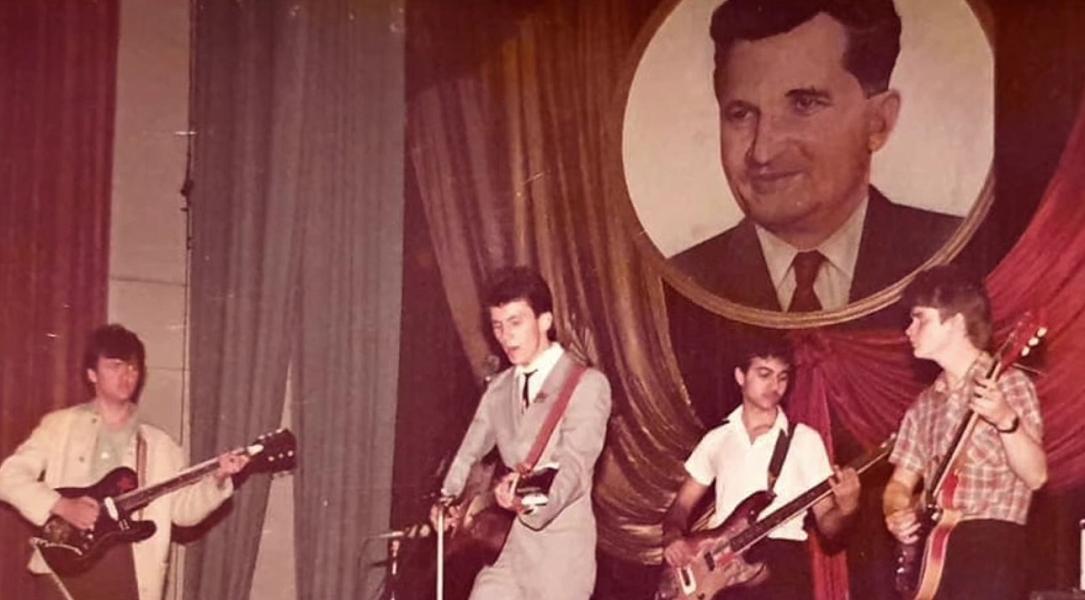
Another thread of the film follows a concert that took place at the Hungarian State Theatre in Timișoara in the autumn of 1985. The performance was by Metamorf, a band that didn’t release any official recordings.

“People I talked to just kept coming back to this concert that they gave in the autumn of 1985, and talking about how anti-regime it was, and how they were there, but they didn't feel like they were in Romania because it was like it was happening in America at the time. So, the other part of the film is trying to figure out what happened at this strange, anti-regime concert at the Hungarian State Theater in the autumn of 1985.”

The documentary is built around interviews with people who were directly involved in Timișoara's rock scene during the communist period, among them Emil Biebel, journalist and writer Mimo Obradov, Mirela Iacob, Lili Molnar-Popa, and Metamorf members Tibor Gajdo, Adrian Popescu, and Tavi Iepan.

The film also features archival footage provided by the members of Metamorf, including recordings from the band's 1985 concert at the Hungarian State Theatre. Music from that performance forms part of the documentary's soundtrack, alongside music by Phoenix, the prominent Romanian rock band founded in Timișoara in 1962.

“I was trying to find some of these recordings and put them on the website so people could listen to them because, basically, they live in boxes, under people's beds. There are other bands like Pro Musica, for instance, that everybody knows about. They're well known, and there's been a really good documentary about them. But there were other, smaller, underground bands that were a part of the culture that I was trying to look at.”

The documentary is not intended to be a comprehensive history of Timișoara's rock scene, but rather a focused exploration of two stories that shed light on the city's music culture in the years before the 1989 Revolution.

“The film is not comprehensive at all. It just kind of takes a deep dive into two very small things that I thought were important. I know a little bit about what was going on here, but I didn't live here; I just got my knowledge from talking to people, and this isn't a part of the recorded Romanian history at all. So, there really wasn't too much to read. I just did the best that I could to find a way to tell a small part of the story of what was happening here in the 1980s. It's a very limited and narrowly focused view of the rock and roll scene here in Timisoara leading up to the revolution, and so it's imperfect in a lot of ways.”

Among many Romanian musicians making music under difficult circumstances, Metamorf stood out to Fretz for their nuanced music.

“I just didn't know that there was an underground culture of people who were influenced by Western rock and roll and making their own. That's why Metamorf is so important to me: because their songs are anti-regime, but they're very nuanced. They're really nuanced because they had to be careful what they were saying, because the Securitate and the informers were all over the place. This is not an easy thing to do under any circumstances, but especially those circumstances.”

Fretz, who plays in a "little rock and roll band" in Denver, brought Metamorf’s music to the stage during a recent New Year's Eve party. “That was just really fun for us to do, and it's just a way to honor them and all the stories they told me.”

How rock reached Timișoara and Romania

Another thread in the story of Timișoara's music scene during the communist period is that of records and cassette tapes being smuggled into the country. Fretz has heard many stories about the clandestine trade, including one about flight attendants and pilots in the 1960s and 1970s who returned from international flights with rock albums tucked into their luggage. The records would then make their way to Romanian DJs, who copied them onto reel-to-reel tapes and played the music at discotheques and private parties in Timișoara and across the country.

“It came across land and sea, too. It’s just the thing: you can't stop ideas from traveling across borders, no matter how many border guards you have across any given nation state. It's just impossible to do. The whole thing is really about communication and technology, and how, if people want to hear something or listen to something or read something, they're going to get it.”

"You can't stop ideas from traveling across borders, no matter how many border guards you have across any given nation state."

This continued after the fall of communism, with an informal, music-related economy, he found. As borders opened, people traveled to Budapest, Poland and the former Yugoslavia, returning with pirated CDs and cassette tapes, as well as rock T-shirts and posters that were difficult to find in Romania. Timișoara's location near the Hungarian and Yugoslav borders helped, and, according to the accounts he heard, some border guards accepted bribes and looked the other way. “It was just a very porous kind of community here when it came to borders, immigration, travel, and goods crossing international borders at that time.”

The kids are alright

In April, the documentary screened at Regis University, in front of an audience of approximately 100 people.

“People really enjoyed the film; they were laughing and engaged. The film is kind of funny because the people who are telling the stories are really magnetic, charismatic, and interesting people, and they have a lot of really funny stories to tell. The American audience responded to that, and they responded to the personalities in the film, too.”

It was the unknown aspects of the underground scene and of what ordinary people were doing that people resonated with. “Traditional history is fun and great and important to read, but people enjoy this social cultural history because it's human beings who are telling stories about the lives that they've lived.”

At a screening in Bucharest, young viewers said the film helped remind them of stories they had heard from their parents about life during communism, and left them wanting to ask them more about that period. “I didn't really need to hear anything else. If you can do something that creates an intergenerational dialogue like that, you can't ask for anything else. That just gave me great hope for young people in the future, and it just made me feel really good about what we did.”

"I think there is an argument to be made that Western rock and roll had something to do with inciting some kind of passion within Romanians to say ‘I don't like this world I'm living in, I want to do something about it.’ "

Western commercial music is two-pronged, Fretz explains. It has a revolutionary part in that it can make people think about the situation that they're living and give them a sense of how to change that. “But popular music can also be an anodyne and just make people think that what they have is okay and ‘I don't want to push or I just want to party.’ […] That’s what made this story so interesting for me because I think there is an argument to be made that Western rock and roll had something to do with inciting some kind of passion within ordinary Romanians to say: ‘I don't like this world I'm living in, I want to do something about it.’ I don't think it was everything. That would be too much, too broad of a brush stroke to paint. But I think there's enough evidence to make the claim that it had something to do with the political changes that happened here.”

The website of the project, with more audio content and a photo archive, can be found here.

(Photo: screen capture from trailer)

simona@romania-insider.com

Normal

Can music help bring down a dictatorship? Documentary about rock scene in Romanian city where 1989 Revolution started explores the question

23 July 2026

The Vinyl Revolution, a recent documentary by Eric Fretz, a two-time Fulbright Program scholar who taught at West University of Timișoara, delves into a less documented chapter in the history of Timișoara’s rock scene and asks whether music played a role in the lead-up to the 1989 Revolution.

From Deep Purple, Led Zeppelin, and Jimi Hendrix to The Rolling Stones or The Beatles, the soundtrack for rock fans in Communist-era Timișoara was much the same as anywhere else in the world. But while audiences elsewhere could simply enjoy the music, in Romania an interest in Western rock could attract unwanted attention from the authorities.

Eric Fretz, a professor of Peace and Justice Studies at Regis University in Denver, Colorado, describes the context as “incredibly challenging and dangerous,” referencing stories of young people who were part of the rock and roll scene being taken by the Communist-era police Miliţie or threatened by the political police Securitate.

“I grew up outside of Philadelphia, Pennsylvania. I was listening to the same music, but there were no threats against me for listening to rock and roll. I just went to the record store and bought the latest Pink Floyd album and listened to it on my turntable. I really didn't think about the political dimensions of it or worry about what I was doing,” Fretz recalls.

Meanwhile, in Romania, rock music could be associated with values seen as incompatible with the communist regime. Access to albums was limited, so fans relied on records brought from abroad, cassette copies, or broadcasts by stations such as Radio Free Europe, which aired the famed pop, rock, and jazz music show Metronom of journalist Cornel Chiriac after it was banned in Romania.

These aspects of the local music scene enrich a historical account that records major events, like Bruce Springsteen’s 1988 concert in East Berlin, but not always finds a place for the many local experiences that shaped everyday cultural resistance.

“If you look at the historical record around Western rock and roll and Eastern Europe and the Soviet bloc countries in the 1980s, you get this 30,000-foot view of how these Western rockers like Springsteen came in here and did their thing. What's not part of the historical record is, for the most part, these underground bands, the ordinary people who were doing kind of extraordinary things politically with Western-style rock and roll music,” Fretz explains.

While he had read about the period in history books, he learned firsthand about Timișoara’s rock scene during his time as a Fulbright scholar at the West University, teaching in the American Studies program in 2016. Throughout the year he spent in the city, he became friends with Emil Biebel, the owner of the record store and pub Viniloteca, located very close to Timișoara’s Maria Square. The square is the place where the protests that sparked the December 1989 Revolution started.

“Emil and I just became friends because we both love rock and roll a lot. We just talked about music a lot at the pub there. One day, he and I were talking, and I asked him how the vinyl shop, Viniloteca, started. He told me that in the 1970s and the 1980s, and then after the revolution too, he was smuggling rock and roll records into the country, rock and roll T-shirts, and things like that. I kind of knew that stuff was happening through the Cold War, but I had just read about it in history books, which are abstract,” he recalls.

As his Fulbright grant ended, he returned to his teaching position at Regis University, but he left Timișoara looking to come back and learn more about the role rock and roll had played in the city's cultural life during the Cold War. That opportunity came when he received a second Fulbright award and returned to teach at West University last year.

“When I arrived here in January of 2025, I didn't really know what I was going to do or what I wanted to do. Emil and I started talking, and he introduced me to all kinds of people. I thought I was going to write another novel about it. But what happened was that about six weeks into my time in the project I realized that it wasn't a novel, it was a film.” He deemed the format of a film more appropriate because “there was just so much going on here in the 1980s in regards to rock and roll and soft-anti regime things.”

The Vinyl Revolution is Fretz’s first documentary project. Besides his academic work, he published Groundswell, a surf-themed murder mystery. With his iPhone and some lavalier microphones, he recorded the interviews for the film. Once he was back in the U.S., he worked with Neville Harson, the film’s editor, to comb through archival footage, interviews, and copious notes to put everything together.

The through line of the film is the question of whether rock and roll played any kind of role in the inception of the 1989 Romanian Revolution. “That's what the film's really about. It doesn't answer that question. I don't think it's an answerable question. It just raises the question, and it allows the audience to figure it out on their own, to either reject it or accept it,” he explains.

The film, which screened last week at the festival Ceau, Cinema! in Timişoara, is geared mainly at American audiences as he wanted “to tell the story about these crazy, brave, young people in the 1980s who were performing rock and roll that was anti-regime.”

"I wanted to tell the story about these crazy, brave, young people in the 1980s who were performing rock and roll that was anti-regime"

It zooms in on the PM6 (Post Meridian 6) club established in the 1960s by Petru Umanschi and housed at the time inside Casa Tineretului in Timişoara, one of the many Youth Houses that the Union of Communist Youth (U.T.C.) administered throughout the country. While the purpose of such venues was to promote state-approved cultural activities, PM6 became a gateway to Western music and ideas. The organizers played classic FM rock for the attendees to dance to and began inviting local bands to perform on Thursdays.

“My sense is that the local rock and roll culture, local music really blossomed from that space at Casa Tineretului. That's where a lot of the local bands that became a big part of TimRock got their start.” Launched in the early 1980s, the festival TimRock grew into one of the defining events of Timișoara's rock scene.

Were people at the time aware that what they were doing was subversive? “Yes and no,” Fretz says. “The young people who were playing and listening to rock and roll in the 80s, in Timişoara and throughout Romania, were just trying to make sense of the situation that they were thrown into. Especially when we're younger, that's hard to do. My sense is that over time, these people who were involved in this culture came to understand it in a better way. […] In the 80s, when all this was happening, they were just doing what they loved, and they were trying to live their lives, be young people, have fun, and just learn how to be in this world.”

The concert that felt like freedom

Another thread of the film follows a concert that took place at the Hungarian State Theatre in Timișoara in the autumn of 1985. The performance was by Metamorf, a band that didn’t release any official recordings.

“People I talked to just kept coming back to this concert that they gave in the autumn of 1985, and talking about how anti-regime it was, and how they were there, but they didn't feel like they were in Romania because it was like it was happening in America at the time. So, the other part of the film is trying to figure out what happened at this strange, anti-regime concert at the Hungarian State Theater in the autumn of 1985.”

The documentary is built around interviews with people who were directly involved in Timișoara's rock scene during the communist period, among them Emil Biebel, journalist and writer Mimo Obradov, Mirela Iacob, Lili Molnar-Popa, and Metamorf members Tibor Gajdo, Adrian Popescu, and Tavi Iepan.

The film also features archival footage provided by the members of Metamorf, including recordings from the band's 1985 concert at the Hungarian State Theatre. Music from that performance forms part of the documentary's soundtrack, alongside music by Phoenix, the prominent Romanian rock band founded in Timișoara in 1962.

“I was trying to find some of these recordings and put them on the website so people could listen to them because, basically, they live in boxes, under people's beds. There are other bands like Pro Musica, for instance, that everybody knows about. They're well known, and there's been a really good documentary about them. But there were other, smaller, underground bands that were a part of the culture that I was trying to look at.”

The documentary is not intended to be a comprehensive history of Timișoara's rock scene, but rather a focused exploration of two stories that shed light on the city's music culture in the years before the 1989 Revolution.

“The film is not comprehensive at all. It just kind of takes a deep dive into two very small things that I thought were important. I know a little bit about what was going on here, but I didn't live here; I just got my knowledge from talking to people, and this isn't a part of the recorded Romanian history at all. So, there really wasn't too much to read. I just did the best that I could to find a way to tell a small part of the story of what was happening here in the 1980s. It's a very limited and narrowly focused view of the rock and roll scene here in Timisoara leading up to the revolution, and so it's imperfect in a lot of ways.”

Among many Romanian musicians making music under difficult circumstances, Metamorf stood out to Fretz for their nuanced music.

“I just didn't know that there was an underground culture of people who were influenced by Western rock and roll and making their own. That's why Metamorf is so important to me: because their songs are anti-regime, but they're very nuanced. They're really nuanced because they had to be careful what they were saying, because the Securitate and the informers were all over the place. This is not an easy thing to do under any circumstances, but especially those circumstances.”

Fretz, who plays in a "little rock and roll band" in Denver, brought Metamorf’s music to the stage during a recent New Year's Eve party. “That was just really fun for us to do, and it's just a way to honor them and all the stories they told me.”

How rock reached Timișoara and Romania

Another thread in the story of Timișoara's music scene during the communist period is that of records and cassette tapes being smuggled into the country. Fretz has heard many stories about the clandestine trade, including one about flight attendants and pilots in the 1960s and 1970s who returned from international flights with rock albums tucked into their luggage. The records would then make their way to Romanian DJs, who copied them onto reel-to-reel tapes and played the music at discotheques and private parties in Timișoara and across the country.

“It came across land and sea, too. It’s just the thing: you can't stop ideas from traveling across borders, no matter how many border guards you have across any given nation state. It's just impossible to do. The whole thing is really about communication and technology, and how, if people want to hear something or listen to something or read something, they're going to get it.”

"You can't stop ideas from traveling across borders, no matter how many border guards you have across any given nation state."

This continued after the fall of communism, with an informal, music-related economy, he found. As borders opened, people traveled to Budapest, Poland and the former Yugoslavia, returning with pirated CDs and cassette tapes, as well as rock T-shirts and posters that were difficult to find in Romania. Timișoara's location near the Hungarian and Yugoslav borders helped, and, according to the accounts he heard, some border guards accepted bribes and looked the other way. “It was just a very porous kind of community here when it came to borders, immigration, travel, and goods crossing international borders at that time.”

The kids are alright

In April, the documentary screened at Regis University, in front of an audience of approximately 100 people.

“People really enjoyed the film; they were laughing and engaged. The film is kind of funny because the people who are telling the stories are really magnetic, charismatic, and interesting people, and they have a lot of really funny stories to tell. The American audience responded to that, and they responded to the personalities in the film, too.”

It was the unknown aspects of the underground scene and of what ordinary people were doing that people resonated with. “Traditional history is fun and great and important to read, but people enjoy this social cultural history because it's human beings who are telling stories about the lives that they've lived.”

At a screening in Bucharest, young viewers said the film helped remind them of stories they had heard from their parents about life during communism, and left them wanting to ask them more about that period. “I didn't really need to hear anything else. If you can do something that creates an intergenerational dialogue like that, you can't ask for anything else. That just gave me great hope for young people in the future, and it just made me feel really good about what we did.”

"I think there is an argument to be made that Western rock and roll had something to do with inciting some kind of passion within Romanians to say ‘I don't like this world I'm living in, I want to do something about it.’ "

Western commercial music is two-pronged, Fretz explains. It has a revolutionary part in that it can make people think about the situation that they're living and give them a sense of how to change that. “But popular music can also be an anodyne and just make people think that what they have is okay and ‘I don't want to push or I just want to party.’ […] That’s what made this story so interesting for me because I think there is an argument to be made that Western rock and roll had something to do with inciting some kind of passion within ordinary Romanians to say: ‘I don't like this world I'm living in, I want to do something about it.’ I don't think it was everything. That would be too much, too broad of a brush stroke to paint. But I think there's enough evidence to make the claim that it had something to do with the political changes that happened here.”

The website of the project, with more audio content and a photo archive, can be found here.

(Photo: screen capture from trailer)

simona@romania-insider.com

Normal

Romania Insider Free Newsletters