Romania travel: Six train journeys to try this summer
Train travel can be a great opportunity to discover beautiful areas of the country, especially when not pressured by time. We have put together below several suggestions of train itineraries, covering historic routes and beautiful sites.…
RI Newsroom · Journalist
· Updated · 4 min read
Train travel can be a great opportunity to discover beautiful areas of the country, especially when not pressured by time. We have put together below several suggestions of train itineraries, covering historic routes and beautiful sites.
Oraviţa – Anina
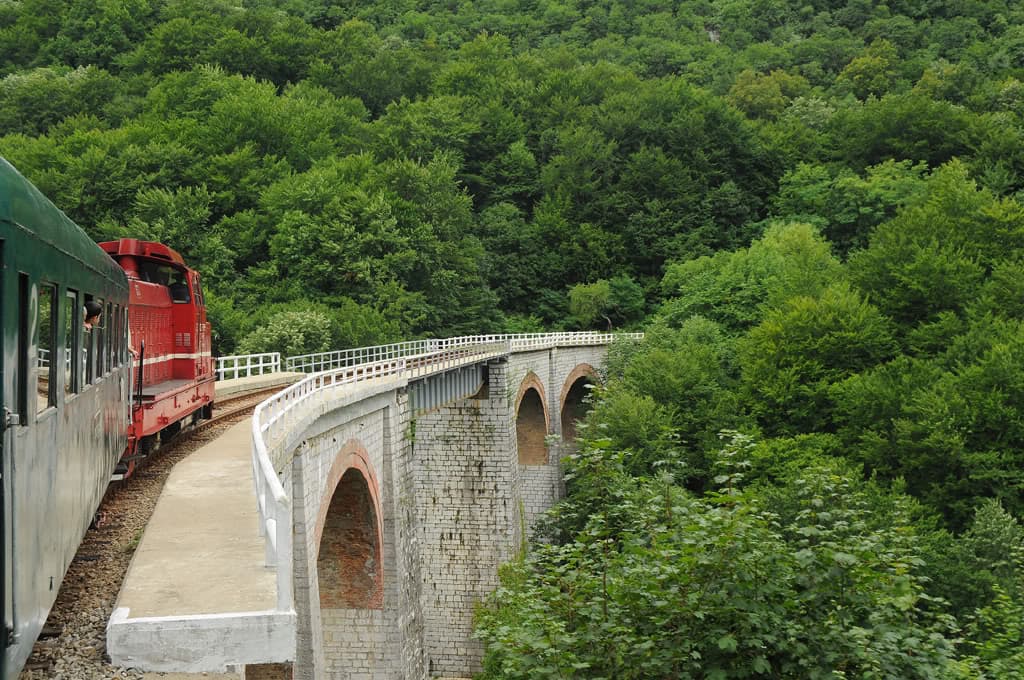
In the region of Banat, the rail route linking the industrial, mining towns of Oravița and Anina was the first mountain railway to function in modern Romania. It opened in 1863 and it is still open to tourists. The route goes through 14 tunnels and crosses 10 viaducts, with plenty of opportunities for picturesque views. The highest viaduct of is the Jitin viaduct, at 37 meters, while the longest tunnel is Gârlişte, at 660 meters. The railroad is also known as The Semmering of Banat, because of the similarities with the Austrian railway Semmering, built between mid-19th century. The train running on this route has today an electro-diesel locomotive. More about this historical train route here.
Orșova – Drobeta Turnu Severin
The train trip linking these two southeastern Romania cities is a great opportunity to see the bank of the river Danube. Orșova is located some 22 km east of the Iron Gates, a spectacular gorge on the Danube, part of a nature park of stunning views. Reaching Drobeta Turnu Severin, you can explore a settlement with a history going back to the time of Roman emperor Trajan. Among the town’s attractions are the ruins of Trajan’s bridge, the Severin Medieval Fortress, and Water Tower. More about visiting Drobeta Turnu Severin here.
Timișoara – Băile Herculane
This route goes also through the region of Banat, one part of the country that is always worth exploring, and links two cities with plenty of historical sites to visit, although not all of them refurbished. Known for it multicultural heritage and Secession-style architecture, Timișoara will be a European Capital of Culture in 2021. Stops on the route are made in Lugoj, once a fortified city on Timiș river, and Caransebeș, an important railway network point and a place filled with 18th and 19th century architectural buildings. Among the city’s landmarks is the building of the City Hall, modeled after the Vienna City Hall. At the end of the ride, passengers arrive at the Băile Herculane train station, one of the most beautiful in the country and one of the many patrimony buildings of the thermal spa resort that traces its history back to Roman times. The Baroque-style edifice of the train station, impressive both on the inside and the outside, was built between 1878 and 1886 on the plans of architect A.D. Serres. The state-owned railway operator CFR announced last year plans to refurbish it, Expressdebanat.ro reported. It would be one of the several historical buildings in the resort that need rehabilitation, among them the Neptune Baths, about which you can read more
Free newsletters
Romania, in your inbox before your first coffee.
Get the Daily — the morning briefing, free, in English, unsubscribe anytime. Want business, real estate or travel digests too? Pick your newsletters →