Climate Change Summit brings 2,100 participants to Bucharest, announces 2027 rebranding
Discussions at this edition of the Summit tackled the green transition, energy security, access to water and food, and Romania’s ability to respond to climate risks.
Radu Dumitrescu · Journalist
· 4 min read
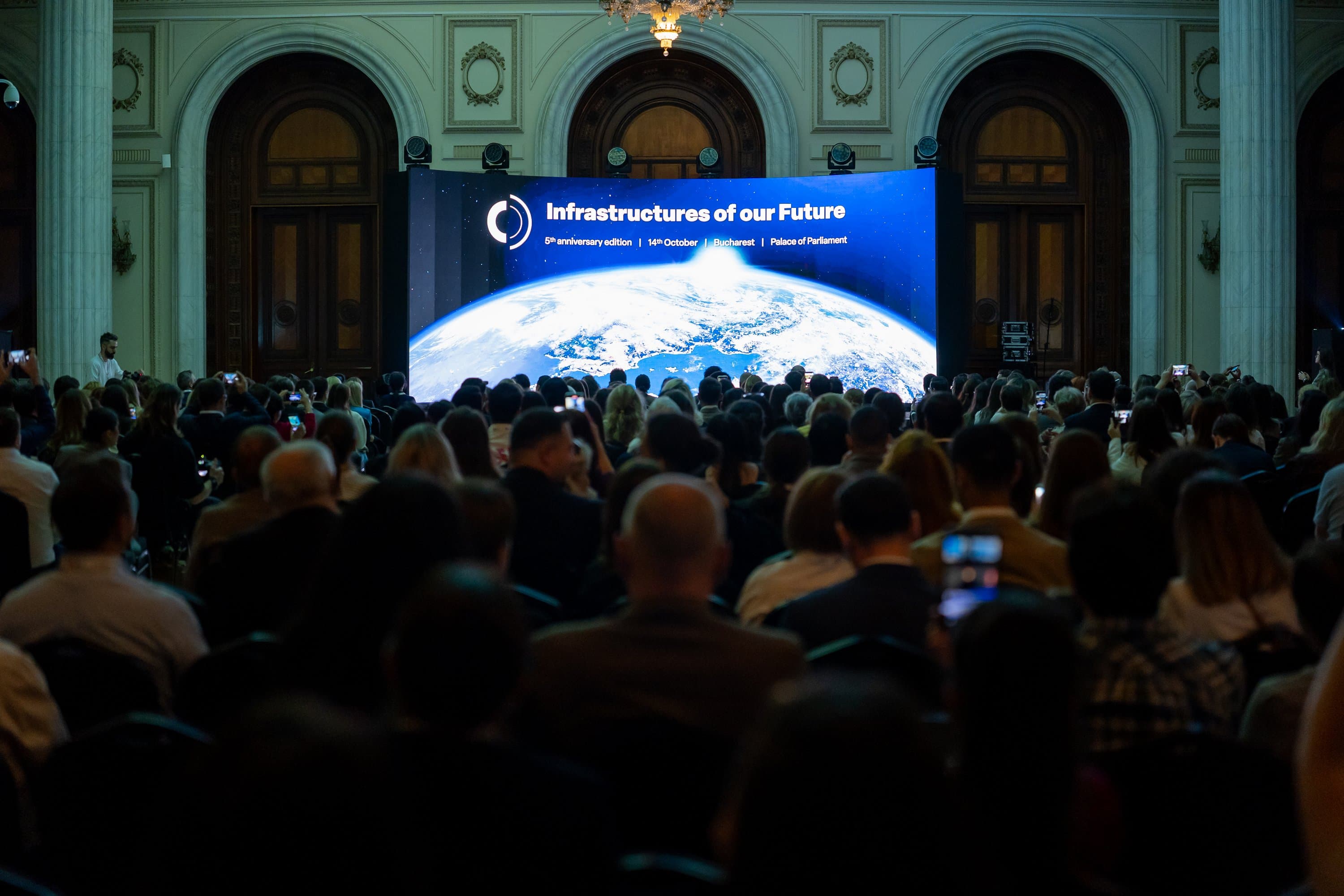
The fifth edition of the Climate Change Summit, an annual event highlighting energy security, access to resources, and economic competitiveness in Romania and beyond, brought over 2,000 participants to Bucharest on October 14.
Under the theme “The Infrastructures of the Future,” the event, connected international perspectives with Romania’s and the region’s economic and social challenges. In particular, discussions at this edition of the Summit tackled the green transition, energy security, access to water and food, and Romania’s ability to respond to climate risks.
At the opening of Climate Change Summit 2026, Romanian president Nicușor Dan delivered a message highlighting the event’s role in connecting public institutions, researchers, the business community, and civil society. He also emphasized the importance of integrating nature protection into development decisions and collaborating with civil society, mentioning the Bucharest–Ilfov Green Belt, Roșia Montană, the conservation of the Lake Techirghiol area, and support for wildlife rehabilitation centers.
The third edition of the “State of the Climate 2026” report for Romania, prepared by InfoClima researchers, was presented at the Climate Change Summit. Topics covered include vulnerabilities in the energy system, the effects of heatwaves on health, and the role of emissions reductions in limiting the intensification of extreme heat.
The effects of heat are also reflected in public health: according to the report, approximately 2,879 deaths in Romania were attributed to heat during June–September 2025.
According to the same report, since 2007, Romania has had an interministerial plan of measures for heatwave periods, but it does not have a heat-and-health action plan in line with the World Health Organization’s approach, including mortality surveillance, registers of vulnerable people, and an assessment of measures.
Issues addressed
Discussions on the Blue Stage – Global Perspective and Green Stage – Regional Impact addressed the relationship between climate, the economy, and geopolitics, infrastructure financing, resource use, and Romania’s potential in advanced green technologies.
Gianpiero Nacci, Managing Director, Climate Strategy and Delivery at the European Bank for Reconstruction and Development, presented the institution’s perspective on financing the transition in Central and Eastern Europe: “Mobilizing human capital is essential to driving the transition.”
Gareth Stapleton, associate researcher and climate ambassador at the University of Reading, analyzed the obstacles preventing climate finance from reaching the project implementation stage.
Free newsletters
Romania, in your inbox before your first coffee.
Get the Daily — the morning briefing, free, in English, unsubscribe anytime. Want business, real estate or travel digests too? Pick your newsletters →