Romania's president designates former finance minister to form center-right cabinet
Romania's president Klaus Iohannis (right) designated finance minister Florin Citu (left) to form a new Government on behalf of a center-right coalition of three parties formed around the National Liberal Party (PNL).
iulian ernst · Journalist
· Updated · 4 min read
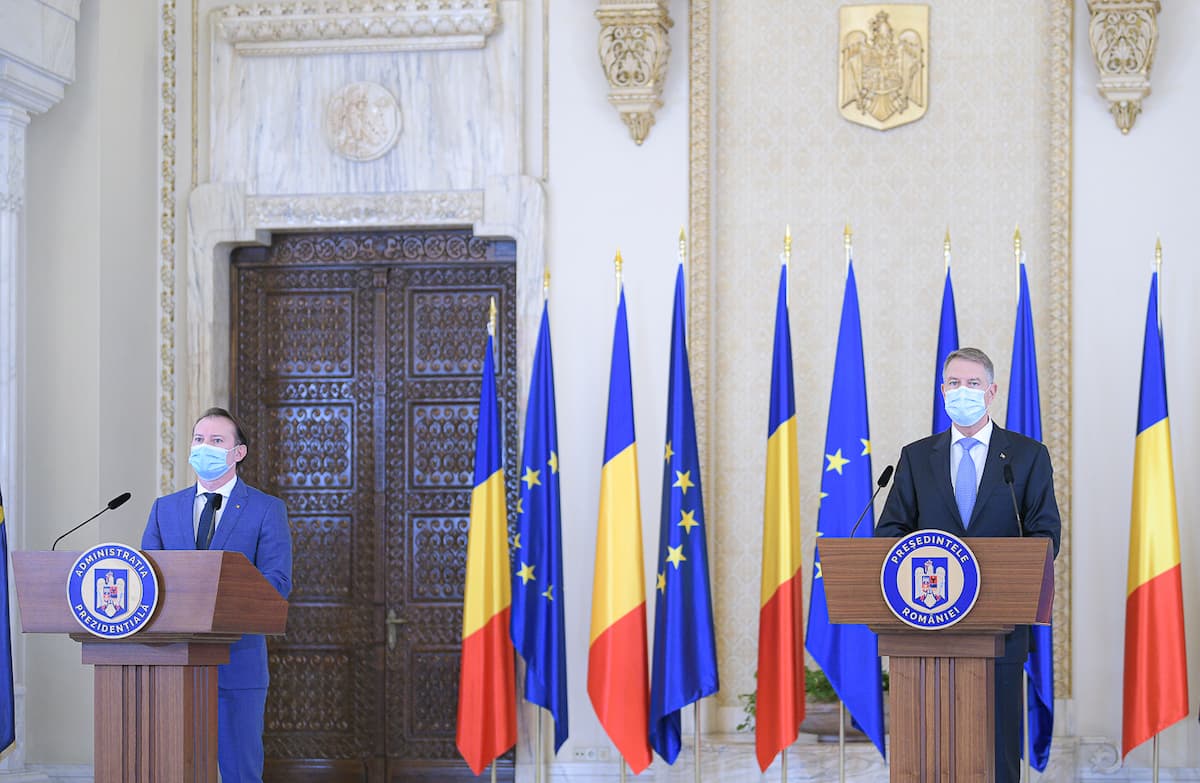
Romania's president Klaus Iohannis (right) designated finance minister Florin Citu (left) to form a new Government on behalf of a center-right coalition of three parties formed around the National Liberal Party (PNL).
Citu should come up with a cabinet and get the lawmakers' vote within ten days. The ruling Coalition's leaders pledged to have the new Government endorsed in Parliament by the end of this week.
The three political forces in the Coalition already split the 18 ministries. PNL will control traditional ministries, including the portfolios of defense, interior, finance, energy, and foreign affairs, and will also appoint the ministers of education, culture, agriculture, and labor. These ministries are essential for president Iohannis' main strategic projects, including the strategic partnership with the US in the energy and defense sectors.
The reformist alliance USR-PLUS will control the ministries with the potential to boost the public sector development: justice, EU funds, health, transport, research and development, and economy.
The ethnic Hungarians' party UDMR was assigned several key ministries as well: development (regional development financed from national budget) and environment (supposed to intermediate major financing for Green Deal), plus the ministry of youth and sports.
Fragile center-right Coalition signs agreement for four-year term
Backed by a fragile majority of 52.4% in Parliament, the National Liberal Party (PNL), the reformist alliance USR-PLUS and the ethnic Hungarians' party UDMR sealed a ruling agreement expected to remain in force for the coming four years. Both major partners in the Coalition, PNL and USR-PLUS, got scores some 5pp lower than expected. Meanwhile, the Social Democrats (PSD) won the biggest chunk of the votes and are in control of just over one-third of the MP seats - a blocking minority that is of practical importance only in the case of major decisions such as the indictment of the president or the amendment of the Constitution.
At this moment, these are remote scenarios but they may occur during a four-year term - the populist party AUR plans to suspend from post and overthrow president Klaus Iohannis, and the ruling Coalition might want to change the Constitution in several points: banning the appointment in public seats for candidates convicted for important criminal deeds or even cutting down the number of MPs to 300 in line with a public referendum already passed.
Under a clause of the agreement, the signatory parties consent not to accept MPs of other parties - a clause broadly seen as authored by the smaller party of ethnic Hungarians as a precaution. But the clause may erode the position of the ruling Coalition if its MPs decide to defect. At this moment, the ruling Coalition holds 11 MP seats more than needed for a qualified majority in joint sittings. In the Chamber of Deputies, the margin is even smaller: four out of the 330 votes. However, the ethnic minorities' deputies (18) have traditionally backed the ruling Coalition by default - once it was established.
Free newsletters
Romania, in your inbox before your first coffee.
Get the Daily — the morning briefing, free, in English, unsubscribe anytime. Want business, real estate or travel digests too? Pick your newsletters →