What’s the real incidence rate of COVID-19 cases in Romania and which are the most affected regions?
The new restrictions decided by the Romanian authorities to limit the COVID-19 spread, such as closing restaurants in Bucharest, have sparked heated debates on whether these measures are justified or not. One of the controversies is…
Andrei Chirileasa · Journalist
· Updated · 3 min read

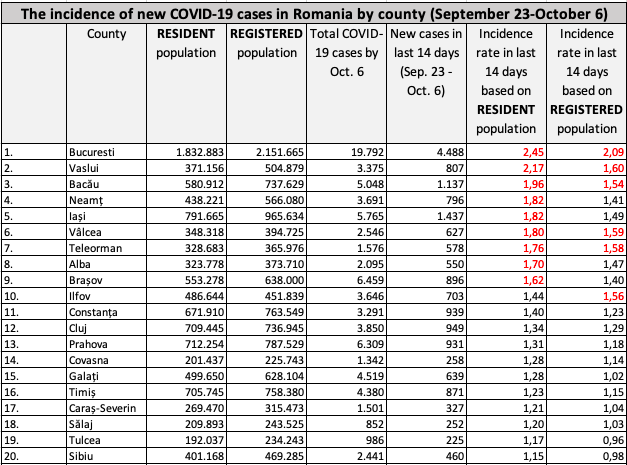
The new restrictions decided by the Romanian authorities to limit the COVID-19 spread, such as closing restaurants in Bucharest, have sparked heated debates on whether these measures are justified or not. One of the controversies is related to the real incidence rate of new COVID-19 cases and whether the data is accurate or not. Romania-Insider.com has crunched the numbers to find the truth behind the public noise.
The controversy is related to the 1.5 threshold over which local authorities in Romania must act and enforce restrictions to limit the virus spread. The incidence rate is calculated as the total number of new COVID-19 cases over 14 consecutive days divided by the population. The indicator is expressed as number of new cases per 1,000 inhabitants, in which case the threshold for moving into the yellow scenario is 1.5, or per 100,000 inhabitants, in which case the threshold is 150. The yellow scenario includes moderate restrictions, such as closing restaurants, cinemas, events halls, and switching schools to a hybrid system in which students attend both classroom and online courses.
When the incidence rate goes over 3 (new cases in the last 14 days per 1,000 inhabitants) or 300 (per 100,000 inhabitants), the authorities activate the red scenario, which triggers harsher restrictions, including closing schools.
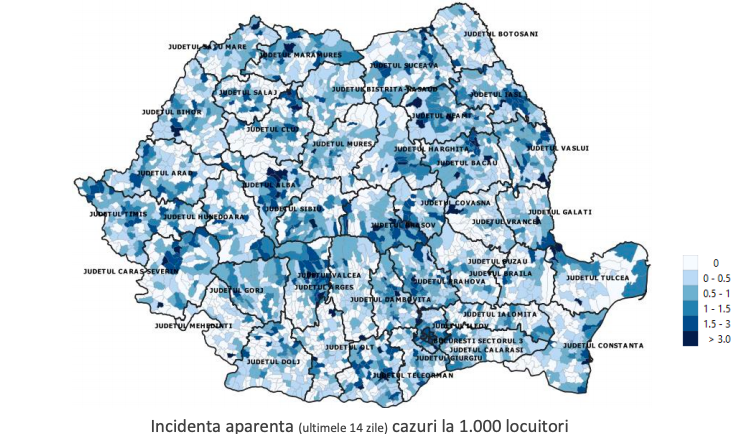
The authorities calculate the incidence rates at a local level, but the data for each locality in Romania is not public. The authorities only released the incidence rates per locality once, on September 7, before the beginning for the school year. Since then, the numbers have been kept secret, but the authorities release a map that shows the COVID-19 hotspots (see picture below - localities painted in darker shades of blue have highest apparent incidence rates).
However, the incidence rates per county are made public every week in the reports of the National Public Health Institute – INSP. These numbers reveal which are the most affected counties in Romania and are a good indicator of where restrictions could be enforced next. The latest report published on October 5, showed that the capital Bucharest had the highest incidence of new COVID-19 cases in the last 14 days – 216.9 per 100,000 inhabitants. Eight other counties had incidence rates of over 150 per 100,000 inhabitants: Vaslui (199.9), Bacau (190.0), Iasi (177.9), Neamt (175.7), Valcea (173.1), Alba (160.6), Teleorman (150.3), and Brasov (150.2). The first four counties are located in Romania’s Moldova region, which seems to be the hardest-hit by the pandemic.
Free newsletters
Romania, in your inbox before your first coffee.
Get the Daily — the morning briefing, free, in English, unsubscribe anytime. Want business, real estate or travel digests too? Pick your newsletters →