Bucharest Centennial: The C.E.C. Palace, a landmark of the changing capital
Romania-Insider.com has started a series of articles about Bucharest landmarks of architecture or history, which have witnessed the last century of what is now the Romanian capital, and noteworthy people who have helped build the Romanian…
Romania Insider · Journalist
· Updated · 5 min read
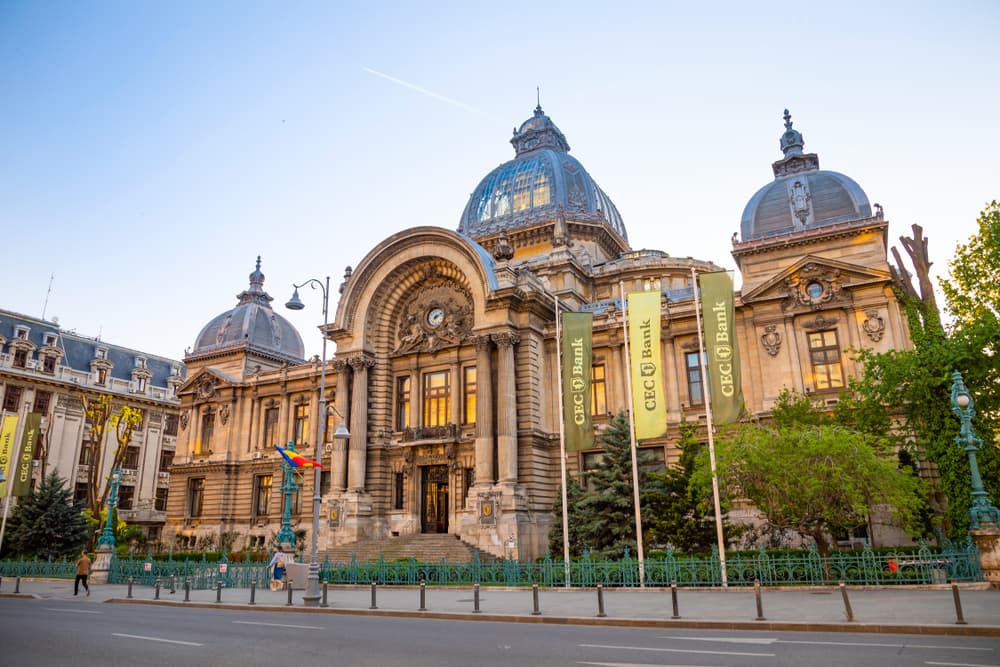
Romania-Insider.com has started a series of articles about Bucharest landmarks of architecture or history, which have witnessed the last century of what is now the Romanian capital, and noteworthy people who have helped build the Romanian capital as it is today. This project is supported by the Bucharest City Hall through the Public Monuments and Touristic Heritage Administration (AMPT), within the cultural program Bucharest-Centennial.
Check the full series of articles dedicated to the Centennial on Romania-Insider.com here. Among the landmark buildings of the capital, the Palace of the Savings Bank (C.E.C. Bank, short for Casa de Economii si Consemnatiuni in Romanian) has its distinct place, both for its architecture and for the role of the institution it hosts: one of the first of the Romanian state formed after the Union of the Principalities of 1859, and later, an important one of Great Romania, created after the 1918 Union. As it happened with other reference buildings of the capital, the palace was erected during the reign of Carol I, at the time of the modernization process that Romania had undertaken. But the history of C.E.C. began in the period preceding the reign of Alexandru Ioan Cuza, with a first statute of the “keeping and lending house” drafted by economist Costache Bălcescu and published in 1845. Modeled after statutes of savings houses in France and after that of the one in Brașov, established in 1835, it stipulated “the establishment of the savings house through voluntary private subscription in the city of Bucharest.” A few years later, in 1864, the finance minister Nicolae Rosetti-Bălănescu submitted a draft law concerning the establishment of a Deposits and Savings House, which Cuza approved, leading to the establishment of the savings bank C.D.C. The institution started its activity in 1865, under the management of Enric Winterhalder, a German who settled in Romania. He was also a director and general secretary with the Finance Ministry, while among the bank’s presidents were Ion Ghica and Costache Bălcescu, the brother of Nicolae Bălcescu. They took part in the 1848 revolution, which kicked off the process of affirming the shared national identity of the Romanian provinces, completed with the Great Union of 1918. The C.D.C administered funds and deposits from various sources and activities. At the same time, a Savings House was established, as an annex of the C.D.C, to attract deposits from people living in urban or rural areas. In between 1877 and 1878, the institution helped finance Romania’s Independence War, with the aid of the “mortgage tickets” which made up a significant amount of the resources needed to fund the participation in the conflict. Furthermore, until the banking system was established, the institution granted credits for building various projects of the public administration, such as schools, hospitals or churches. The project of the C.E.C. Palace, necessary since the bank had expanded its activity, was entrusted to architect Paul Gottereau, while Romanian architect Ion Socolescu was in charge of executing the works. Gottereau also designed in Bucharest the Cotroceni Palace, the Central University Library, and the first version of the Royal Palace, destroyed in a fire in 1926. On June 8th, 1897, the foundation of the construction was laid, in the presence of King Carol I and of Queen Elisabeth of Romania. The place chosen for the building had been taken until 1875 by the Sfântul Ioan cel Mare (St. John the Great) monastery and inn. The constructions were erected during the 16th century and restored by Prince Constantin Brâncoveanu at the beginning of the 18th century. They were demolished in 1875 as they had degraded. Following this, on Calea Victoriei, across the street from the