The pursuit of happiness and the true meaning of a cup
On the second floor of an apartment building in the center Bucharest lives an Indian teacher of Hinduism and a former TV personality. “Enjoy the feeling of being effortless,” says Yogeshvar Karthik, in a calm, firm voice. Some noisy birds…
Diana Mesesan · Journalist
· Updated · 6 min read
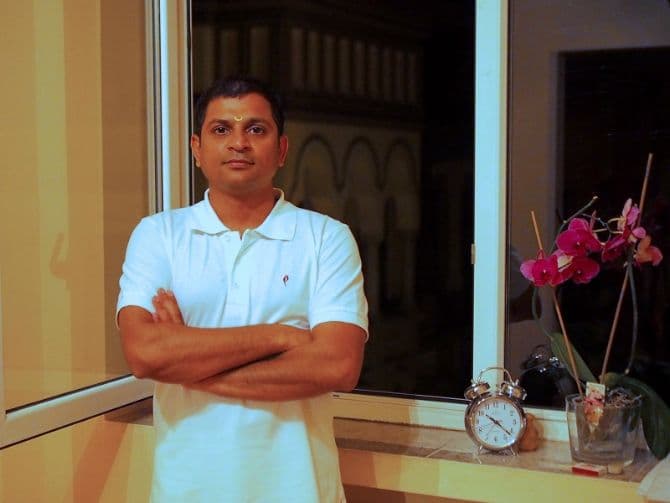
On the second floor of an apartment building in the center Bucharest lives an Indian teacher of Hinduism and a former TV personality. “Enjoy the feeling of being effortless,” says Yogeshvar Karthik, in a calm, firm voice. Some noisy birds chirp outside the open window, as the Yoga students try to relax and focus on the postures. Yogeshvar moves across the room and gives various indications about the correct position, or the right way to breathe. Born in Chennai, the capital city of the Indian state of Tamil Nadu, in a Brahmin family, Yogeshvar lives now in an apartment close to the Cismigiu Park in Bucharest. It’s here where he also teaches his Yoga and Vedanta classes. But he doesn’t consider himself a Yoga teacher. “Yoga is only one of the things. I teach Hinduism. I teach Vedanta. Yoga is an accessory of Vedanta. Vedanta is spiritual knowledge.” One can get confused with all these notions, but luckily Yogeshvar has a lot of practice in explaining subtle, complex concepts of Hinduism even to absolute beginners - even to a non-spiritual Romanian-born girl. In India he had a TV show for many years, where he taught Yoga and explained the theory behind. He says that even in the land where Yoga was born, people lack the correct understanding, and nowadays it’s seen more like fitness and sports, rather than a spiritual method. Add to that the fact that Yogeshvar belongs to the Brahmin class- the priests class- so he had been introduced to all this long long time ago by his father. In most Brahmin families, children are initiated into the ritual when they are 6 or 7, but his family is “semi-modernized, as he calls it, so his initiation was delayed until he was 13-year old. But ever since, he has practiced the ritual every day. “It was an initiation into a way of life that includes a lot of discipline and practice.” He wasn’t totally spiritual from childhood, but he enjoyed doing the ritual. “It’s like in Christianity, when a small boy goes to church, and he gets the opportunity to be the altar boy, and there are shiny things; he will love it.” But now, wearing a white t-shirt and white trousers, he takes the cup in front of me, that I used to drink a great herbal tea, which is served to all the students after the Yoga class, and says: “What is this? It’s a cup, if I want to drink something from it, but it becomes a projectile if I become angry. At that moment of anger I don’t see this as a cup, but as a projectile.Then let’s say I have a small nut to crack, a pistachio. I can use this cup as a hammer. But what is it? It is all that and more than that. Basically it’s clay. If I show this to a quantum physicist he will say, this is an idea, not even clay.” Then he adds: “What is this depends on what you want out of this. Similarly with reality. Spirituality talks about reality for you, and it’s about learning to relate to reality, in a way that it’s meaningful to me. So first I need to figure out what I want, then spirituality comes to tell you how to get what you want, without losing your head.That’s how it starts.Then it takes you to more complex aspects.”