A German coach helps people recognize their own miracles
It is a cloudy February day, but Petra Müller - Demary doesn’t mind it. Sunny days are demanding whereas dark mornings don’t ask for much from you. You can take your time and think. Petra, a tall, straight-backed woman, is sitting on a…
Diana Mesesan · Journalist
· Updated · 7 min read
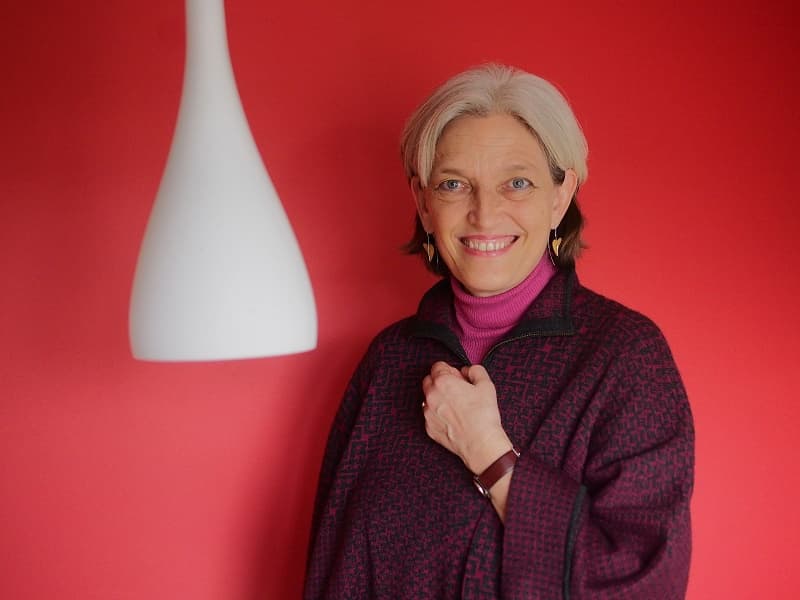
It is a cloudy February day, but Petra Müller - Demary doesn’t mind it. Sunny days are demanding whereas dark mornings don’t ask for much from you. You can take your time and think. Petra, a tall, straight-backed woman, is sitting on a big, cosy couch in her living room while I am on the other couch. It looks like one of Petra’s coaching sessions: she and another person sitting next to each other in search of a personal truth. Cologne-born Petra is a senior coach and trainer specialized in solution-based therapy. She has been living in Bucharest for more than 20 years. However, this time she is doing the talking and I am asking the questions. We meet for an interview at her home in Piata Domenii, a Bucharest neighbourhood with a lot of Art Deco houses. Petra is wearing a mauve poncho, contrasting the cloudy day and her white skin. Doesn’t she feel tired to listen to all the difficult stories people tell her and carry around their burden, a friend once asked Petra. But the woman had long overcome the temptation of thinking that she knows what’s best for another person. Maybe at the very beginning of her career she felt like she had to save the person that was coming to her. But she slowly began to grasp that there is no such thing as knowing what’s best for another human being. As a coach or therapist, you can only guide the person help herself. Petra likes a saying. Let me take you out of the water, said the friendly monkey and placed the fish on the ground. From the outside, it may seem that people are drowning or suffocating. But they are not. It’s curiosity what drives her and the confidence that a person can regain hope, although hope seems like the most absurd thing at a particular moment. “I am fascinated about what our brain can do, it’s the force of life.” Petra says. “You see people sitting in the darkness and you see that they are getting out of it. Having this experience again and again helps me stay away from the temptation of saying I am going to save you. You are going to save you.” Whether she works with top managers or people that need counselling on a personal level, Petra is asking questions to help people look at reality from a different angle. As human beings, we are all constructing our reality. There is no such thing as an objective reality. Switching the perspective is sometimes the exit out of a situation that seems without escape. Petra also does team coach. Somebody once told her that they haven’t made a lot of changes in the organisation, but that somehow things went smoother after the coaching sessions. “Sometimes I say I am the drop of oil in a machine,” Petra says smiling. “You don’t need to change a lot, but it will work better.” Simplicity Growing up in Cologne has shaped Petra into becoming the person she is. Cologne is a rich city, with ten-million inhabitants and a very good infrastructure that makes it one of the most easily accessible metropolitan areas in Europe. As a true inhabitant of Cologne, Petra has always been an independent, confident woman, who liked to meet people and get things organized. But she also grew increasingly disappointed with how life developed in Germany’s fourth largest city. It was too much about the job you had, the car you drove, the area you lived in. She felt that people forgot to talk about what they actually enjoyed in life, about whom they really were. And this is exactly what made Romania attractive for her in the ‘90s. Her husband came to Romania on an expat contract at the beginning of the ‘90s. He is of German origin and was born in the Romanian town of Turda, but moved with his family to Germany in the ‘70s. In 1995, Petra joined him and moved to Bucharest. Still recovering after decades of communism, Romania was very poor. But for Petra, the country had a certain innocence which she liked. She met artists, musicians, scientists who had very little money, but were very passionate about culture and things that weren’t material. Petra remembers a musician friend who once organised a concert in his tiny bedroom. He still had posters from the ‘70s and wallpaper in his room. But he had a huge keyboard. The guests were sitting on the bed and listening to the music he played. For Petra, this simplicity was attractive. Unlike Cologne, it seemed to be about people and not about what they owned. But this dream of simplicity has dramatically faded away in the 2000s. The wealth dream was taking over a country that had lacked money for a long time. For Petra, the good part was that things slowly became more predictable. “If you want to make God laugh, make plans,” says Petra, thinking about her first years in Romania. Everything was relationship-based those days. You needed a plumber? You had to know somebody who knows somebody who knows somebody. Everything took forever, and even paying your phone bill was a challenge. Her husband’s expat contract finished in 1998, and Petra had to make an important decision. Move to other countries and start anew again and again, or take a different way. But Petra didn’t want to typical expat life. She wanted to settle down and build up something for herself. “It’s difficult to be the wife of someone who is an expat. Your plans have no impact on the decision of the company,” she says. Returning to Germany seemed boring. But Romania presented so many opportunities. And it also had a beautiful, wild countryside. So they decided to stay in Romania and build up a life here. Almost 20 years later, here we are drinking coffee and tea in her living room in Bucharest.