Mark Francis Williams draws art and gymnastics together
A British artist living in Bucharest discovers that everything in life, from art, to sports, to music, follows the same patterns. The building looks massive like an old school. “There’s only renters inside,” says a guy who has just parked…
Diana Mesesan · Journalist
· Updated · 7 min read
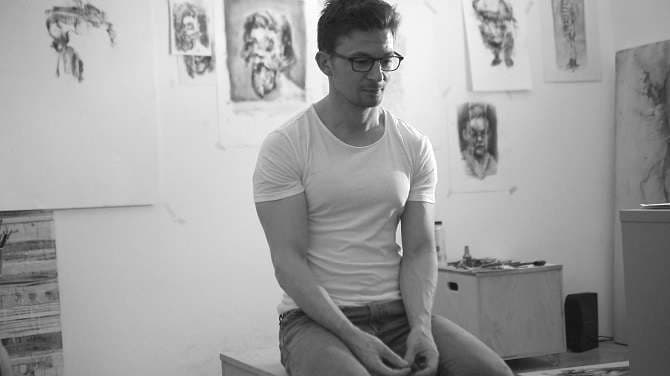
A British artist living in Bucharest discovers that everything in life, from art, to sports, to music, follows the same patterns. The building looks massive like an old school. “There’s only renters inside,” says a guy who has just parked his bike and is taking pictures of this downtown Bucharest building. We’re both standing in front of the entrance door. I’m waiting for Mark Williams, a British artist. We agreed for an interview in his studio. The guy next to me is from Enel, a local energy provider. He came to check the electricity readings for those who don’t declare consumption. “They pretend they are never home.” He’s angry at them, and at the building. Mark Williams shows up- but he is not the pray the electricity guy is after. We pass through a large, shadowy yard and then start climbing the spiral staircase. The stair makes me feel dizzy, but Mark moves easily through the narrow space, with his thin, yet taut body, after years of cycling, running and gymnastics. The studio is cosy and filled with light. It shelters a bike, a bookcase and many drawings. Actually, not that many, Mark says. He has just shipped several works to a gallery in the UK. Mark has been living in Bucharest for ten years, a great part of his adult life. He almost doesn’t remember how it feels like to live in the UK. He does have his parents there and exhibits almost exclusively in England. But his life is in Bucharest and here is where he transfers his experiences on canvas. “Everything fits your way into your work, but not in a conscious way either.” Most of his black & white drawings display people. It’s not a random thing, Mark explains. “Our life is about other people. Other people are the main thing that in your head all the time. Of course you notice the environment when you walk down the street, but there is a hierarchy to what you notice. And I’m noticing people.” Faces are not visible in Mark’s drawings. They are all blurred and ambiguous. He doesn’t go about specific stories and individuals. “If there’s a narrative at all, it’s the narrative …it’s sounds horribly cliché and grandiose…but it’s the narrative of everyone, the narrative of living.” The backflip Mark moved to Romania in his late 20s. He didn’t want to work as a freelance illustrator for various clients anymore. “The work became more and more subverted by the client. Eventually I felt like a mini factory. It took away the joy of my own work.” He got a certificate in education and thought he could teach art for a living, while making his own art. That’s how he arrived in Bucharest in 2005, to teach at the British School. One of the things he knew about Romania was gymnastics. He also knew that he was too old to start training, but he started it anyway. He was drawn by the physical challenge of it. How far can you push something? “That’s like triathlon. I was never interested in team games. For me it’s just like not intense enough. When I cycled, I started with 25 miles, then 40 then 80 then 120. Every time I wanted to cycle more.’ So he started gymnastic, with learning to do the backflip. “I was failing, failing, failing and I thought if I kept trying I would succeed". But his gymnastics teacher told him he needed to stop because he was now teaching himself how to do it badly. “By practicing many times you’re not doing it better, you’re doing it wrong.” “There’s a difference between determination and obsession,” she explained Mark. “You need to be willing to stop repeating that mistake because you’re going nowhere and change something.”