Green tea with a no ordinary diplomat: Rene Kubasek of the Czech Centre in Bucharest
Rene Kubasek, the director of the Czech Centre Bucharest, makes diplomacy seem like fun. If this article were to be a comic strip, it could start with an image of Rene Kubasek’s office, seen from above. Rene has a nice office: big windows,…
Diana Mesesan · Journalist
· Updated · 8 min read
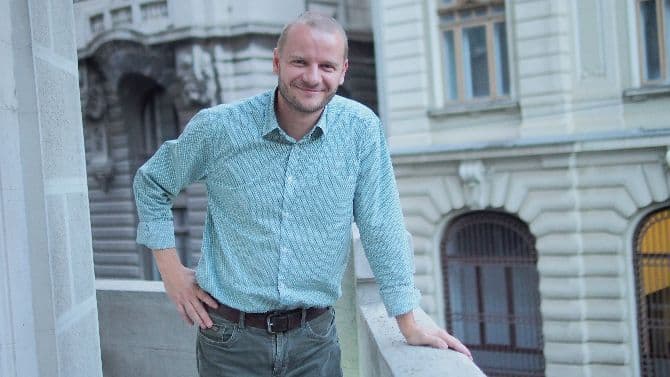
Rene Kubasek, the director of the Czech Centre Bucharest, makes diplomacy seem like fun. If this article were to be a comic strip, it could start with an image of Rene Kubasek’s office, seen from above. Rene has a nice office: big windows, a large balcony, film posters, and a lot of books. It’s almost like his own room. But you could say, who cares about a nice office? And I would answer: if you have a nice office, there are at least some good premises for a nice life. Or it could start with an image of this active Czech guy riding his bike through the flat Bucharest, wearing his checkered cap and knowing everybody in the city. But this is not a comic strips. A proper introduction is due. Rene Kubasek has been the director of the Czech Centre Bucharest for the last four years, has organized so many interesting events that he almost deconstructed the myth that diplomacy is boring. He dared to show his own photographs to Josef Koudelka, the great Czech photographer, and has two kids. In a few months - that is, in February - he will leave Bucharest for good, as his job here comes to an end. The green tea As I enter the Czech Centre building designed by a Romanian architect a century ago, I notice a lot of bicycles. Some of them are diplomatic bikes, Rene explains laughing. “Every time we have guests, we show them the city by bike. Only once a girl couldn’t ride the bike, so we taught her.” He became a bike fan only when he moved to Bucharest and received a bike from a friend. He thinks Bucharest is the perfect place to ride a bike. “It’s flat. All the rest you can manage. If it’s hilly it’s difficult. And bikers are such rare creatures here that cars rather let you go in peace.” A little teapot with green tea waits on the table, in Rene’s office. “Do you like green tea?” I ask him. “Not really,” he replies. “Oh, so it’s only for guests.” “No, it’s only for you. You said you are getting a cold. And when I’m really tired, this prevents me from sleeping in the afternoon.” It seems that Rene Kubasek is not only kind and friendly, but also knows how to make a good cup of tea. Aren’t the diplomats supposed to be the stiff, telling deeply elegant and boring stuff? “I think there are stiff people in every field, I know many diplomats who are super relaxed, inventive people, and my case, being a diplomat in the field of culture, I'm not a career diplomat,” Rene explains. “I sometimes get to know young people, young diplomats and I can see that they have their idealistic image about diplomacy, but in the end it may be a super boring job. But it’s all about the person. How open you are.” Pouring some green tea, I go on asking Rene: “If your drink is not green tea, what is it”? “I’m Czech, so it would be beer. It’s like the mother’s milk of Czechs,” he answers in his direct, funny way. The notebooks Even though he studied Political Sciences, and was interested in international relations, he didn’t want to pursue a career in this field. “My father was a diplomat, so I spent my childhood in foreign countries. It gave me something, but I also lost connection with my friends, my country and so on, and I didn’t want to live this life, and in the end I basically ended up the same.” His background is mainly in the NGOs sector. He used to work in an NGO which was founded and somehow run by the former president Vaclav Havel, organizing meetings of very interesting people, from all walks of life, including Dalai Lama, politicians, writers, who met once a year to discuss the future of the planet. Then he was the Czech representative for three years in the Visegrad fund, a fund for Czech Republic, Slovakia, Hungary and Poland, that distributes money to the joint artistic projects, NGOs, festivals, artists. “Sort of similar to what I do here.” And now he’s in Bucharest, this city whose current dynamics and freedom resembles Prague in the ‘90s. He thinks this is the best moment for Bucharest, because new things are searched for and experimented, whether in Prague, for example, everything is now settled and stabilized and it gets a little more boring. “All the Czech artists we invite here are really impressed and want to come back.” On Rene’s working table there are so many notebooks, with covers made out of maps, or dictionary pages, that a writer could get a bit jealous. There are literally more than 20 notebooks, with notes written in Czech, about newsletters, press releases, all sorts of comments, even drawings. “Basically it’s my external memory, my computer,” he says. They mix personal and work information, because in his life here, these two categories are so much interlinked, that he couldn’t separate them. “Actually I wish I would write a diary. And very often I’m thinking it’s never too late. But I’m lazy for that. I need discipline and I don’t have it for that.”