Politicians, businessmen and activists debate environment at Bucharest Climate Change Summit
Bucharest’s surrounding forests are cut down while its inhabitants breathe in more and more pollutants. Globally, we’ve wiped off almost 70% of wildlife species in the last 50 years, including those contemporary to dinosaurs, and to make…
Radu Dumitrescu · Journalist
· Updated · 4 min read
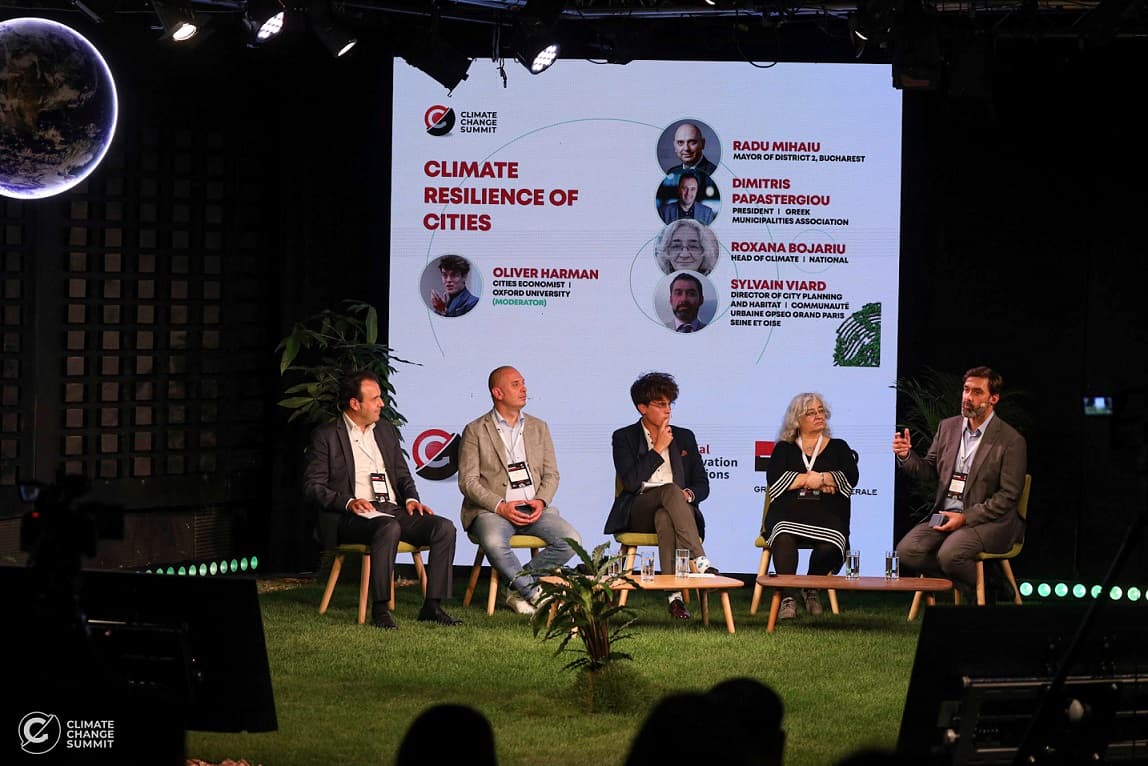
Bucharest’s surrounding forests are cut down while its inhabitants breathe in more and more pollutants. Globally, we’ve wiped off almost 70% of wildlife species in the last 50 years, including those contemporary to dinosaurs, and to make up for it we’ve built bike lanes. We are co-authoring our own demise, blindly hunting profits while the world’s coastline cities are sinking. There are solutions out there, but we think they are too costly or bothersome. These are some of the conclusions of the first Climate Change Summit, which reunited Romanian and European politicians, business leaders, and environmental activists in Bucharest for two days packed with talks and panels.
The speakers underlined the urgency of a more environmentally-conscious lifestyle and specific policies that can be implemented at all levels to safeguard the world’s and Romania’s biodiversity, forests, and also its cities and economy.
The event, organized by BRD Groupe Société Générale and Social Innovation Solutionsas part of the Lumea9 (New World) sustainability platform, took place at the Odeon Theater in Bucharest between 4 and 5 October.
The forum featured speakers such as the World Bank’s Anna Akhalkatsi, country manager for Romania and Hungary, Emmanuel Martinez, chief environment economist at Société Générale, Romanian ministers Sebastian Burduja, Florin Spătaru and Tanczos Barna, as well as many others. The event also included a video message from Indian spiritual leader Sadhguru. Romanian president Klaus Iohannis sent a message to the audience, delivered by Maria Bocșe, a state councilor with the Climate and Sustainability Department.
The stage of the Odeon theater, from which speakers addressed those gathered in the room as well as around 4,000 people attending remotely, was covered with real grass for the summit. Each guest tackled specific environmental topics ranging from biodiversity to energy consumption and storage. The event took place mostly in English, but some speakers chose to use Romanian during their time on stage.
Hans van der Loo, chairman of the Institute for Integrated Economic Research, noted that much of humanity’s assets are built along coasts and that cities such as Venice, Amsterdam, or Hamburg would be flooded if the Greenland icecap would melt. He also said that massive CO2 emissions are involved in producing a single combustion-powered car, which are released before the car is ever driven, and that fundamental changes in humanity’s lifestyle must occur.
Environmentalist and high-altitude climber Alex Găvan, participating in one panel, made an impassionate plea for the preservation of the remaining forests that surround Bucharest and other major cities. Găvan has repeatedly called for the creation of a protected
Free newsletters
Romania, in your inbox before your first coffee.
Get the Daily — the morning briefing, free, in English, unsubscribe anytime. Want business, real estate or travel digests too? Pick your newsletters →