Bucharest redesigns Herăstrău lake-shore works to protect healthy trees
A survey of 1,844 trees prompted the authorities to reduce the planned concrete surface and preserve specimens that are healthy or can be saved.
Irina Marica · Journalist
· 3 min read
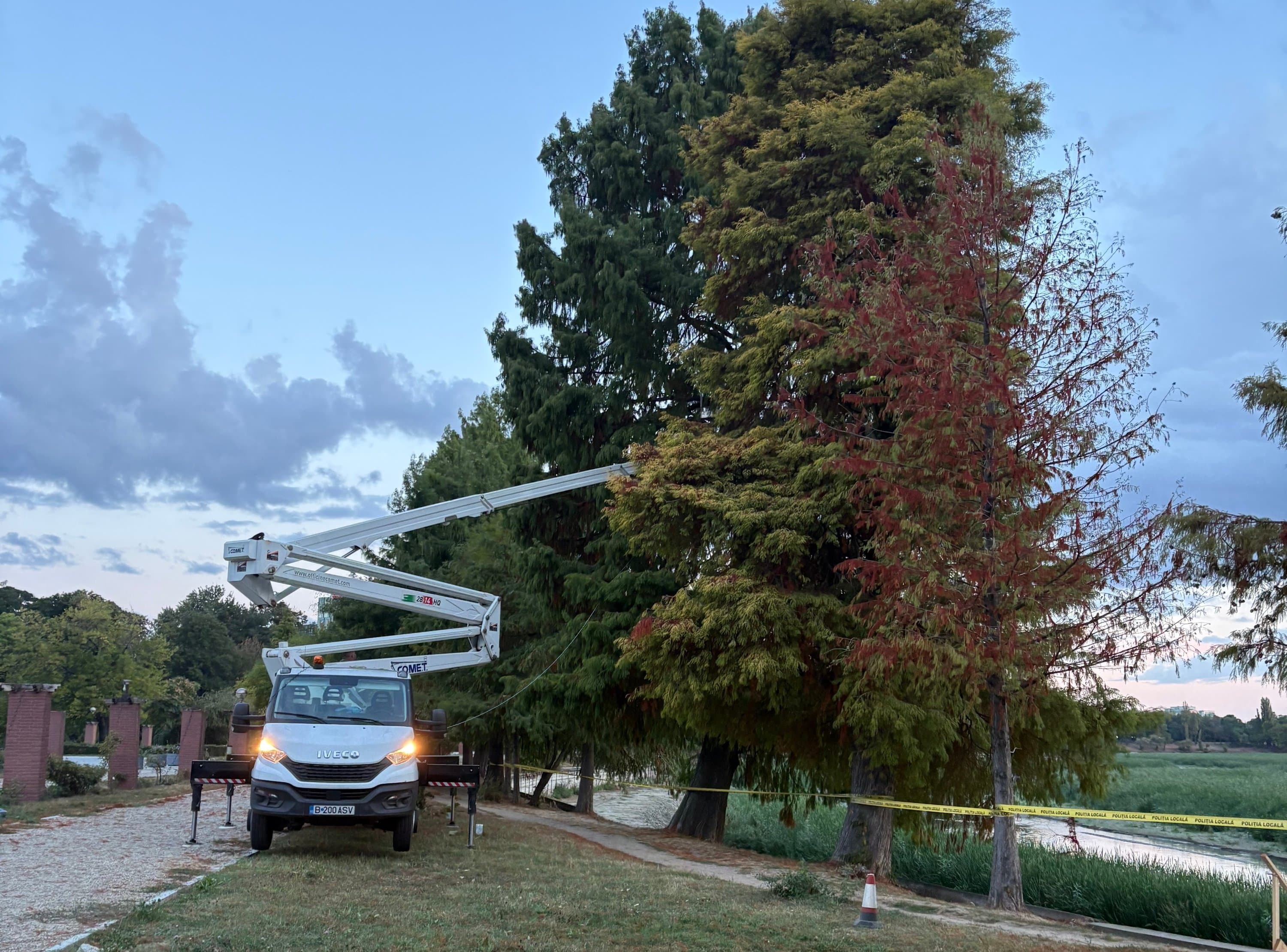
Bucharest City Hall has revised the technical plans for reinforcing the shores of Herăstrău Lake following a specialist assessment of every tree along the waterfront. Information and photographs for all 1,844 inventoried trees are also being added to a digital registry accessible to the public.
The assessment was conducted by the Bucharest-Ilfov branch of the Romanian Landscape Architects Association, or AsoP Bucharest, as part of a wider public-private initiative to regenerate Herăstrău Park.
The initial reinforcement project was considered technically suitable from a hydraulic engineering perspective but would have created a two-metre-wide concrete walkway around the lake and required the removal of trees, according to Bucharest mayor Ciprian Ciucu.
“I cannot imagine a Herăstrău with a two-metre concrete path around the lake, which would have meant removing all the trees,” Ciucu said, as quoted in the press release. “We chose to stop and rethink the project in order to save them.”
The revised design reduces the area covered by concrete and introduces spaces where flowers and shrubs can be planted. It is intended to avoid cutting down healthy trees or specimens that specialists believe can be preserved.
According to the assessment, 420 trees are in good condition and 697 are in reasonable condition. Another 403 were classified as being in poor condition, while 54 were found to be dead.
The risk assessment identified 1,070 trees as low risk, 259 as moderate risk, 74 as high risk and ten as extreme risk. A total of 1,036 trees require no intervention, according to the official statement.
Recommended work varies according to the condition of each specimen. The proposals include removing deadwood from 408 trees, cleaning the crowns of 393, and reducing the weight at the ends of branches in 330 cases.
Other possible measures include crown restoration, thinning or reduction, structural repairs, and shaping young trees. Some degraded, dead or dangerous specimens may be removed where the technical assessment finds this necessary.
The survey also identified problems including insufficient water, compacted soil, leaning trunks, deadwood, and broken branches.
“The digital inventory allows us, for the first time, to move from a general picture of the vegetation to a detailed, tree-by-tree assessment of an important area of Herăstrău Park,” said Andreea Răducu-Lefter, president of AsoP Bucharest.
She described the Green Registry as both a record of current conditions and a tool for planning immediate work and monitoring the park’s vegetation over the longer term.
Free newsletters
Romania, in your inbox before your first coffee.
Get the Daily — the morning briefing, free, in English, unsubscribe anytime. Want business, real estate or travel digests too? Pick your newsletters →