Guest post: Three decades after the Fall of the Berlin Wall, Romania sees most notable economic liberalization
Romania is the former communist country that has recorded the most significant improvement in economic freedom in the 30 years since the Fall of the Berlin Wall, shows this analysis by Tanja Porčnik, Senior Fellow of the Fraser Institute.
Romania Insider · Journalist
· Updated · 4 min read

Romania is the former communist country that has recorded the most significant improvement in economic freedom in the 30 years since the Fall of the Berlin Wall, shows this analysis by Tanja Porčnik, Senior Fellow of the Fraser Institute.
The fall of the Berlin Wallon November 9, 1989, was not only the beginning of the reunification of German as the people of Berlin brought down a monstrous physical barrier that cut through their city since 1961, it was also one of several events that in the months and years to come would have more than 100 million people turn their back to communism, also because of their fortitude to steer their economies out of socialism toward the market.
Prior to the fall of the Iron Curtain, the former socialist economies—to the East of the now infamous barrier dividing Europe—varied considerably in their degree of openness, soundness of their institutions, economic growth and the development process. Similarly, these countries opted for different paths of market liberalization, some of them moving rapidly and with great strides to reform and liberalize their economies, while others were only undertaking gradual and few transitional steps. Today, thirty years later, unsurprisingly, public policies and political institutions of the former socialist economies do not equally support economic freedom. However, notably, they support it to a greater extent than they did before the 1990s.
Providing a quantitative assessment of the degree of market liberalism, the Fraser Institute Economic Freedom of the World index displays that the highest levels of economic freedom in Eastern Europe, Caucus and Central Asia in 2017, the most recent data available, were in Georgia, Estonia, Lithuania, the Czech Republic and Latvia, while the lowest levels of economic freedom were in Ukraine, Tajikistan, Azerbaijan, Belarus and Moldova (see Figure).
Economic Freedom, Former Socialist Economies, 1995-2017
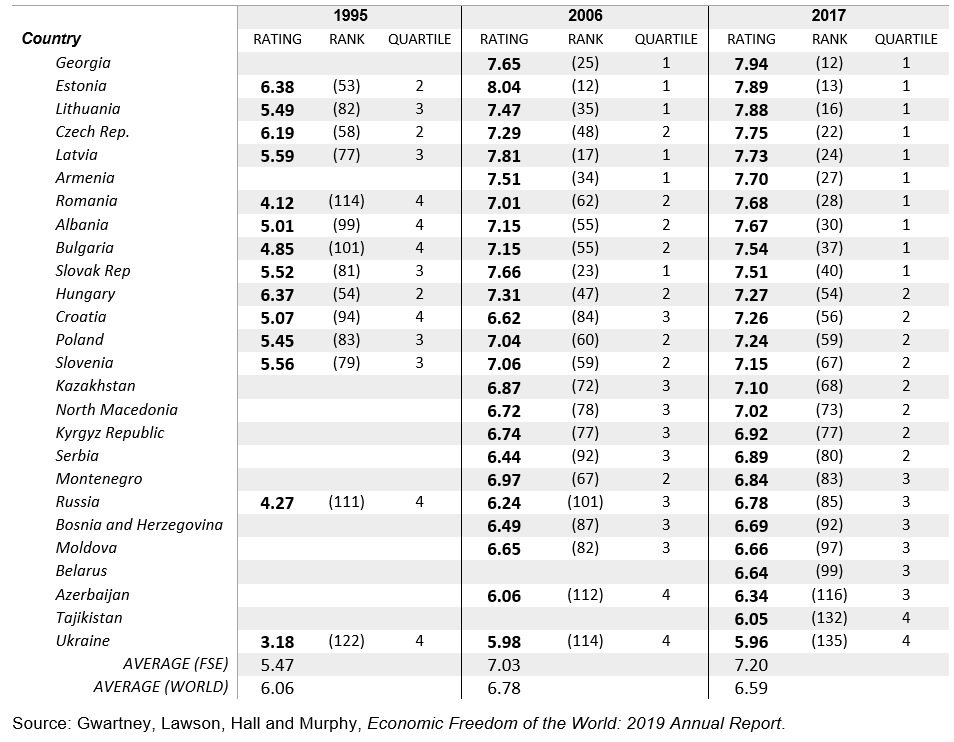
As the data show, all the former socialist economies in Eastern Europe, Caucasus and Central Asia have strengthened their market features since the fall of the Iron Curtain. This sizeable and wide-spread transformation reflects the region’s wholehearted embrace of private property, the rule of law, entrepreneurship, free trade, foreign direct investment and globalization. Actually, in the last few decades, economic liberalization has spread across the former socialist region at a higher pace than in the world, with the average degree of market liberalism in the former socialist economies (FSE) increasing from 5.47 in 1995 to 7.20 in 2017, while the average level of economic freedom in the world went from 6.06 in 1995 to 6.59 in 2017.
Free newsletters
Romania, in your inbox before your first coffee.
Get the Daily — the morning briefing, free, in English, unsubscribe anytime. Want business, real estate or travel digests too? Pick your newsletters →