Swedish diplomat discovers Bucharest’s volatile beauty by bike
Alexander Peyre knows about Romania’s capital more than people born here, but his curiosity is still restless. Alexander, half Swedish, half Uruguayan, is riding his bike to work, like he usually does, wearing a suit. It’s September 2013…
Diana Mesesan · Journalist
· Updated · 6 min read
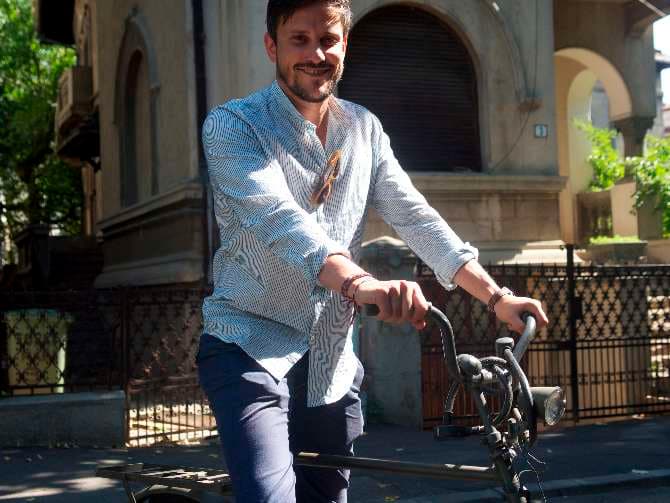
Alexander Peyre knows about Romania’s capital more than people born here, but his curiosity is still restless. Alexander, half Swedish, half Uruguayan, is riding his bike to work, like he usually does, wearing a suit. It’s September 2013 and he’s in his second week in Bucharest; he is the Deputy Head of Mission at the Swedish Embassy. Suddenly a car pulls over and a guy gets out. “Sorry to stop you, I just want to ask you the story of your bike. I really like your bike, and I am a bike fanatic.” “It’s a Swedish military bike, heavy as a tank and ready to fight cars,” Alexander says laughing. The story goes back to 1901, when Sweden introduced bicycle infantry. By the Second World War II, the Swedish Army had six bicycle infantry regiments. These bikes, however, became useless when the war was over and ended up in warehouses. Some managed to survive time, and were put up for sale in the early ‘90s. Alexander bought his bike when he was 17 from a shop near his house in Stockholm. It has accompanied him everywhere ever since, from his early morning rides after partying as teenager, to his rides in Buenos Aires or Teheran, where he later worked as a diplomat. Two years forward, Alexander parks his bike near a tree in Bucharest’s Dorobantilor Square, where we meet for an interview in the morning. The area hosts a lot of embassy buildings and local cafes regarded as meeting places of the capital’s nouveau riche. It also has less traffic compared to other areas of Bucharest. “When I look at the budget of Bucharest’s City Hall I can see that a lot of money goes to facilitating access of cars, whereas most European cities try to get rid of cars,” says Alexander. With coffees on our table, we start talking about Bucharest. Alexander says early on that he’s talking from the perspective of a simple observer who loves the city. Having lived in places such as Mexico, Teheran, Buenos Aires, Barcelona, Alexander’s gaze on Bucharest is both critical and loving. He loves the city’s asymmetry and its “volatile and endangered beauty”, but he is also very aware of the neglect and the danger Bucharest is experiencing. He mentions the Uranus Boulevard in Bucharest, whose first segment was inaugurated last year. For its construction, the City Hall approved the demolition of 90 houses, among them historical buildings. The fragile Romanian civil society tried to protest, but the authorities went on with the project. Alexander says that the forces of real estate speculation and the forces that want to transform cities without respect for the heritage exist in all countries, in Sweden too. But most of the countries have organized resistance, from the City Hall and Government institutions, but also from NGOs and citizens. This creates a balance. “In Bucharest, the balance is not there yet.” Sometimes, it only takes political will and very few resources to radically transform a city and the life’s quality there, he says. Buenos Aires, for example, was a huge, chaotic city, where biking was impossible, until the current mayor Mauricio Macri decided to make Buenos Aires a bike-friendly city. It now has more than 100 kilometers of bicycle lanes, as well as the most efficient bike public loan service in the world, which is free. This has reduced traffic a lot. Born in Stockholm and brought up by a Swedish mother and an Uruguayan father, Alexander has dark skin and dark hair and a slight Spanish accent. Even though he grew up in the Swedish capital, he spent half of his life in other cities. By now, he knows the magic recipe of adapting to a new place, the coping strategy, he says laughing. “The important thing is to be open to anything and be social with everybody. Get active in something that you’re interested in. For example I like swimming. And I met people at swimming that maybe haven’t necessarily become my best friends, but they introduced me to their networks, where you always find people that you really connect to.” He says that in social anthropology you have this theory of the people you first meet when you’re a foreigner, an alien in a new place. These are people that have lived abroad for a while, or they are searching for something new, people that are a bit outside of society. They are easier to get to know in the beginning and they can help you. *