Scientists discover oldest vestiges of human activity in Europe in Romania, dating back 2 million years
A recent scientific paper published in the Nature Communications journal revealed evidence of “hominin activity” dating back at least 1.95 million years in Romania. The result marks the oldest proof of human activity in Europe, predating…
Radu Dumitrescu · Journalist
· Updated · 3 min read
A recent scientific paper published in the Nature Communications journal revealed evidence of “hominin activity” dating back at least 1.95 million years in Romania. The result marks the oldest proof of human activity in Europe, predating that found in Georgia, set at 1.8 million years.
The findings were built based on a thesis proposed in the 1960s by one of the pioneers of Romanian prehistoric archaeology, Constantin S. Nicolăescu-Plopșor.
Specialists from research centers in Romania, the USA, the UK, Australia, Sweden, and the Republic of Moldova reanalyzed faunal elements discovered during the archaeological excavations conducted in the early 1960s at the Valea lui Grăunceanu – Bugiulești site in Vâlcea county, Romania. These elements were dated using the uranium-lead method, one of the most efficient radiometric dating techniques for objects older than one million years. The same methods were also applied to animal fossil remains uncovered at several sites nearby.
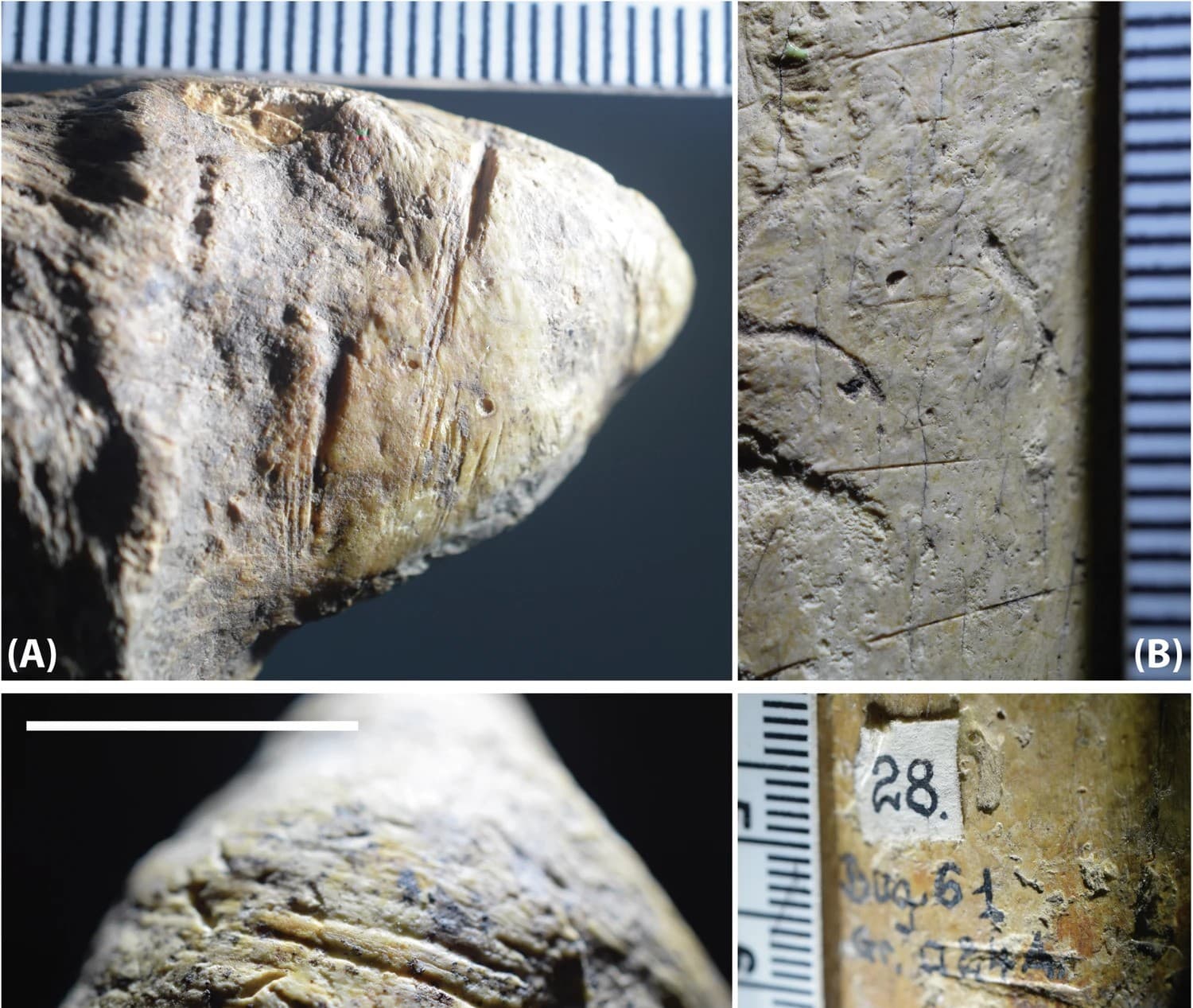
A total of 4,524 fossil elements out of 4,983 were analyzed using high-resolution microscopes to identify possible artificial modifications on their surfaces. The results showed that 20 of these fossils displayed incisions, with at least eight of them being definitively identified as artificially made.
According to the authors of the study, the placement of the incisions in anatomical positions indicating defleshing suggests a deliberate operation to remove soft tissues from bones - evidence of a hominin species capable of using tools for this purpose.
“These incisions had not been observed until now, even though the faunal elements were discovered nearly 60 years ago, simply because the specialists of those early days of Romanian prehistoric archaeology either did not pay attention to this aspect or failed to notice them. At the time, the focus was on the presence of possible bone tools, a hypothesis later debunked through detailed analysis of the elements in question,” noted Adrian Doboș, an archaeologist at the "Vasile Pârvan" Institute of Archaeology and one of the authors of the study, cited by HotNews.
Dating results indicated an average age of at least 1.95 million years for the fossils, possibly even exceeding 2 million years. This makes Valea lui Grăunceanu the oldest European site showing evidence of hominin activity.
“Given the extremely scarce fossil record from that period in Eurasia, it is difficult to determine the specific hominin species responsible for leaving these traces in Romania. Most likely, we are dealing with individuals of the Homo erectus species or evolutionary precursors of this species,” added Doboș.
Free newsletters
Romania, in your inbox before your first coffee.
Get the Daily — the morning briefing, free, in English, unsubscribe anytime. Want business, real estate or travel digests too? Pick your newsletters →