Analysis: Household income & spending, double on paper in five years. What's the reality behind the numbers in Romania?
The average monthly income of a household in Romania was nearly double in 2019 compared to the level recorded in 2014, according to official data presented by the National Statistics Institute (INS). But how much of this increase was on…
Andrei Chirileasa · Journalist
· Updated · 4 min read

The average monthly income of a household in Romania was nearly double in 2019 compared to the level recorded in 2014, according to official data presented by the National Statistics Institute (INS). But how much of this increase was on paper due to an artificial change and how much was it visible in people's actual net revenues? And how much of the growth in official spending numbers went to consumption? Have the population's revenues really increased twice as fast as the whole economy?
Romania-Insider.com has crunched the numbers to find the drivers behind this increase: how much of it is real, and how much of it just on paper?
Let's have a look first at how things look on paper, according to statistics.
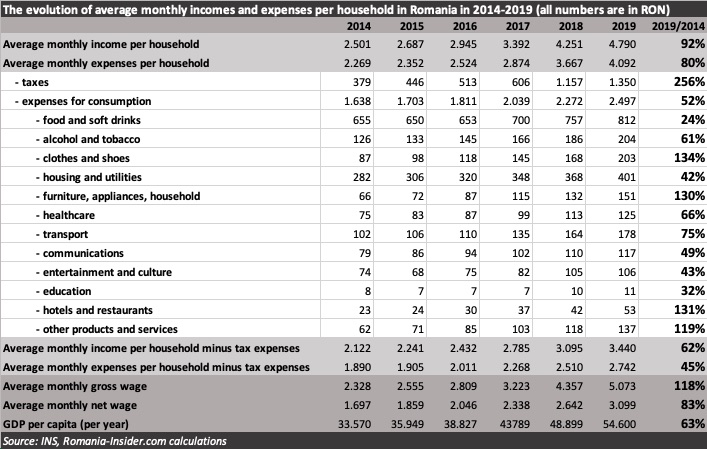
The average monthly income of Romanian households reached RON 4,790 (EUR 1,000) in 2019, official statistics show. It's for the first time when the average revenues of Romanian households pass EUR 1,000 per month.
The average income of local households went up by a whopping 91.5% compared to 2014, when it stood at RON 2,500 per month. By comparison, the GDP per capita increased by 63% in the same period. Thus, the population's revenues seem to have increased almost twice as fast as the economy as a whole.
The average monthly expenses per household went up by 80.3% during these five years, reaching RON 4,092 (EUR 854) in 2019. So the increase in revenues also brought about an increase in expenses.
These nominal growth rates were only marginally influenced by inflation, which was only 7.75% (combined) in the same period.
Theoretically, these figures paint a rosy picture: Romanians are earning more than they were earning five years ago, and they also afford to spend more.
But there's a catch...
The evolution of wages largely influences the average household income as it is officially reported. Salaries have indeed grown in Romania in the last five years. However, while the average gross wage was 118% higher in 2019 than in 2014, the average net salary was 83% higher. Where does the difference come from?
In January 2018, the Social Democratic Government moved all the social contributions paid on wages from employers to employees, thus artificially increasing gross wages. So, with this move, it just looked like people earned more; the gross wage includes taxes paid to the state, and the taxes part was the one that went up in this case.
When it calculates the monthly household income, the INS takes into account the gross salaries and not the net ones. So a significant part of the increase in household revenues was determined by this fiscal change.
Free newsletters
Romania, in your inbox before your first coffee.
Get the Daily — the morning briefing, free, in English, unsubscribe anytime. Want business, real estate or travel digests too? Pick your newsletters →