Frederic Vigroux's testimony that Chekhov was right about the gun
“If you say in the first chapter that there is a rifle hanging on the wall, in the second or third chapter it absolutely must go off, ” Anton Chekhov wrote. First Chapter Here is the five-year old Frederic Vigroux,- now 27 -, born in…
Diana Mesesan · Journalist
· Updated · 4 min read
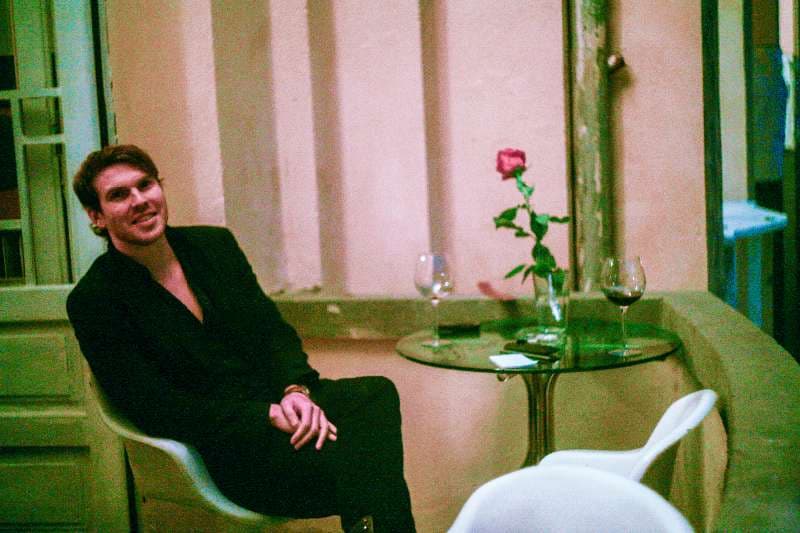
“If you say in the first chapter that there is a rifle hanging on the wall, in the second or third chapter it absolutely must go off, ” Anton Chekhov wrote. First Chapter Here is the five-year old Frederic Vigroux,- now 27 -, born in Serraval, in the French Alps, who in 1991 moves with his family to Bucharest, where people at the time learn to master a new groove called capitalism. Frederic has a big garden, goes to the French school and after three years moves back to France. Just like that. Romania remains a distant memory, kept in some Kodak pictures of a city with few Dacias and no advertising. It might well be the end of his story with Romania, but it isn’t. Once a bracket is open, it has to be closed and once a rifle is hanged on the wall, it has to go off. Second Chapter About twenty years later, on a beautiful, disturbingly spring-like October evening, Frederic’s long fingers grab the glass of red wine, swirl it and then carry it to the mouth. It’s about seven in the evening, at a café in Bucharest. This dimly moment of the day is the best hour to open a bottle of wine in the company of somebody, Frederic says. “Sometimes a Rose de Provence, a cheap wine, can be better than an expensive wine if it's in good company. I'm not saying this like a catch phrase, this is very, very honest. The best bottles I drank were those when I was in good company.” Frederic Vigroux's master thesis was about the representation of women in the Romanian cinema after the Revolution, so he returned to Romania in 2009, to study the Romanian cinema for four months. He found a job in the communication field and the four months extended to four years. Frederic knew all along the way that he would work in the wine industry some day, but he didn't know when. In February this year he launched his wine business called NumberWine, importing wine and selling it here. Even though Frederic thinks that one discovers wine in the family and not by himself, he doesn’t really have any family members who are involved in the wine business. Well, there is actually somebody. “When my grandfather retired he bought some shares into a champagne company and we were receiving 36 bottles of champagne per year.” Wine revealed itself to Frederic, while he was living in a small village in Burgundy, where life wasn’t exactly thrilling for a teenager and wine wasn’t more expensive than beer. He drove a scooter, did a lot of trips around the village, played the guitar in his room and drank a lot of wine. “You slowly start to understand that one bottle is better than the other by making comparisons. If you have three wines in front of you, you can make a real difference and say I prefer this one and then start to look for other wines from that region.” Things got more serious about 5 or 6 years ago, when Frederic was doing a master of political communication, in London. “After Christmas, I spent a lot of time eating and drinking and I realized it was really annoying for me not to be able to talk about the wine I really liked. There was a Chardonnay and a Sauvignon Blanc Sancerre I was really in love with and I wasn't very comfortable explaining why I like them so I decided to do a course of wine tasting in London. Wine is tasting, but is also a huge part of chemistry, agriculture.”