European Union Prize for Literature 2025: Bogdan Crețu's novel Less Than Love is Romania's nomination
Bogdan Crețu’s novel Mai puțin decât dragostea/ Less Than Love is Romania’s nomination for this year’s European Union Prize for Literature (EUPL).
Simona Fodor · Journalist
· Updated · 3 min read
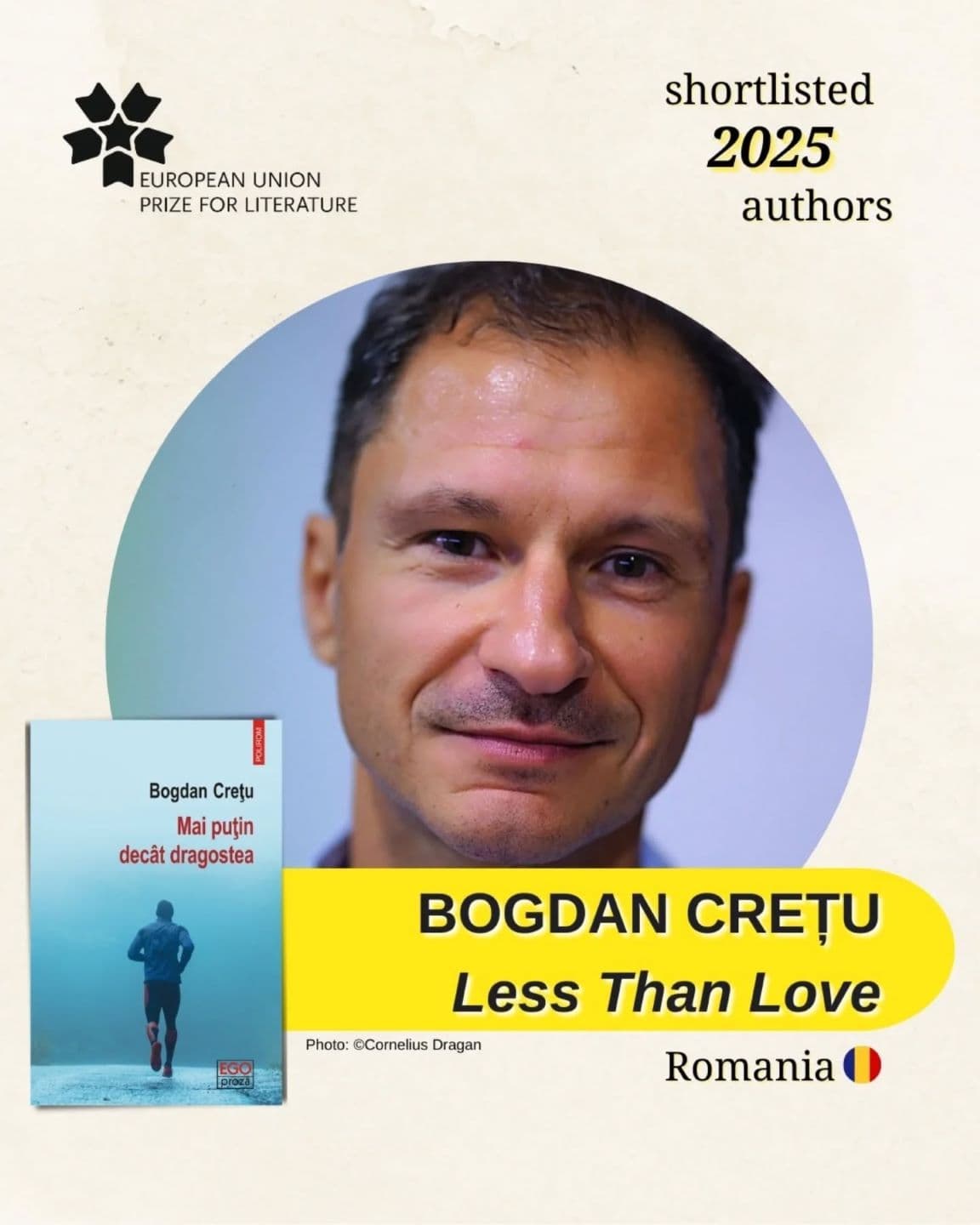
Bogdan Crețu’s novel Mai puțin decât dragostea/ Less Than Love is Romania’s nomination for this year’s European Union Prize for Literature (EUPL).
The EUPL recognizes emerging fiction writers from the European Union and beyond. Each year, national juries choose their proposal in a rotating selection of countries participating in the Creative Europe program.
The Romanian Cultural Institute (ICR) organized in 2025 the jury that designated the work representing Romania. The jury included writer, professor, and PEN Romania president Ruxandra Cesereanu; writer and translator Péter Demény, also chief editor of Matca literară magazine; and literary critic and professor Angelo Mitchievici.
Before selecting Crețu’s novel, the jury's longlist included Simona Goșu’s Stela (Polirom, 2023), Ioana Maria Stăncescu’s Tăcerea vine prima/ Silence Comes First (Trei, 2024), Suzănica Tănase’s A unsprezecea zi din august/ The Eleventh Day of August (Litera, 2024), and Cristina Vremeș’s Balada necunoscutului/ The Ballad of the Unknown (Humanitas, 2024).
"In his novel, Bogdan Crețu x-rays Romania through the lenses of communism and post-communism, as historical frames. His emblematic characters, the daughter of a torturer and the son of a victim, form a problematic couple, which raises a discussion and, at the same time, a polemic about the limits of love, freedom, survival, and betrayal. The tragedies caused by communism are psychologically traced to post-communism. That is precisely why the novel Less Than Love is emblematic both for the Romanian space and the entire Eastern Europe," the local jury explained.
"I believe literature is an important instrument of community memory: through the stories it tells, it fixes images and perceptions not only about the present but also about the recent past. That is why the joy I felt when I learned my novel was nominated for the European Union Prize for Literature is not only the proud reaction of an author who feels confirmed. It is to a greater extent the contentment that the stories of the world I grew up in have the chance to circulate in an extended, European space," Bogdan Crețu said. "My novel is about memory, trauma, and the evil that persists beyond the changes in political regimes. It is, in fact, an old story, inspired by ancient tragedies, brought into the present, confronted with the limits of totalitarianism, when politics gain the force of destiny from classical scenarios."
Bogdan Crețu is a professor at the Faculty of Letters of the Alexandru Ioan Cuza University in Iași. Between 2013 and 2022, he was the director of the Iași Branch of the A. Philippide Institute of Romanian Philology of the Romanian Academy. He was editor-in-chief of the magazine Timpul. He has published eight volumes of literary criticism. He has contributed numerous studies to academic volumes in the country and abroad and edited, curated, and prefaced multiple anthologies. He writes a literary review column for the magazine Observator Cultural.
Free newsletters
Romania, in your inbox before your first coffee.
Get the Daily — the morning briefing, free, in English, unsubscribe anytime. Want business, real estate or travel digests too? Pick your newsletters →