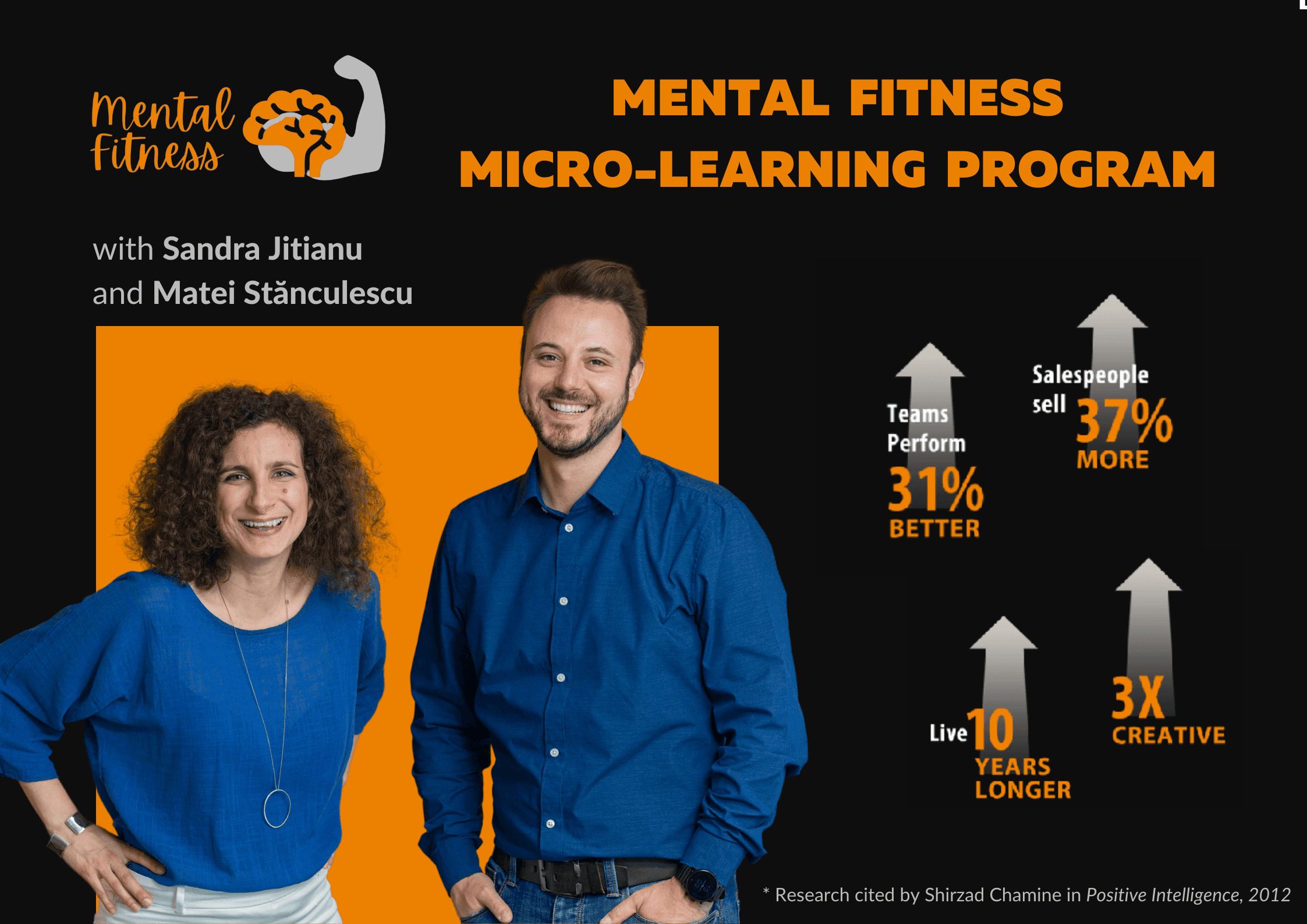
(P) When Taking Decisions, Mental Fitness is the X-Factor. New program for leaders now available in Romania
"This has been the most impactful training I ever experienced. You develop powerful mental muscles to deal with challenges with much less stress and greater clarity, creativity, and resilience. Every sales professional would benefit…
"This has been the most impactful training I ever experienced. You develop powerful mental muscles to deal with challenges with much less stress and greater clarity, creativity, and resilience. Every sales professional would benefit greatly from this" - Adam McGraw, Sales VP & GM, American Express
A leader’s life has not grown easier over the past roller-coaster year: pressure on results is still there despite the growing ambiguity, disruption in how we interact socially, and the resultant soaring levels of anxiety. They need to constantly think how to adapt ways of working, how to redefine processes to keep up the pace, and how to integrate the new tools that promise increases in productivity. The disruption in social interaction has driven down the level of trust, team vibe has withered, people no longer learn from each other the way they did before.
How are you as a leader supposed to weather these unwelcome variations while keeping calm and making the right choices for your business and teams? It turns out that what happens out there is only half of the story. What we tell ourselves about it is the other half - and it often is a stronger predictor of our behavior than the situation itself.
When getting angry over a situation how often did it happen that your emotions got carried over to the next situation you were involved in, causing you to overreact? And have you noticed we usually see more optimistic prospects when we are in a good mood and vice-versa? Judgment is often impacted by mood and many psychological scientists now assume that emotions are the dominant driver of most meaningful decisions in life.
Emotions shape decisions, as a team of researchers from Harvard and three other prestigious universities summed up 35 years of work on emotions and decision making. (Emotion and Decision Making, Jennifer S. Lerner, Ye Li, Piercarlo Valdesolo, Karim S. Kassam, Annual Review of Psychology 2015 66:1, 799-823).
What if you could voluntarily activate or reduce your affective, mental, and behavioral responses in order to pursue a goal? This is what self-regulation is all about. It puts you in the driver seat.
The good news is that self-regulation is a learnable process.
One way to achieve this skill is to train your positive mental ‘muscles’ and have them activated before taking a difficult decision. Think of athletes getting ready for a workout or competition: they will always warm up their muscles before that. People will typically react from the part of the brain that is more ‘fired up’. When encountering a stressful situation with those positive neural connections activated there is a bigger probability that we will act from a place of clarity and wisdom.
Free newsletters
Romania, in your inbox before your first coffee.
Get the Daily — the morning briefing, free, in English, unsubscribe anytime. Want business, real estate or travel digests too? Pick your newsletters →