(P) Mathematical modeling teams in Budapest have an impact on global markets. Morgan Stanley develops trading algorithms in Hungary
In mathematics, research does not always immediately yield tangible results; in many cases, it might take several years for asolution or new method to be put to practical use. However, there is one field where new models or algorithms face…

In mathematics, research does not always immediately yield tangible results; in many cases, it might take several years for asolution or new method to be put to practical use. However, there is one field where new models or algorithms face real-life tests very quickly. That field is banking. In global financial markets, the success or failure of new approaches becomes apparent within days. It is this challenge that attracted György Ottucsák and Ágnes Jónás from the fields of machine learning and evolutionary biology to Morgan Stanley in Budapest.
This year marks the 15th anniversary of Morgan Stanley in Budapest. The office opened in 2006 as a mathematical modeling center with only a handful of members. It has since grown into a major technology and analytics center within the firm’s global network, employing 2,000 people. From technology to risk management, many new teams have been added to the Budapest office, but the pioneering modeling team has also continued to grow steadily, offering new opportunities to professionals who are interested in pursuing new challenges in a quantitative role.
Today, more than 100 quantitative analysts are employed here in front-office teams supporting the firm’s sales and trading activities. Most hold degrees in mathematics, physics, computer science, or finance, but fields such as biology, chemistry, and even meteorology are also represented in these diverse teams.
Among other responsibilities, they are tasked with developing mathematical models to identify trends and patterns in markets, pricing financial products, and supporting the bank’s trading activities through algorithms. The efficiency of these quantitative models and algorithms plays an important role for the firm to operate a successful market-making business in the given asset class, be it government bonds, stocks, or foreign exchange.
From theoretical mathematics to government bonds
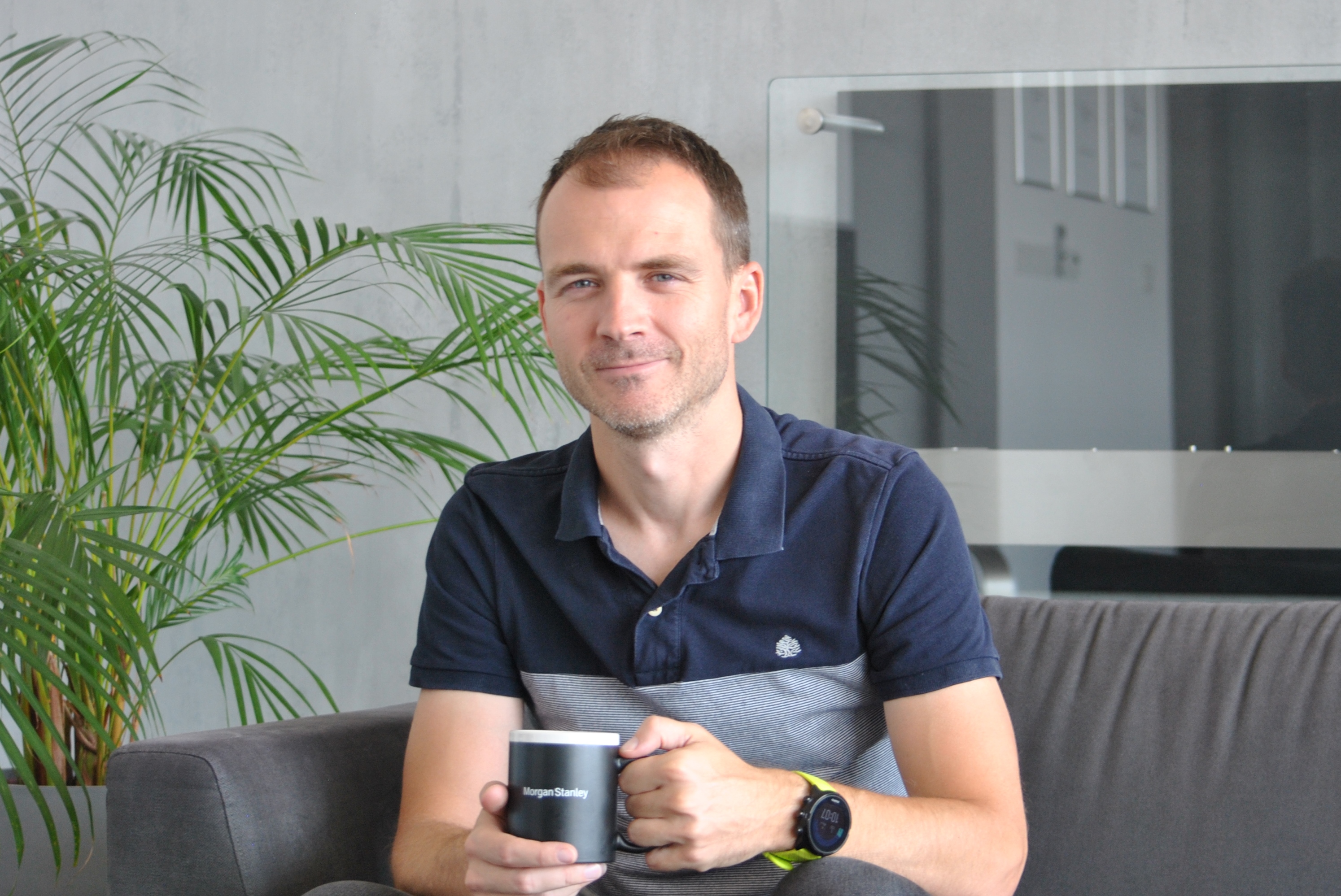
György Ottucsák (in picture below) is a member of the modeling team focused on government bonds, one of the most important asset classes. A graduate in computer science from Budapest University of Technology and Economics, he went on to author his Ph.D. thesis in machine learning. At the time, he was less interested in the practical application of artificial intelligence than in the theory behind it. Coding was not a major part of his life either; today, it is an essential part of his daily work. After finishing his Ph.D. studies, he started putting his skills to more practical use at various startup companies but found the most inspiring challenge of his life when he eventually joined Morgan Stanley in 2014.
Free newsletters
Romania, in your inbox before your first coffee.
Get the Daily — the morning briefing, free, in English, unsubscribe anytime. Want business, real estate or travel digests too? Pick your newsletters →