EC promises to fund Romania-Georgia strategic undersea cable project
The leaders of Azerbaijan, Georgia, Hungary, and Romania signed an agreement in Bucharest on December 17 to build a 1GW undersea electric interconnector through the Black Sea for transporting "green" energy from Azerbaijan to Hungary and…
iulian ernst · Journalist
· Updated · 3 min read
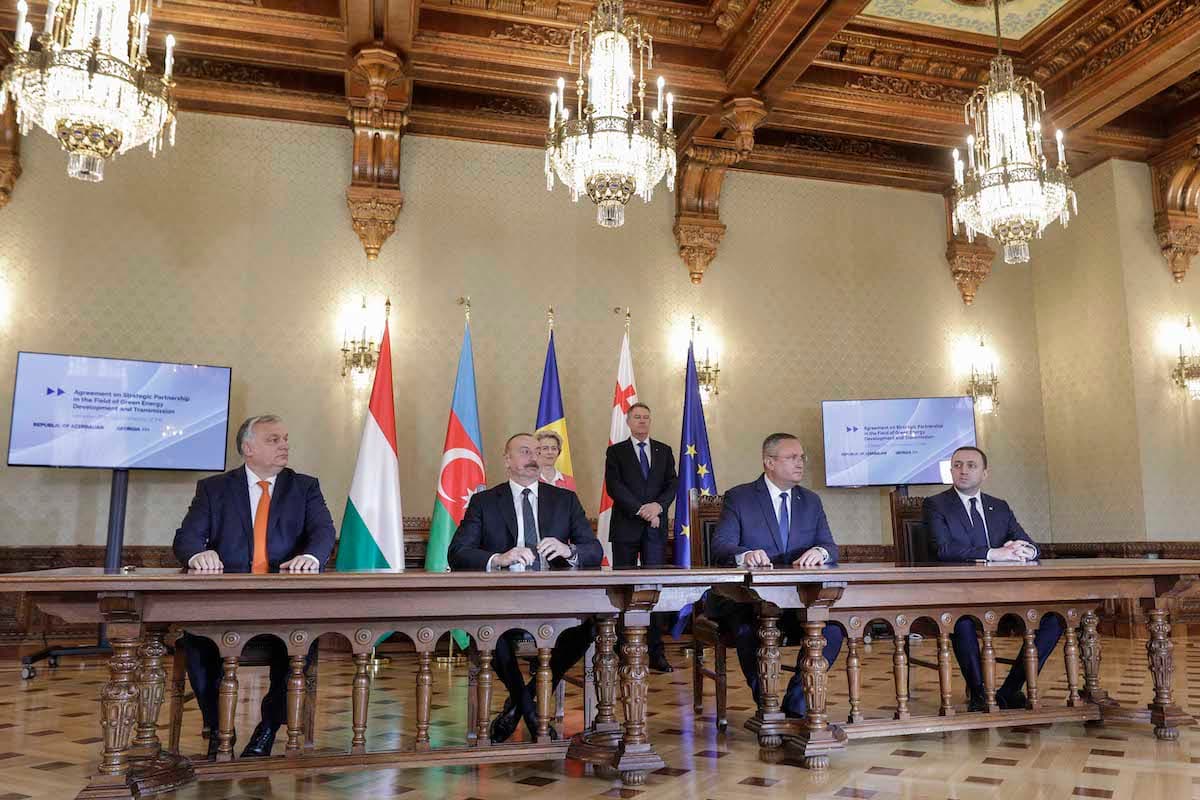
The leaders of Azerbaijan, Georgia, Hungary, and Romania signed an agreement in Bucharest on December 17 to build a 1GW undersea electric interconnector through the Black Sea for transporting "green" energy from Azerbaijan to Hungary and further to Europe. The 1,200-km cable is not supposed to be ready before 2029 and is estimated to cost EUR 2.3 bln.
CESI consultancy firm of Italy is carrying out a feasibility study paid by Georgia with World Bank money, but it rather seems aimed at choosing from among alternative solutions (as opposed to estimating whether the project makes sense). At the same time, Prysmian (also of Italy) notably announced in November that it is building a new ship to lay submarine cables.
"Since the beginning of the Russian war, we have decided to abandon Russian fossil fuel and diversify our options towards reliable partners in the energy field, such as those present at this table. And it is working," said Ursula von der Leyen, president of the European Commission.
The 1,100-kilometer cable from Azerbaijan to Romania will provide Azeri energy for the rest of the continent – it was said at the ceremony, Euronews.com reported. As explained by Azerbaijani President Ilham Aliyev, the Asian country currently produces 27 GW of wind and solar power [this is, actually, the total potential of the country, largely untapped as of now] and is developing projects that should increase this capacity by 4 GW by the end of 2027.
On purely economic merit, such a project would never be completed –but the EU Commissioner for Neighbourhood and Enlargement Olivér Várhelyi hinted, in a Tweet a couple of days earlier, that the EC would "allocate" EUR 2.3 bln for the Black Sea cable, out of the EUR 17 bln economic and investment plan of the Eastern Partnership (EaP).
Visibly, the project, with a predictable minor economic impact (significant for energy market balancing), is a political statement that comes to reinforce the morale across the EU countries ahead of the cold winter of 2023 to 2024. In longer terms., it greatly depends on the terms at the end of the Russian invasion of Ukraine.
Free newsletters
Romania, in your inbox before your first coffee.
Get the Daily — the morning briefing, free, in English, unsubscribe anytime. Want business, real estate or travel digests too? Pick your newsletters →