(P) The Importance of Environmental Education in Today’s World
ECO Schools have become a growing phenomenon, encouraging young people to engage in their environment by allowing them the opportunity to actively protect it. This starts in the classroom, expanding into the rest of the school and…
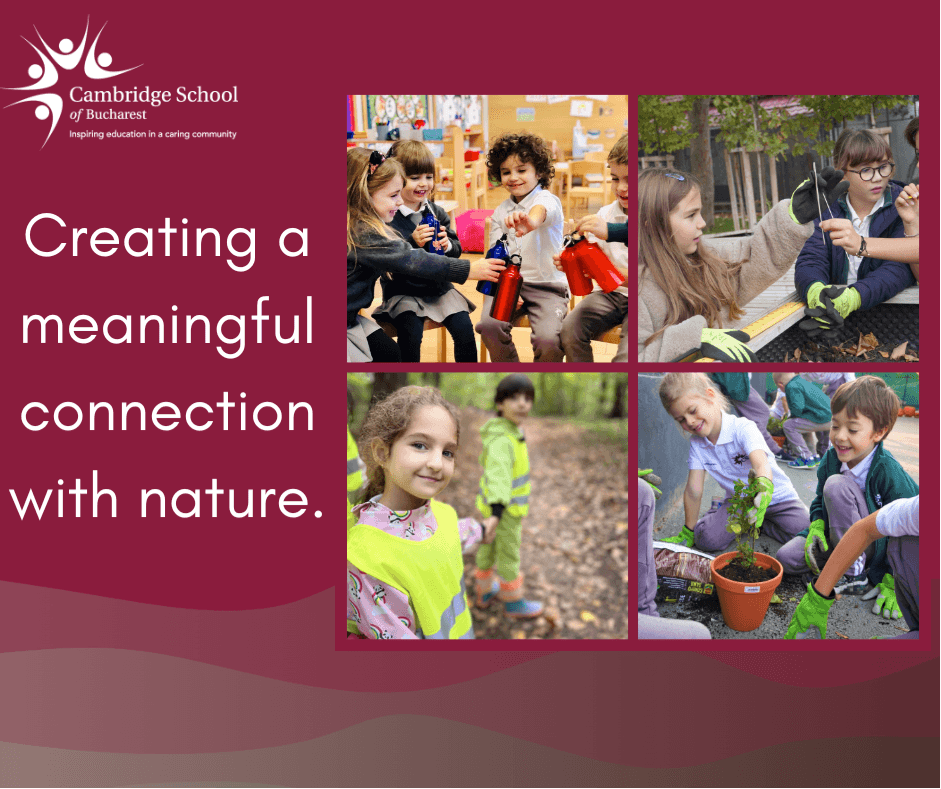
ECO Schools have become a growing phenomenon, encouraging young people to engage in their environment by allowing them the opportunity to actively protect it. This starts in the classroom, expanding into the rest of the school and promoting change in the community at large.
Educating students to be mindful about the environment is an ideal way for schools to embark on a meaningful path toward improving their surroundings, while at the same time having a life-long positive impact on the lives of young people, their families, school staff, and local communities.
Research has shown that educating students about sustainability and climate change not only motivates, but also improves attitudes to learning and wellbeing, in turn advancing their academic and personal development.
In 2021, Cambridge School of Bucharest was awarded the title of ECO School in Romania, due to its initiatives to connect students to the natural world. They designed a new curriculum entitled ‘Education for Sustainable Development’ (ESD). This programme focused on three of the UNESCO ESD themes; Sustainable Communities and Cities, Responsible Consumption and Production, and Climate Action.
The ECO-School programme for environmental management and certification is supported by the European Union, UNESCO, and the United Nations Environment Programme. It is coordinated at an international level by the Foundation for Education for the Environment (FEE), bringing together 81 organisations from 68 countries, and the CCDG, the Romanian coordinators for ECO-Schools in Romania, has 261 schools participating in their programme.
This initiative was developed in 1994, starting from the need to involve young people in finding solutions to the challenges imposed by sustainable development at a local level. This scheme is continually growing and becoming more popular within schools, with 19 million students participating each year.
“Young people experience a sense of achievement at being able to have a say in the environmental management policies of their schools, ultimately steering them toward certification and the prestige which comes with being awarded a Green Flag.” – Gavin Roberts, Education for Sustainable Development Lead at CSB.
To bolster its success in becoming a Green Flag School, CSB students and staff hold weekly ECO-Committee meetings to discuss the development of sustainability projects within the school, with the aim of making a difference as a community within Bucharest and Ilfov.
Throughout the school, the campus has urban gardens, where students plant and grow flowers, herbs, fruits, and vegetables during their afterschool clubs. During break times, students collect acorns and leaves, and water the plants on a voluntary basis, earning house points in the process. CSB’s Afterschool Gardening Clubs have a “Market Gardens” event each term, selling herbs, salads and other vegetables that students have grown for parents and staff to purchase.
Free newsletters
Romania, in your inbox before your first coffee.
Get the Daily — the morning briefing, free, in English, unsubscribe anytime. Want business, real estate or travel digests too? Pick your newsletters →