How BIGALPS is bringing nature-inspired bio-cementation to commercial geotechnics
Following three years of rigorous research, field evaluations, and cross-border cooperation, BIGALPS, short for Bio Inspired Geotechnical Applications to Launch Pan-European Solutions, is nearing the completion of its EU-funded initiative.
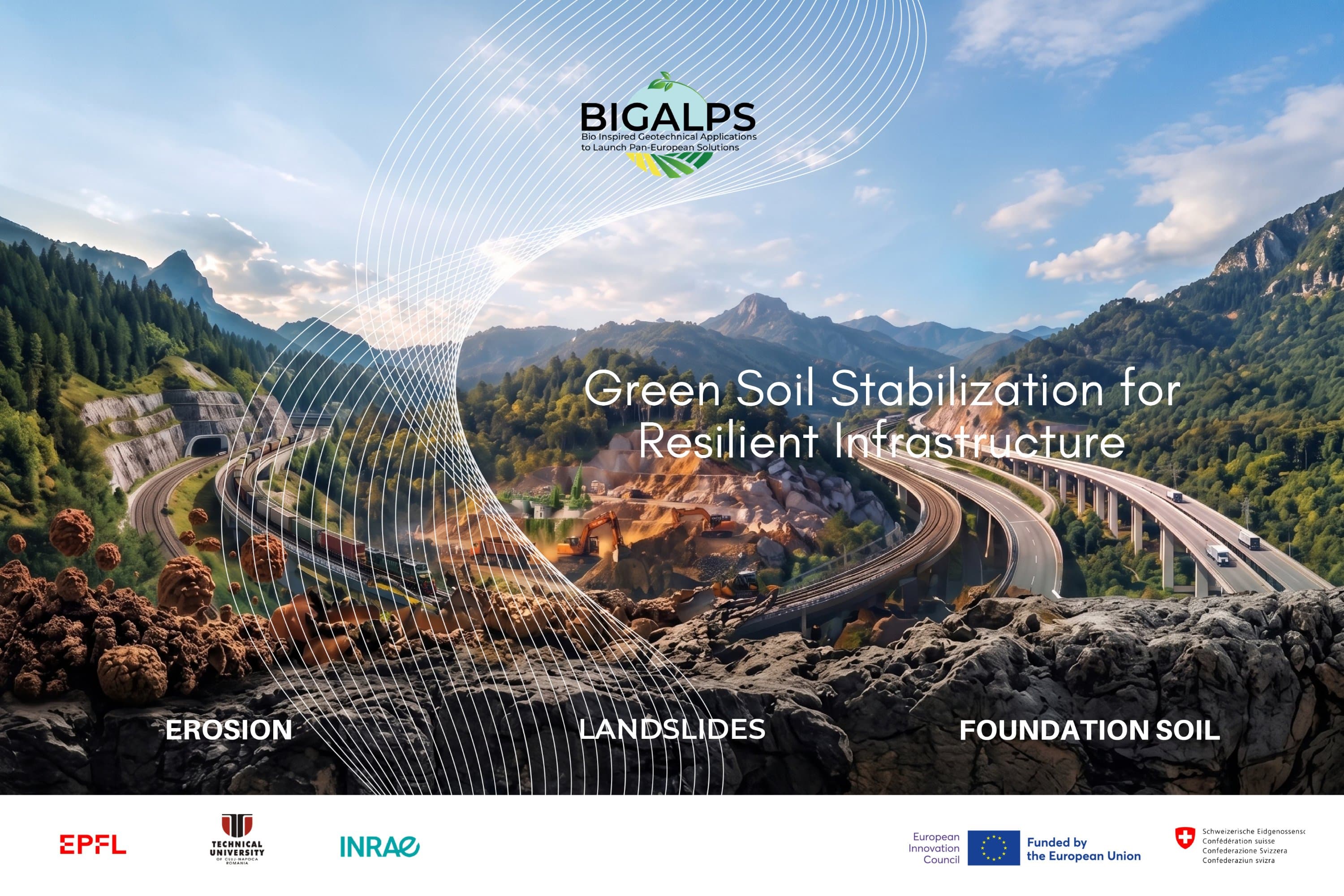
Following three years of rigorous research, field evaluations, and cross-border cooperation, BIGALPS, short for Bio Inspired Geotechnical Applications to Launch Pan-European Solutions, is nearing the completion of its EU-funded initiative. Led by the Technical University of Cluj-Napoca alongside key international partners EPFL (Ecole Polytechnique Federale de Lausanne, Switzerland) and INRAE (National Research Institute for Agriculture, Food and Environment, France), the consortium set out to transition a pioneering bio-cementation method into practical engineering workflows.
By harnessing natural microbial activity to generate calcium carbonate, the process binds soil particles together, offering an eco-friendly substitute for traditional soil stabilization methods. Proven through pilot trials targeting erosion, slope instability, and foundation enhancement, the project is now poised for its next major milestone: commercial market entry.
We sat down with Dr. Iulia Prodan, Principal Investigator for BIGALPS and lecturer at the Technical University of Cluj-Napoca, to review the project's milestones, key takeaways, and future trajectory.
As BIGALPS concludes its three-year run, what stands out as the project's defining accomplishment?
Dr. Iulia Prodan: Without a doubt, our primary breakthrough has been taking bio-cementation out of controlled lab settings and proving its viability under real-world engineering conditions in real site environments.
When we launched BIGALPS, the goal went far beyond re-confirming the fundamental science. We already had a solid academic foundation courtesy of prior work carried out at EPFL during many years of research on biocementation. Our real mission was discovering how the technology performs when subjected to genuine ground conditions, field constraints, regulatory engineering standards, and the operational demands that any solution must satisfy before expecting any commercial adoption.
Over the course of the project, we targeted three distinct applications, mitigating erosion, stabilizing landslides, and strengthening foundation soils, via field pilots across Romania and France. Testing under diverse conditions gave us a comprehensive view of how to tailor the process to varying geotechnical problems.
Ultimately, BIGALPS served as a bridge linking academic discovery to field-level execution. As this chapter closes, we leave with far more than scientific insights; we have gained the technical expertise, site experience, and commercial clarity required to launch this innovation into the market. We conclude the project with a consolidated network of stakeholders committed to future collaboration, including opportunities for co-development to further mature biocementation towards higher TRLs and market deployment.
Free newsletters
Romania, in your inbox before your first coffee.
Get the Daily — the morning briefing, free, in English, unsubscribe anytime. Want business, real estate or travel digests too? Pick your newsletters →