Bucharest Stock Exchange follows the international markets into the red. Can local stocks weather the global storm?
Bucharest Stock Exchange’s total return index BET-TR dropped by almost 12% in September and slipped into the red compared with the end of December 2021 as all the major international markets recorded strong corrections. Despite a slight…
Andrei Chirileasa · Journalist
· Updated · 3 min read

Bucharest Stock Exchange’s total return index BET-TR dropped by almost 12% in September and slipped into the red compared with the end of December 2021 as all the major international markets recorded strong corrections. Despite a slight recovery in the first week of October, the BET-TR index has stayed close to the level recorded at the end of September, which is still 9% below the 2021 closing value.
Volatility has returned to the stock markets and will likely continue in the following months as the high inflation rates have started to weigh down on economic growth. However, the Romanian market may prove slightly more resilient than international peers due to the significant weight energy stocks have in local indices.
Most stock indices in international capital markets went into the red in September, marking a double-digit decline at the end of the first nine months of this year, according to an analysis by the Bucharest Stock Exchange.
The deterioration in investment sentiment intensified after the summer months as investors’ fears about rising interest rates and the possibility of a recession in developed markets grew. These elements already overlap a long line of concerns about the uncertainties generated by the instability in the international climate. Persistent inflation, energy and utility high costs, supply chain risks, and a complicated regional context are elements that capital markets investors have had to navigate so far this year.
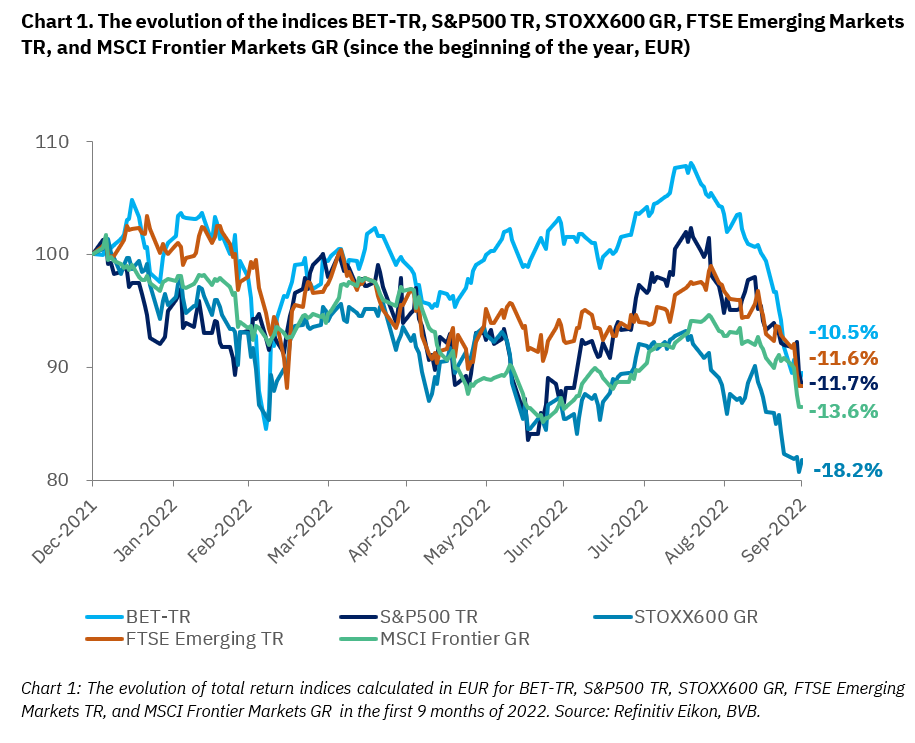
At the end of the first 9 months of the year, most stock indices were in correction territory. For example, several total return indices, which also include dividends, posted declines of more than 10% between January and September. Thus, the American S&P500 index registered a depreciation of 11.7%, while in Europe, the most representative 600 companies recorded a decline of 18.2% through the lens of the STOXX600 index.
A series of international indices in which Romania is included also ended the first 9 months in negative territory: -11.6% for FTSE Emerging Markets and -13.6% for MSCI Frontier Markets. The capital market in Romania aligned with the international trend, even if the BET-TR index had a more moderate depreciation, of 10.5% after the first 9 months of the year. In Romania, a better comparative evolution in relation to other international indices was possible after the BET-TR index reached a new all-time high in August.
Free newsletters
Romania, in your inbox before your first coffee.
Get the Daily — the morning briefing, free, in English, unsubscribe anytime. Want business, real estate or travel digests too? Pick your newsletters →